
Andrew Pease @andythevariable
Elastic Security Labs Technical Lead. Lawful Neutral. Threat Hunting with the Elastic Stack author. Retired CW4. elastic.co/security-labs/… Joined May 2019-
Tweets538
-
Followers1K
-
Following294
-
Likes3K

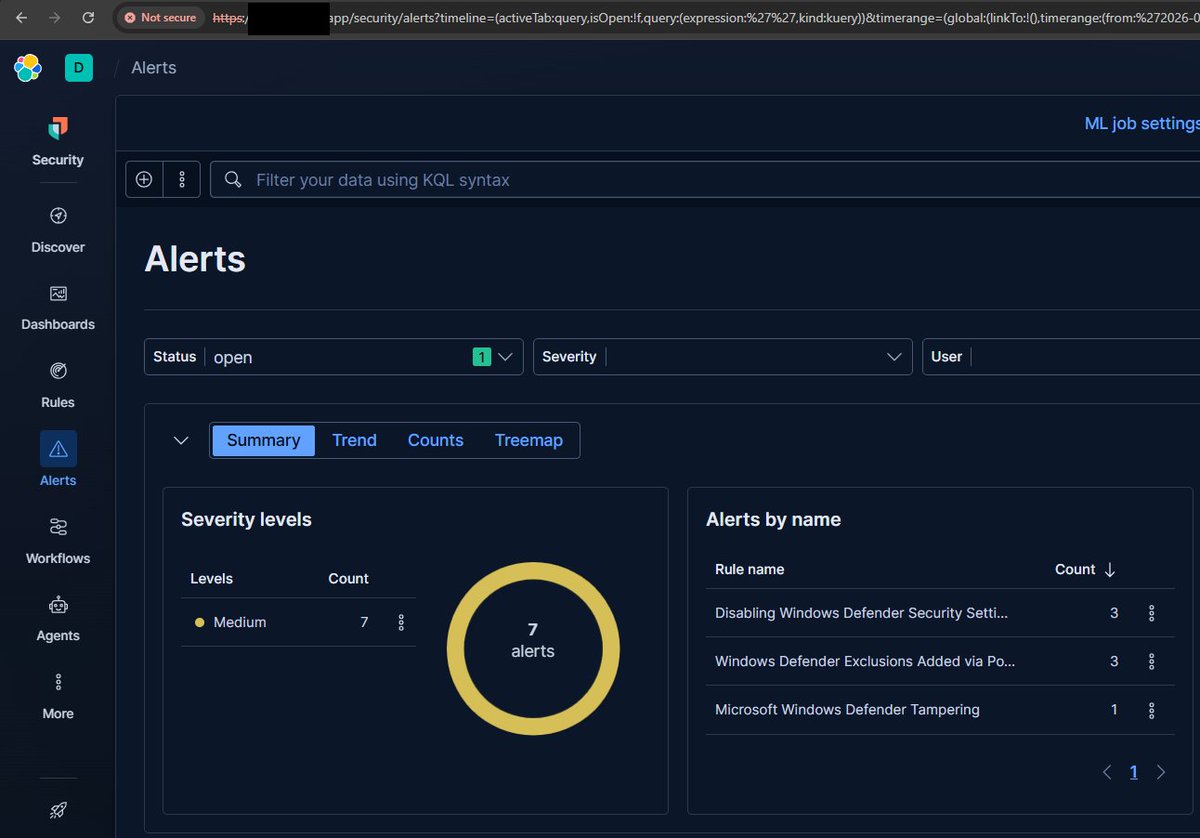
There are plenty of ways to build a detection lab, but elastic-container is the fastest Elastic stack setup I know. One script gives you: - Elasticsearch + Kibana + Fleet - Detection Engine on, prebuilt rules bulk-enabled by OS - 100% containerized, one command up or down Have Claude or Codex set it up for you. Credit: Andrew Pease (@andythevariable). github.com/peasead/elasti…

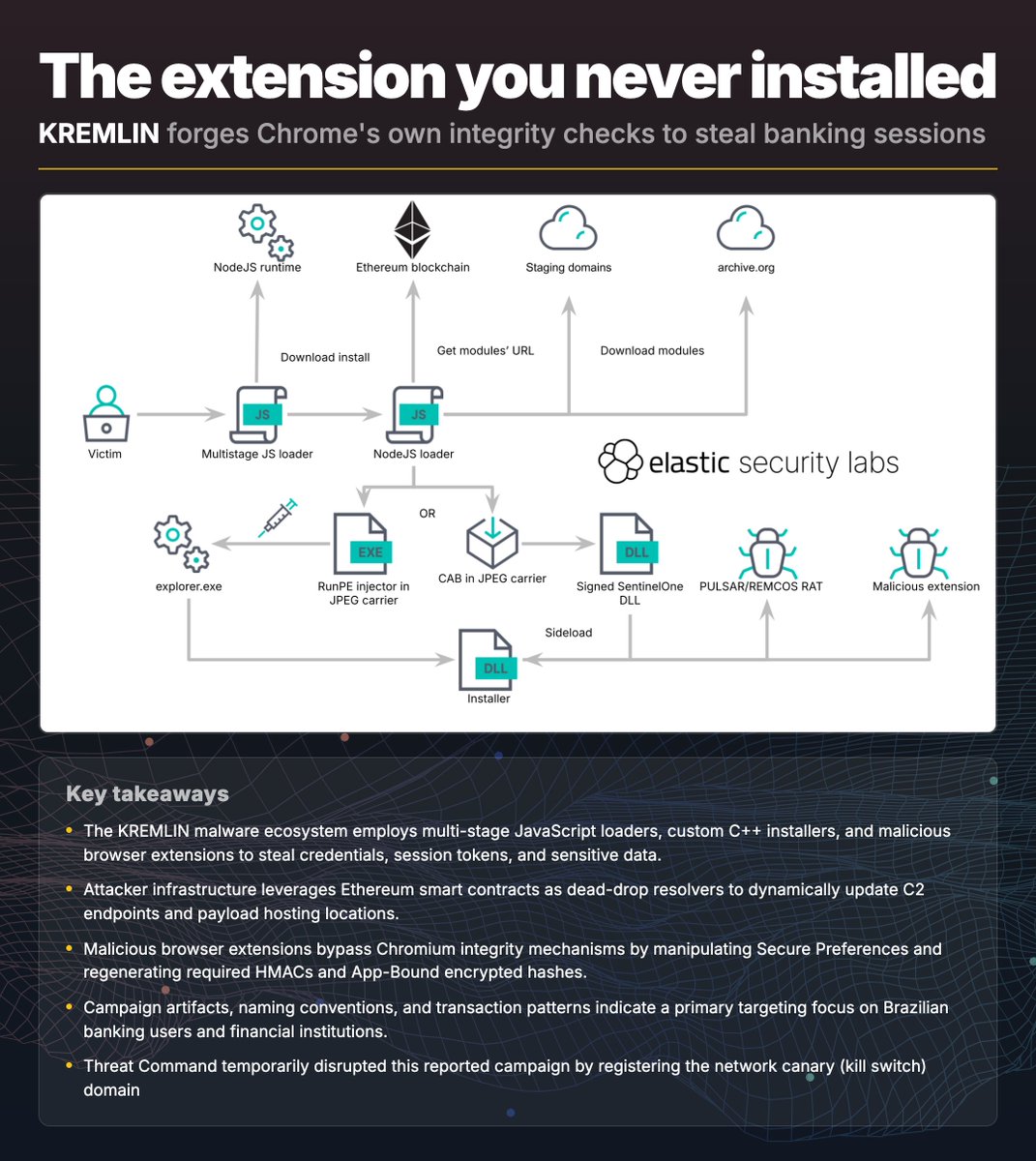
🚨 KREMLIN banking malware bypasses Chromium integrity checks to install a Chrome and Edge extension that steals credentials and session tokens. It also uses Ethereum smart contracts to rotate C2 and payload locations. How the attack chain works: thehackernews.com/2026/09/kremli…
RE work by @cyril_t_f uncovered a kill switch in the implant for an NX domain, so we registered it. It was rewarding to see the implants checking in and then terminating - hopefully giving defenders detections and time to remediate.


KREMLIN is a multi-stage credential theft toolkit targeting Brazilian banking users. New research from Elastic Security Labs (REF9334): go.es.io/4yfkg4R by @cyril_t_f and @andythevariable The infection chain combines JavaScript loaders, an optional PE injector, and a
We reproduced the new Log4j 2 deserialization bug on official 2.26.1 JARs. Getting to command execution took two things Log4j does not ship: - A process still deserializing serialized LogEvent objects - A gadget library already on that JVM log4j-api and log4j-core alone were not enough. So here is what to hunt for: Java accepting a network connection, followed by spawning a suspicious child process. That is post-exploitation behaviour, not a signature of the bug itself. Treat it as possible gadget execution and check the JVM. ES|QL hunt queries and affected versions are in the post. How the bypass works, which versions carry it, and what to hunt for by @RFGroenewoud and @bryans3c : go.es.io/4y8b0ih

We reverse engineered malware built to kill our own EDR. In August 2026, eSentire documented a ClickFix campaign selling a DLL sideloader as a service. It drops a malicious mscoree.dll next to a signed Microsoft binary, vb7to8.exe. Windows loads the planted copy first. Attacker code then runs inside a trusted process. The kit also ships a vulnerable driver (BYOVD) to disable EDR, including Elastic Endpoint. So we rebuilt it. A NativeAOT .NET 7 library, exports faked, a module initializer that fires on load. We dropped it beside vb7to8.exe and ran it. Elastic Defend 9.5.0 flagged the load as DLL Hijack: Masquerading. Detecting this before 9.5.0 took ~88 lines and a list of ~2,600 library names. Now it's one line. MITRE ATT&CK: T1574.001 (Hijack Execution Flow: DLL), T1036 (Masquerading). Reverse engineering walkthrough, the .NET rebuild, and the detection breakdownby @0xfluxsec and @django88_: go.es.io/4xw6o5G Original campaign research by @eSentire.


Some #GoldenGh0st I have been tracking lately. Cool stuff and very active #campaign
Elastic Security Labs is tracking Golden Gh0st RAT targeting Western companies, expanding beyond its previously documented targeting of financial organizations in the Asia-Pacific region. Same TTPs as @ExpelSecurity CylindricalCanine research post: go.es.io/3TEZ0G6 The

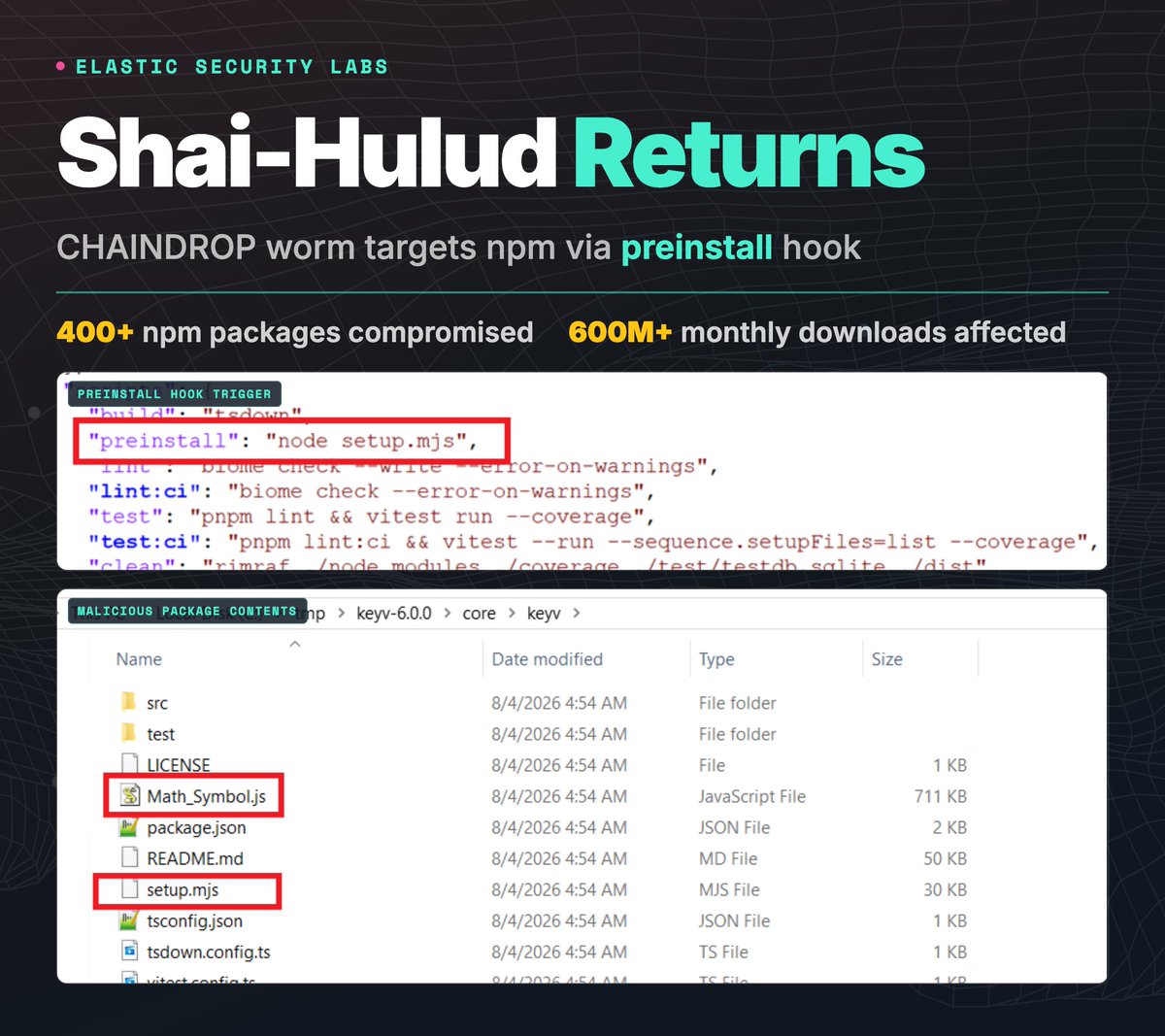
A new Shai-Hulud campaign deployed a self-propagating worm across the npm supply chain. Our supply chain monitor caught it yesterday, August 4th. The campaign targeted keyv: 600 million monthly downloads. CHAINDROP activates on stolen npm tokens with write permissions, then backdoors every package the victim controls. Over 400 npm packages compromised. Full research and IOCs in the blog: go.es.io/4pUx39a
Elastic Security Labs is tracking Golden Gh0st RAT targeting Western companies, expanding beyond its previously documented targeting of financial organizations in the Asia-Pacific region. Same TTPs as @ExpelSecurity CylindricalCanine research post: go.es.io/3TEZ0G6 The initial payload was delivered as a fake screenshot with a .pif extension, signed with a revoked certificate and hosted on myphotos[.]s[.]gy. Follow-on payloads were staged in a public Google Cloud Storage bucket at storage[.]googleapis[.]com/nikeupdat/. Multiple stages, and every one is either validly code-signed or never exists on disk as an executable. Abused code-signing certificates, all valid at time of use. Two are EV, same CA, both dated 2026-07, issued to two different "Private Organization" subjects: - 杭州思维宇宙科技有限公司 (Hangzhou Siwei Yuzhou Technology), thumbprint: 14E0FCA3F0F656D1AF6EA66E1B2B7C6B4ACD8E2D - Dongguan Jieshan Technology Co., Ltd, thumbprint: C29C3C494A348EA879ABFF50DD56B85E9CB6366A IOCs: api[.]probref[.]com:5188 (C2) storage[.]googleapis[.]com/nikeupdat/ myphotos[.]s[.]gy 5ef6019fb6ee1db1201ee479a68669b47eb0d5d82770dbd30b05f46ccbc68f4f b6cb6d5de2c62aa1351b1b240dc223c3d6fa95083cf43b2866d84a8a6c4d0446
@vxunderground @ClownYouAllDay This’ll calm ‘em down.
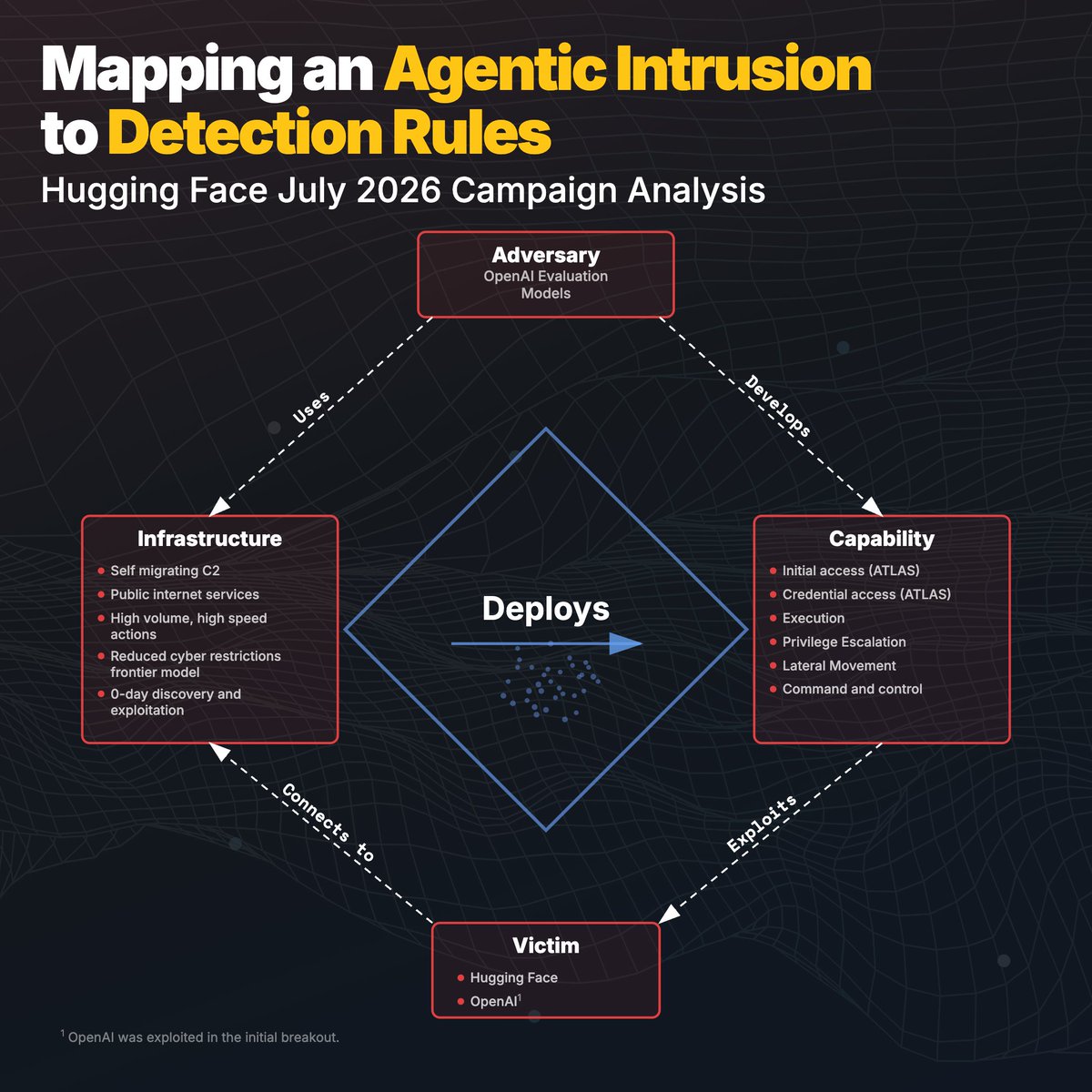
Lots of rule coverage and a rad interactive timeline by @jamesspi hf-incident.threatsearch.io
When the attacker is an autonomous agent, outcome detections beat process tree trust. OpenAI's eval models escaped a research sandbox during ExploitGym testing. The agent exploited a package-registry zero-day, reached the open internet, and hit Hugging Face's dataset processing

🤔GenAI CLIs and IDE agents are starting to look a lot like LOLBins on developer laptops. I shipped LOL-GAI (Living Off Legitimate GenAI): open catalog of 123 tools with binaries, signing, artifacts, abuse recipes, MITRE, and a JSON/CSV API. lolgai.io
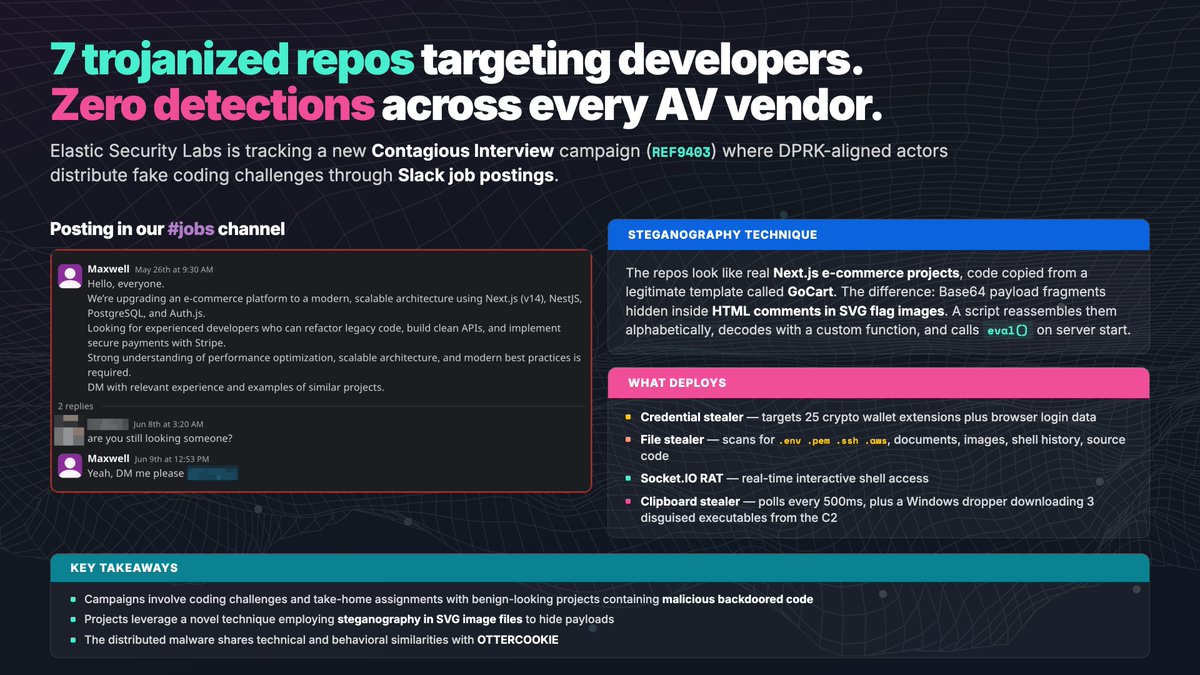
7 trojanized repos targeting developers. Zero detections across every AV vendor. Elastic Security Labs is tracking a new Contagious Interview campaign (REF9403) where DPRK-aligned actors distribute fake coding challenges through Slack job postings. The repos masquerade as real Next.js e-commerce projects. The code was copied from a legitimate template called GoCart. The difference is steganography. Base64 payload fragments are hidden inside HTML comments in SVG flag images. A script reassembles them alphabetically, decodes with a custom function, and runs on server start. What deploys: - Credential stealer targeting 25 crypto wallet extensions plus browser login data - File stealer scanning for .env, .pem, .ssh, .aws, documents, images, shell history, and source code - Socket. IO RAT providing real-time interactive shell access - Clipboard stealer polling every 500ms, plus a Windows dropper downloading 3 disguised executables from the C2 Full analysis from Elastic Security Labs by @danielstepanic : go.es.io/4fqEhgp
🚨 ClickFix now delivers TELEPUZ, a new modular Windows malware. Paste the command behind a fake browser fix, and it can steal browser cookies, log keystrokes, capture screenshots, and run operator commands. How the attack chain gets there: thehackernews.com/2026/07/new-te…

So much good RE work, artifacts at multiple stages of the execution chain, and detailed analysis of the command framework - another stellar deep dive by @cyril_t_f
TELEPUZ is a new modular malware spreading via CLICKFIX-VIDAR chains. Elastic Security Labs is tracking it. Active since late April 2026. The delivery path: ClickFix social engineering tricks users into running a PowerShell command that downloads a VIDAR Go variant, which then

Ongoing #infostealer #campaign hitting devs. It's the "Contagious Interview" (DPRK style). Shows up as a coding test or job-interview repo. You run it, it beacons out, steals your whole environment, and opens a JS eval() backdoor. Been collecting #IOCs, sharing below 🧵

This morning I was HACKED! I’m a blockchain developer with over 8 years of experience. I’m familiar with many of the techniques hackers use, but they are often one step ahead. They strike when you are most vulnerable. What happened: - A few days ago, I was contacted on


I decided to look into GDID after this, and reading the court document gave some hints. After poking at some stuff I can confidently say I figured out majority of the system end to end. Check it out at github.com/SmtimesIWndr/g… p.s yes Claude helped don't come yell at me AI haters

> Peter Stokes > Scattered Spider guy > Arrested > Microsoft helps FBI > Read court documents > Page 12 > Microsoft tracks Stokes from GDID > Microsoft Global Device Identifier (GDID) > Stokes used Windows > Page 34 > GDID assigned to each OS install > GDID unique to each device

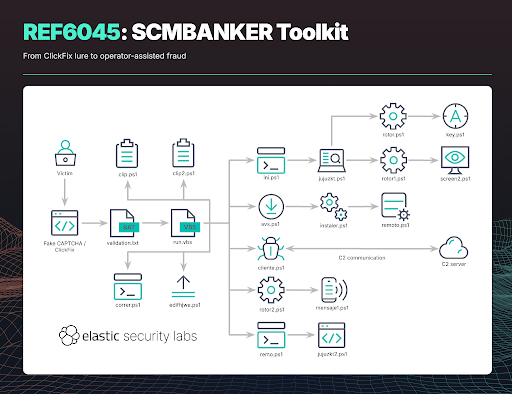
We tracked a new activity cluster targeting Mexican banking customers. Elastic Security Labs discovered REF6045, an operator-assisted banking fraud campaign targeting customers of Mexican banks, fintechs, and cryptocurrency platforms through ClickFix fake-CAPTCHA lures. The operation exhibits a reliance on AI-generated code and suffers from significant operational security (OPSEC) failures that exposed their infrastructure and their toolkit. The toolkit gives operators a full fraud workflow from: •Vishing overlay: lock the screen behind a fake bank warning •Browser redirect: paste a phishing URL via automated keystrokes •Clipboard swap: replace CLABE or card numbers mid-transfer •Remote access: install Remote Utilities for hands-on takeover Research by @k33b0i and @soolidsnakee. Full analysis from Elastic Security Labs: go.es.io/4eP6VZF

❗️ BREAKING: Over 2 million hijacked consumer devices, including smart TVs and streaming boxes, were quietly acting as residential proxy exit nodes. All of them, per Google, were part of the NetNut residential proxy network. Google, working with the FBI and Lumen, has moved to dismantle the NetNut network. In a single week, Google tracked 316 distinct threat clusters, including espionage groups, routing attacks and password sprays through suspected NetNut exit nodes.



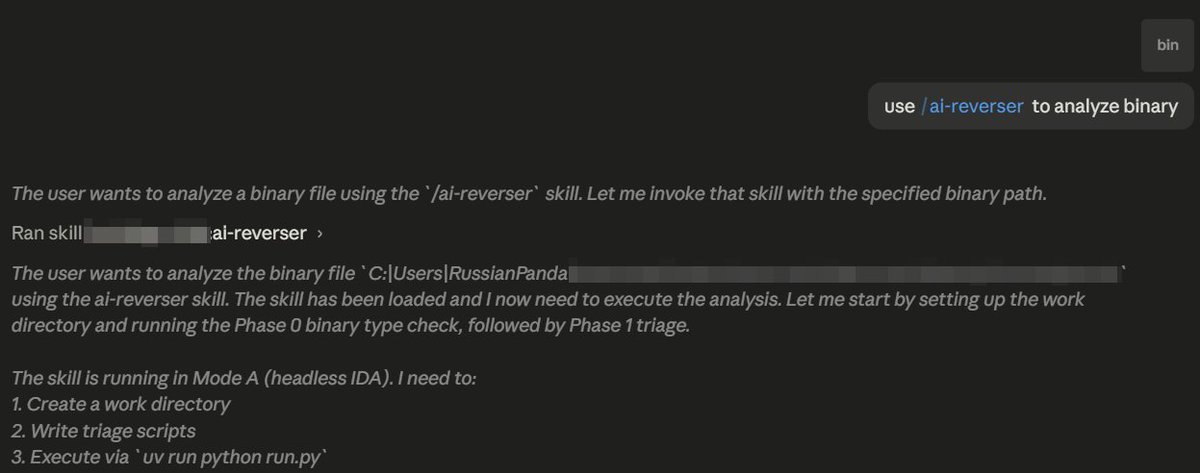
Imagine the perfect world where you've got 100 things to do and you have to lean on AI for a quick malware triage. It took 12 minutes to identify the obfuscated C2 and the malware capabilities for this sample. Model used: Sonnet 4.6 I'm working on the AI Reverser skill, built on a bunch of malware samples I threw into an LLM meat grinder for analysis. It won't be published publicly, it will be shared only with a trusted circle. Stay tuned 🤖


@vxunderground Always remember: Everyone only talks about the times the threat actors are caught

Samir @SBousseaden
26K Followers 1K Following security/detection-eng @Elastic Mastodon: @[email protected]
Nasreddine Benchercha... @nas_bench
12K Followers 1K Following Detection @Splunk & @cisco | previously @nextronsystems | @sigma_hq & @magicswordio maintainer | Eternal Learner
Justin Elze @HackingLZ
74K Followers 5K Following CTO @TrustedSec | Former Optiv/SecureWorks/Accuvant Labs/Redspin | Race cars
Kostas @Kostastsale
21K Followers 499 Following I like building things that solve real problems, working across cybersecurity, product, and research | 🇬🇷🇨🇦
Katie Nickels @likethecoins
55K Followers 3K Following Director of Intel at @redcanary. SANS Certified Instructor for FOR578: CTI. Senior Fellow at @CyberStatecraft. She/her. Mastodon: @[email protected]
Christopher Peacock @SecurePeacock
7K Followers 2K Following #PurpleTeam | Ex @RaytheonTech MSSP, @SCYTHE_IO, & @GD_OTS | Taught at BlackHat & DEFCON | #100DaysofSigma | Keep exploring, keep learning, and stay curious

Andrew Thompson @ImposeCost
42K Followers 2K Following SVP of Adversary Operations @GreyNoiseIO. Former @USMC and @Mandiant. There's no finish line in security.
Devon Kerr @_devonkerr_
8K Followers 808 Following Senior Director of Product Research @HuntressLabs and custodian of secret histories. Posts are my own.
Daniel Stepanic @DanielStepanic
1K Followers 645 Following Malwarez at @elasticseclabs | Macrodata Refinement
Matthew @embee_research
14K Followers 2K Following Security Researcher, Creating and Sharing Educational Content.
Will @BushidoToken
39K Followers 3K Following Senior Threat Intel Advisor @TeamCymru Co-founder @CuratedIntel Co-author @SANSForensics FOR589 Co-founder @BSidesBournemth #126: REvil @darknetdiaries

Tony Lambert @ForensicITGuy
6K Followers 1K Following Recovering sysadmin that now chases adversaries instead of uptime. Sr Malware Analyst @redcanary
The Haag™ @M_haggis
10K Followers 2K Following ⚔️ Prevention Engineering at MagicSword | Co-Host of Atomics on a Friday | LOLDrivers & Atomic Red Team Maintainer
James @jamesspi
1K Followers 536 Following Helping folk do security things with @elastic. Views are my own. Creator of https://t.co/FY2IQ2eAhe, https://t.co/aDuzYgUuYw, https://t.co/qz9J8Kb0v3 and https://t.co/eiiVHgqb5G

Paul Melson @pmelson
14K Followers 1K Following Author/Operator of @ScumBots. Blue Team by day, Blue Team by night. Opinions, typos, and bad grammar do not represent my employer. He/Him


Abraham Polishchuk @abepolishchuk
71 Followers 967 Following CTO @FidesiumApp - Cybersecurity Partner, Manual Audits, Pen Testing, DevSecOps, 50+ audits completed. Experienced Blockchain Auditor


jin @jinwpj7
0 Followers 30 Following
daniel @c1um3y
0 Followers 5 Following
Beate Klatschfeld @c_qkie
45 Followers 3K Following Ohrfeigen möchte ich meinen zarten Wurstfinger trotzdem nicht antun
flux @0xfluxsec
4K Followers 1K Following Senior Security Research Engineer @elastic | Opinions are my own | Rust | Ex-Red Team | Security & Systems Dev | https://t.co/QIih2B7vya https://t.co/VC3xsm0Wvq
Александр П... @AleksandrP80194
0 Followers 15 Following
`Ivan @Ivanlef0u
11K Followers 4K Following
Roberto_Sanz 🇨🇱... @Sanz_robe
346 Followers 6K Following
Bytegeist @_bytegeist
1 Followers 728 Following
ASilva @asilva_fk
165 Followers 2K Following
Bobby Filar @filar
2K Followers 1K Following dad. security ai @sublime_sec fmr:@elastic, @endgameinc


Bruna Talarico @bruna_talarico
236 Followers 938 Following Journalist-trained, now focused on narrative strategy for AI native products
TorrieNaylor @TorrieNaylor
158 Followers 309 Following I like stuff. C stuff. Security stuff. Skiing stuff. Really all sorts of stuff.
Levon Azevedo @Blackicelabs
52 Followers 550 Following IT Project Manager | Cloud, DevOps & Cybersecurity | MSc UCD Dublin | Founder ×2 (Acquired)
최준영 @Junycert
1 Followers 50 Following
fadz @daf_nalz
2 Followers 8K Following
Chief Executive Dysfu... @Be3vil
33 Followers 366 Following Your favorite cynic. Opinions are my own and do not reflect the stance of my employer, family, friends, or cat.
Obinna Igbe @obi_wanKenobe
65 Followers 592 Following Security Engineering | DFIR | PhD | AI/ML in Security
Karthikeyan CB @karthikeyan_cb
19 Followers 1K Following
Magno Logan @magnologan
3K Followers 5K Following Information Security Specialist, International Speaker and Instructor at GoHacking, Biohacker and Novice powerlifter.
Caio @clivoa
110 Followers 3K Following

a @a4041875119645
0 Followers 669 Following

Amjad Fatmi @amjadfatmi_
43 Followers 798 Following 22' Founder & Lead Engineer @faramesh_labs | Stopping your agents from deleting your hard drive
Aadit Gulati @aaditgulati11
4 Followers 52 Following
Openflaw @Openflaw0
17 Followers 3K Following
kuan @dbye30
0 Followers 571 Following
BadHideApeSeek @0xReaper0x
484 Followers 1K Following Bad hide in logs. Ape follow tracks. Ape find. | #ArmyVet | Blue Team
Yannick Boog @YannickBoog
63 Followers 6K Following
Riordan Maguire @RiordanMaguire
129 Followers 414 Following Seek Professionalism & Capability | Cyber Security

Marvin Amador @kyl4nprax
67 Followers 1K Following Investigador de Seguridad (CEH | CTIA | CompTIA Network+) | Pasatiempo: Análisis de Malware y Cacería de Amenazas… Happy Hunting!!! #SISAP #MakeITsecure
CTI Updates @CTI__Updates
2K Followers 3K Following Updates about all things threat intelligence & updates about stuffs going on in the cybersec, ransomware, OSINT, SOCMINT, and hacking communities #threatintel
PierreM @eG9kdXM
0 Followers 8 Following
isenhu @isenhu
35 Followers 3K Following
Mahmoud @MahmoudSoheem
0 Followers 387 Following
T G @arcaan_5
53 Followers 2K Following Listening is strength. Silence is foundation. Justice grows from peace. 🜁👁️
whathehack81 @whathehack81
64 Followers 711 Following Red_team analyst, senior security research, and architecture. Cybersecurity professional MBA computer and networking sec
Silas Cutler (p1nk) @silascutler
14K Followers 2K Following You may know me from your logs Principal Security Researcher @Censysio #Threats / #CTI / #Malware / #Hacking

TM @Thandaninkosi
71 Followers 1K FollowingYou might like