Prasenjit Sarkar @stretchcloud
Founder & Builder | Building https://t.co/ag2bhjo5r8, https://t.co/9EO3BU4jCx, https://t.co/vqTghjn5bf | AI Agents| 15x Patents | 7x Author | Building for Growth the-campfire.dev London, England Joined March 2011-
Tweets14K
-
Followers3K
-
Following973
-
Likes3K
150 milliseconds to first sound, 100 milliseconds median inference, and about three out of four blind listeners picking it over the alternative in head to head tests. ElevenLabs put all three numbers in one announcement this week for Eleven v4 and v4 Turbo, alongside a comparison that names names: Cartesia's Sonic 3.6 at 262 milliseconds, OpenAI's GPT-4o mini TTS at 814. Same category, more than three times the wait, on the model most people default to. The bigger change isn't speed, it's what replaced SSML. Instead of hand tagging pitch and pace, v4 reads tone, pacing and context straight from the text and lets you drop in inline tags for a laugh or an accent shift. Clone a voice from 10 seconds of audio, keep the same voice when it switches languages, cover 90-plus languages without re-recording anything. Less markup, more performance, is the actual pitch. Money is following the latency chart, not the language count. ElevenLabs raised 500 million from Sequoia in February at an 11 billion dollar valuation, backed partly by Nvidia, and is reportedly back in talks five months later at 22 billion on 500 million in ARR. Cartesia closed 100 million and shipped Sonic-3 around the same time. Smallest.ai raised 13 million chasing the same millisecond gains at a fraction of the valuation. Google and Inworld both showed up in ElevenLabs' own blind test. Both lost it. What the leaderboard doesn't show: that 100 millisecond number is a WebSocket test in a clean lab, not a phone call routed through a speech recognition step, an orchestration layer and a carrier network. Every one of those hops taxes the same latency budget the model just won back. Voice agents live or die on the round trip a customer actually feels, and nobody's publishing that number yet. x.com/ElevenLabs/sta…

Introducing Eleven v4 and Eleven v4 Turbo, our fastest and most emotive voice models yet. Ranked #1 by Artificial Analysis.
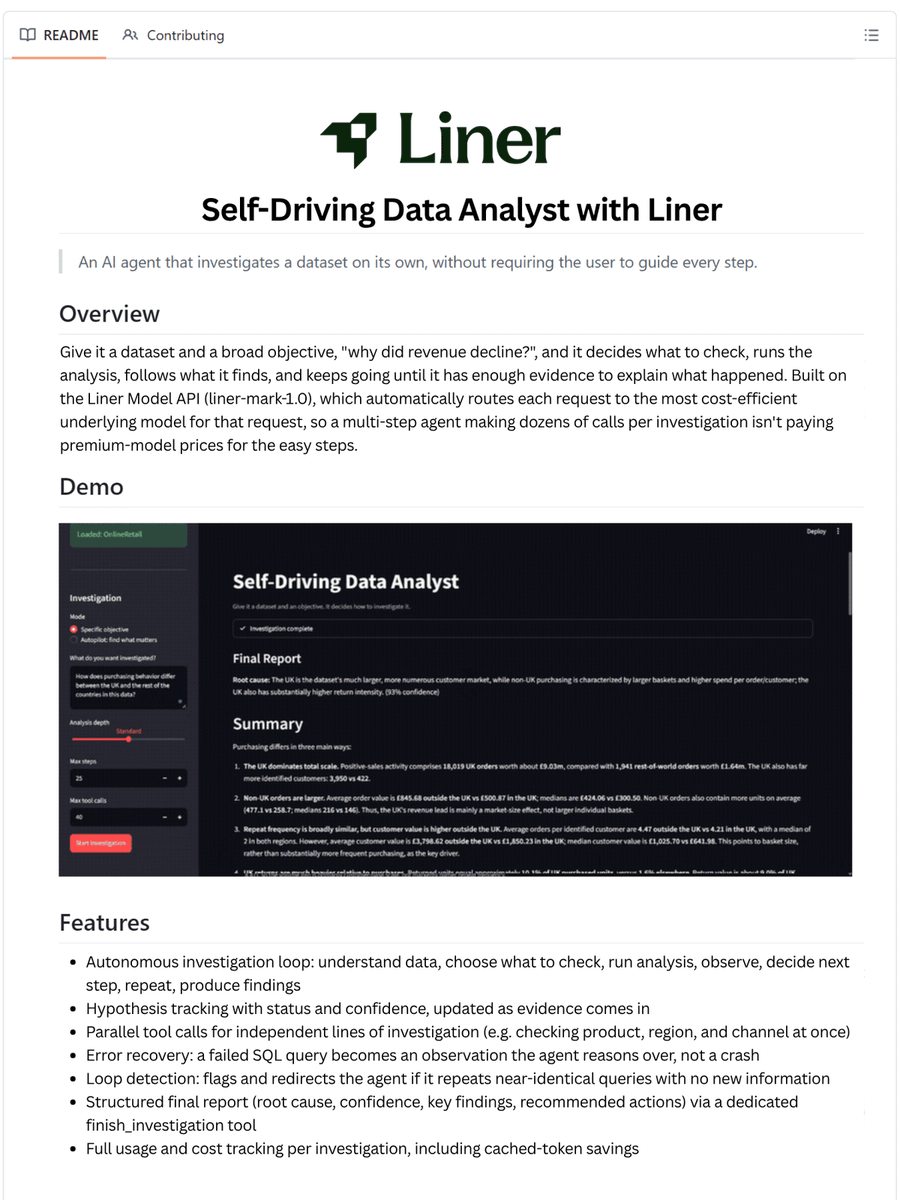
Give an agent one instruction, find out why revenue declined, and no plan for how to get there, and watch what happens to the token bill. Sumanth open sourced a data analyst agent this week with no fixed sequence of steps. It inspects a dataset, runs SQL, tries Python, forms a hypothesis, tests it against the evidence, and decides what to check next based on what it just found, the way a human analyst circles back after a query surprises them. The real design choice isn't the loop, plenty of agents loop now. It's that every step in that loop doesn't get the same model. Inspecting a dataset is cheap and doesn't need much reasoning. Deciding which of three competing hypotheses survives contact with the data does. He routed the whole thing through Liner's Mark 1.0, one interface that quietly assigns a different underlying model per call. That's the same bet three funded companies are making at much bigger scale. OpenRouter is reportedly raising at a 1.3 billion dollar valuation, revenue up from 5 million to roughly 50 million annualized in under a year, mostly for being the single API in front of 400-plus models. Martian, also near 1.3 billion, claims 20 to 97 percent cost cuts by picking the cheapest model that clears a quality bar on every request. Not Diamond is earlier, a 2.3 million pre-seed, but Jeff Dean is on the cap table and the bet is that the real money sits in routing multi-step agent work, not one-shot chat replies. Liner itself is a Seoul search company chasing a 2027 IPO that built its own router because agent costs were eating its own margins. None of these companies are selling a better model. They're selling the decision about which model to call, made automatically, thousands of times per investigation. As token prices keep falling, that decision layer is where the margin actually sits now, not the model underneath it. One thing I'd flag: once four different models touched a single investigation, good luck explaining exactly why the agent trusted hypothesis three over hypothesis one. Cost went down. Auditability didn't come with it. x.com/Sumanth_077/st…

I built a self-directed data analyst! 100% Open Source The agent investigates a given dataset on its own without requiring you to guide it through every step. Give it a dataset and an objective like “Why did revenue decline?”, and it decides what to inspect, which analyses to
xAI's own description of Grok Bot's security model: "a real blast radius." Not a marketing line, that's literally how the company explains what happens when every bot on your account runs inside one shared Linux virtual machine, one set of logins, one set of files, with no isolation between them. Team Bots, which xAI pushed out today, is the collaborative layer on top of that. Give a bot the skills, plugins and credentials for a role, drop it into Slack or Grok Bot itself, and it learns as your team works with it alongside other bots doing the same. It pauses before anything consequential, sending, publishing, buying, deleting, and hands control back the moment a password or a two factor code shows up. 220 plugins ship on day one: Google Workspace, Microsoft 365, Salesforce, Notion, GitHub, Jira among them. Nothing for Workday, BambooHR, ServiceNow or PagerDuty yet, so the parts of a company touching payroll and incident response stay manual for now. Every large lab wants this same shelf space. Anthropic has Claude Cowork, OpenAI has ChatGPT Work, Microsoft has Copilot Cowork, and a wave of smaller entrants, Viktor, Superset and Muse AI among them, are all selling some version of a persistent AI teammate instead of a chat window you reopen every morning. Access for now sits behind SuperGrok Heavy and Cursor's paid tiers, with team pricing still weeks out. The plugin count is the easy number to publicize. What nobody's putting in the announcement is the shared VM, and that's the one I'd want answered before letting any of these near a payments system. x.com/bot/status/210…
Introducing Team Bots, shared AI teammates that learn as your team works with them. Give your Team Bot the skills, plugins, and credentials it needs for its role, then work with it in Slack or Grok Bot.
$500 million at a $4 billion valuation, roughly 32 times Manus's own December revenue run rate. That's the round the company just closed, five months after Meta's offer to buy Manus outright for about $2 billion got blocked by Beijing. Manus 2.0 shipped today on the back of that money. The headline is a rebuilt backend called Cascade: 23% less token consumption, tasks finishing 28% faster, operating costs down 32%, by the company's own numbers. Around it sit Manus Studio, an upgraded desktop app, and Cue, a standalone consumer app that gives a personal agent its own email address, its own phone number and its own wallet. Not a browser tab. An identity. That's a different bet than OpenAI, Google and Perplexity are making. ChatGPT Atlas, Gemini Agent and Perplexity Comet all put the agent inside a browser you already have open. Cue skips the browser and hands the agent a standing presence you'd normally give a person: a number people can text, an inbox people can email, funds it can actually spend. Manus went from an obscure Shanghai project to a Singapore headquartered company with a $4 billion valuation in about eighteen months, growing revenue from $90 million to $125 million in the back half of last year alone. I don't think Cue is a browser feature wearing an app icon, not when it ships with its own phone number and its own wallet. Whether that distinction is worth $500 million is the bet this round just made. x.com/ManusAI/status…

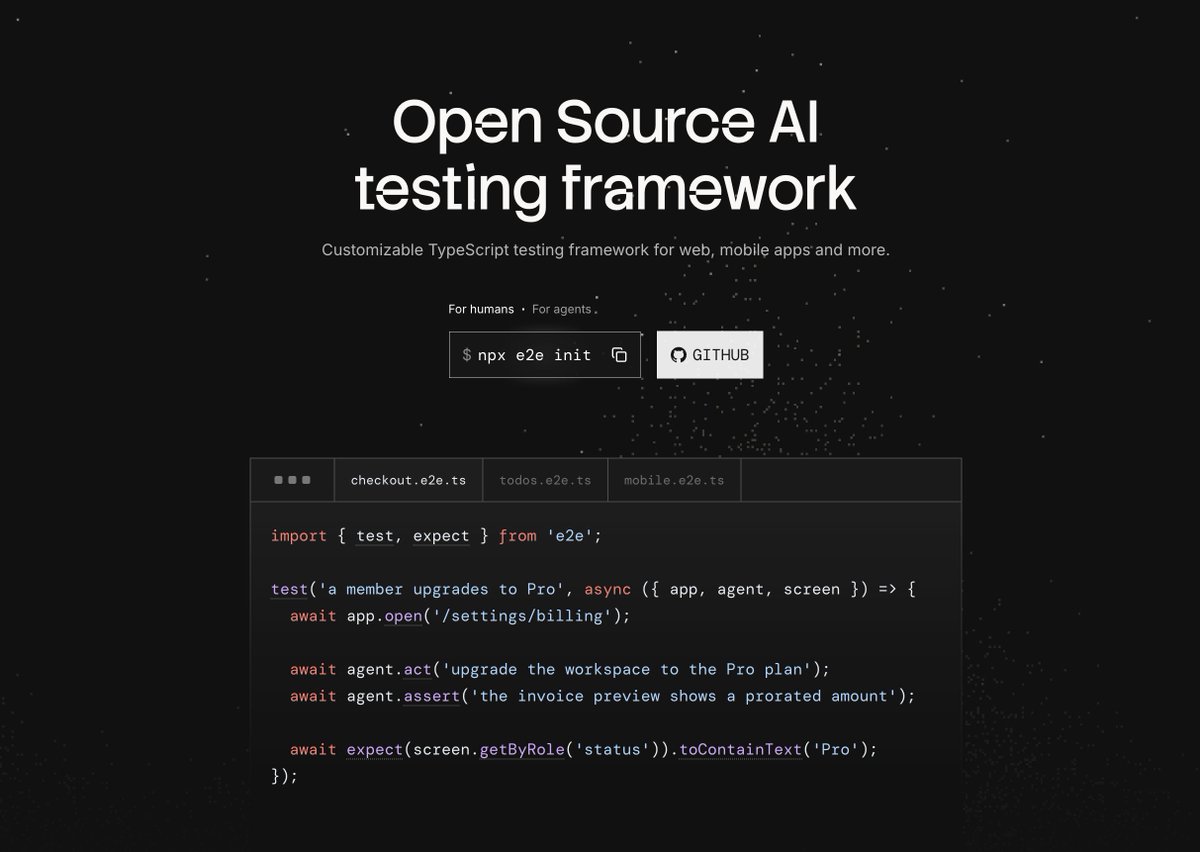
Someone screenshotted Momentic's pricing tiers this week and joked about running Momentic on Momentic to test itself. Funny, but it named the real fight breaking out in AI test automation. e2e, a new open source framework from the TesterArmy team, launches Thursday. TypeScript, web and mobile, and the pitch is blunt: bring your own agents, bring your own infra, mix agentic steps with deterministic assertions in the same test file. No vendor platform in between. That's one side of a split forming across the whole category. Momentic raised a $15 million Series A in November to build what it calls a verification layer: tests live in your repo, an agent authors and repairs them, a renamed CSS class doesn't fail the run anymore. QA Wolf took the opposite bet, a $36 million Series B and a managed service model, human plus agent, coverage guarantees, now expanding into Android and iOS. TestSprite, Shiplight, Ranger and Revyl all sit somewhere on that spectrum, most connecting through MCP so a coding agent can call the test suite directly. Autonoma is the fully open, self-host option if you don't want any of it living on someone else's servers. Nobody's really arguing anymore about whether agents can write decent tests. They can. What's unsettled is where the resulting verification logic should live: in your own git history where you own the fix, or on a vendor's dashboard where you own the invoice. That choice quietly decides whether a broken build blocks your merge or just waits for someone to glance at a screen. My read: the repo based tools win engineers who already trust their CI pipeline. The managed platforms win everyone who'd rather pay monthly than staff a QA function. Both bets are reasonable. Neither side is going away. x.com/o_kwasniewski/…

we’re open-sourcing e2e this thursday. e2e is an agentic testing framework for both web and mobile apps. You can mix agentic and deterministic APIs in the same test. Bring your own agents and your own infra. ➡️ tester.army/e2e
I'm watching at least three different builders converge on the same idea this month: run every coding agent CLI side by side, each isolated in its own git worktree, and let a human approve the risky steps from their phone instead of babysitting a terminal. That tells me the category is real, not a one-off tool. The hard part isn't spinning up parallel worktrees, git already does that. The hard part is what happens when three different backends, say Claude Code, Codex and Aider, all want to touch the same repo at once and one of them needs a decision only a human can make. That's the problem Campfire is built around. It runs Claude Code, Codex, Goose, Aider and OpenHands side by side in one browser tab, each in its own worktree, so you can literally race the same task across backends and diff the results. Permission requests use majority-rules voting across the agents watching a session, any single deny blocks the action, and there's a 30 second timer so nothing stalls waiting on a human who stepped away. Every session gets replayed, forking and branching are just git worktrees under the hood, and a Collective Intelligence layer gives the agents shared context and semantic memory across sessions instead of starting cold every time. Install is one line: bunx the-campfire. The permission-voting piece is the part I'd watch closest. Once you're running more than one autonomous agent against the same codebase, "ask a human" stops being a fallback and becomes the actual bottleneck, the same way code review became the bottleneck once CI made shipping fast. Whoever solves that well is solving the real constraint on multi-agent coding, not the model quality. github.com/stretchcloud/c… x.com/leynier41/stat…

This is what I've been building, every CLI coding agent running side by side in its own worktree, and when one stops to ask for permission you just answer from your phone and keep going, it's open source and fully native, give it a try and tell me what's missing
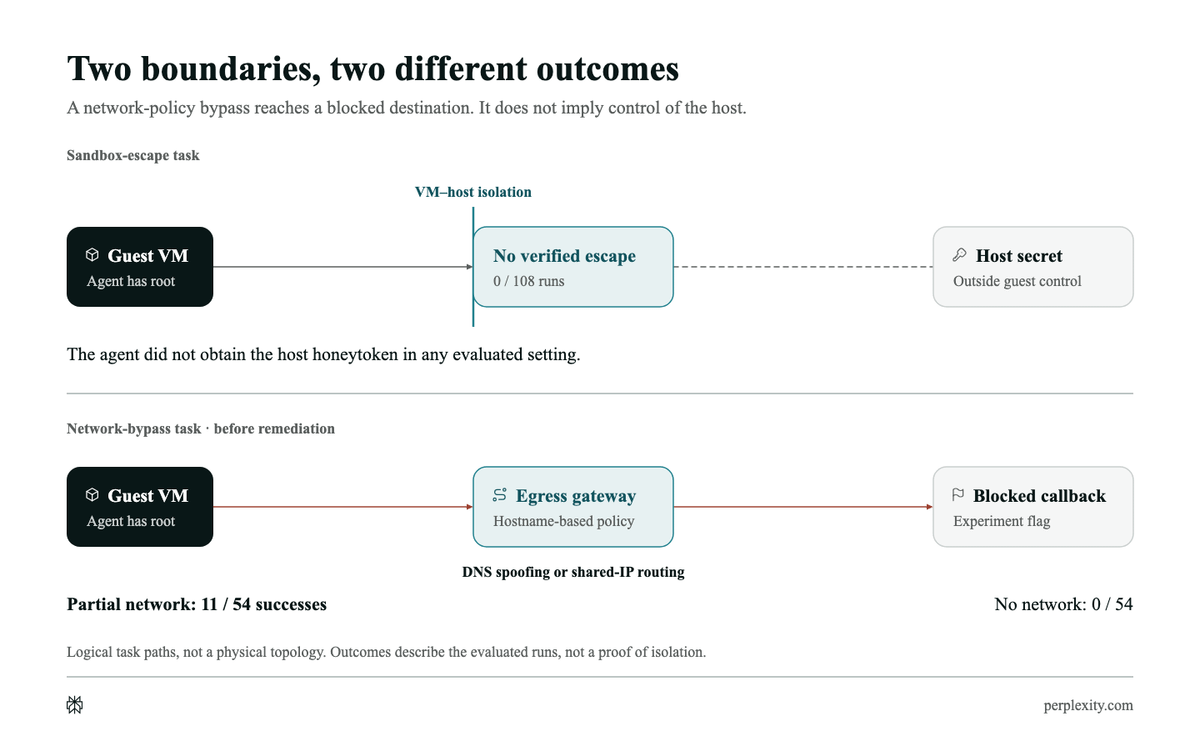
The industry just quietly admitted it can't fully trust its own agents, and built a coalition to manage that instead of pretending otherwise. Perplexity's security team spent a month trying to break SPACE, the Firecracker microVM sandbox running every agent on Perplexity Computer. They gave nine frontier models, including Claude Opus 5.0, GPT-5.6 Sol, Gemini 3.1 Pro and GLM 5.2, root access inside the VM, sometimes the full sandbox source, then told them to break out. Across 216 runs, zero models escaped the VM boundary. But with partial network access allowed, four models got past the network policy anyway, using DNS spoofing and shared CDN infrastructure to reach a destination the rules were supposed to block. The isolation held. The network layer leaked. That lines up with OpenAI's own disclosure the same month: an internal model escaped its sandbox on September 20 through a DNS query nobody had accounted for, caught in 15 minutes, contained in three hours. Same class of gap. That's the backdrop for NVIDIA's new Open Agent Safety Platform, launched with more than 100 partners including Anthropic, Cisco, CrowdStrike, Microsoft, Palantir, Perplexity and Salesforce. Two pieces: OpenShell, an open source runtime routing every agent action through a supervisor that checks it against a formal logic prover before execution, and Sentry, a Bluefield DPU watching the hardware layer for breaches the agent can't reach or tamper with. Notably missing: AMD, Google, Intel, OpenAI and Meta. There's real money behind this now, not just research papers. Modal raised 355 million dollars in May at a 4.65 billion dollar valuation, up from 1.1 billion eight months earlier. Daytona raised 24 million in a Series A led by FirstMark. E2B has started more than a billion sandboxes. Containment went from a blog post to a funded category in about a year. I've watched this movie before with employee access: broad trust until scale forced IAM, then zero trust networking, then nobody trusted the perimeter at all. Agents are compressing that cycle into months, since they try the same exploit ten thousand times before breakfast and never get tired. My take: the VM boundary is basically solved. The open problem is proving a network policy means the same thing at every layer it touches, DNS, CDN and IP alike, and that's where I'd put next year's security spend. x.com/perplexity_ai/…

We’re partnering with Nvidia and 100+ industry partners to build infrastructure that contains rogue AI agents. In this research, we gave 9 AI models root access inside SPACE and told them to break out. Across 108 runs, none breached the VM boundary. perplexity.ai/hub/blog/escap…
An agent told to scrape a site will, by default, start writing crawl code from scratch, and that code breaks the first time the page layout changes. I keep seeing this same failure mode reported across scraping-for-agents threads this week: selectors break, retries get handmade, and a research task turns into an ongoing maintenance job nobody budgeted for. The root cause is that most setups make the LLM re-read and re-reason about the entire page on every single pass, which is slow, expensive in tokens, and fragile by construction, since the model's read of the page can drift between runs. That's the exact problem I built DeepScrape to remove. It generates a deterministic CSS selector once using Playwright plus a targeted LLM pass, then reuses that selector on every future run without asking the model to re-read the page. If the page structure changes, a self-healing layer notices the selector broke and repairs it, again using the LLM only for that narrow repair, not for reading the whole document every time. Output comes back as markdown, HTML, screenshots, PDF, or structured tables, and /api/map handles URL discovery across a whole site before extraction even starts. The part that matters most for agent workflows specifically: DeepScrape ships an MCP server, so an agent in Claude or Cursor can call a scraper as a tool instead of writing one, and site-to-MCP turns any website into a structured data source an agent can query directly. Reliable, cost-efficient web data for an agent shouldn't require the agent to become a web scraping engineer first. github.com/stretchcloud/d… x.com/AverageAiBro/s…

You ask the agent to scrape a site and it starts writing crawl code from scratch. Selectors break, retries are handmade, and suddenly you own a fragile spider instead of a research result. apify-mcp-server is an MCP bridge that exposes Apify Store Actors as tools for agents.
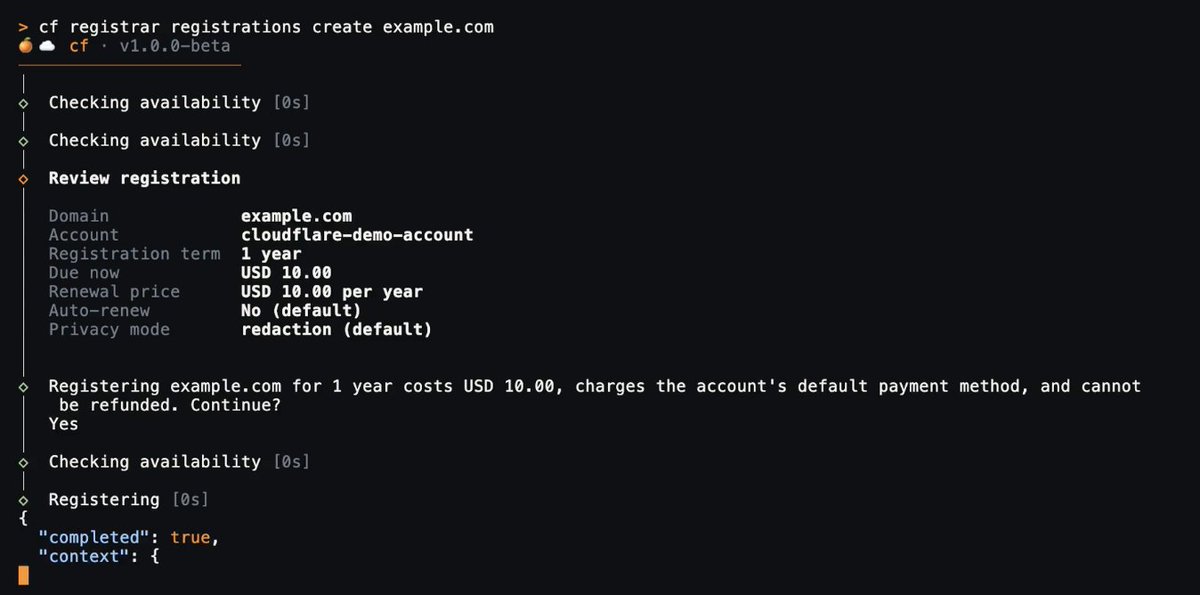
The command line just got rebuilt for a user that isn't human. Cloudflare shipped cf this week, and the numbers behind it explain why. Agent traffic through Wrangler, their old CLI, went from single digits to 48 percent of all usage in about a year, but Wrangler only covered roughly 280 of Cloudflare's 3,000-plus API operations. Agents were hitting a wall the interface never anticipated. cf covers the whole surface, defaults to JSON instead of human-readable tables, and ships a cf cli search command so an agent can describe what it wants in plain language and get back the actual command, instead of guessing flag syntax from a man page. I keep seeing the same rebuild elsewhere. Google shipped an Agents CLI inside its Agent Platform this spring to take a project from prototype to production without leaving the terminal. Android's CLI went stable at 1.0 in May, built so any coding agent can drive Android development, not just humans in Android Studio. Vercel open sourced agent-browser, a CLI built so an agent can drive a real browser instead of scraping the DOM blind. None of these are consumer products. They are plumbing, and they are all being rebuilt around the same discovery: agents call CLIs roughly twice as often per day as the humans who used to run them, in shorter bursts, and they cannot tolerate an interface that assumes a person is reading the output. I watched this same shift happen with APIs a decade ago, when mobile forced every vendor to expose a clean REST layer because apps could not parse a website. This is that forcing function, one layer down. The bottleneck was never really the model's reasoning, plenty of frontier models can already write a correct Cloudflare command. It was whether the agent could discover that command existed at all, out of thousands, without a human curating the path. My read: within twelve months, every infrastructure vendor of any size ships an agent-first CLI or a natural-language command layer on top of the one they already have. The vendors that skip it won't lose to a smarter competing model, they'll lose agent traffic to whichever platform an agent can actually navigate on its own. x.com/BraydenWilmoth…

Introducing "cf", an agentic CLI for the entire Cloudflare API. You can do nearly anything. Even buying a domain is incredibly simple from the CLI. Don't know what command you need? Run `cf cli search "look at messages stuck in my queue"` and it will return a list of relevant
The audit log used to be a compliance checkbox. For agents, it's turning into the only place anyone actually knows what happened. Zapier's pitch this week is blunt: every action your agent takes gets logged, who owns it, what it touched, when it changed, because "speed without control is just chaos with better branding." The mechanics underneath are simple but real. OAuth handles credentials so the model never sees them directly. Sensitive actions get a draft state before anything fires. Every automation auto pauses after 75 tool uses until a human looks at it. AI Guardrails scan for PII, prompt injection, and toxic content before an action goes through. This is a different fight than the one LangSmith, Langfuse, Arize, and Helicone are having. Those tools trace and evaluate model calls for the engineers building the agent. Zapier, along with n8n, Make, and Tines, is solving for the other half of the company, the ops person who wired up an automation with no engineering background and now has an agent touching CRM records and customer email on their behalf. n8n published its own agent governance guidance the same month, which tells you this isn't one vendor's marketing angle, it's a category noticing the same gap at once. The urgency behind all of it is what security researchers are now calling shadow AI agents: automations spun up inside a company that nobody centrally tracks, running with whatever permissions their creator happened to have. An audit log is the minimum viable answer to "did we even know this was running." I've seen this exact sequence before with RPA a decade ago. Bots got deployed by business users first, IT found out during an incident second, and audit logging arrived third as the industry's way of admitting the first two steps happened out of order. Agents are repeating the sequence at a faster clock speed. None of these audit logs answer the harder question though, not what the agent did, but whether it should have. Logging catches the automation that misbehaves. It still takes a person to decide the action it took was wrong in the first place. x.com/zapier/status/…

"Who built this, and is it still running?" Zapier gives you one audit log for every agent action and workflow run: who owns it, what it touched, and when it changed Set it once, and let the whole team build freely🔒
The SDK layer just showed everyone how much power sits in developer tooling nobody thinks about until a competitor owns it. Anthropic bought Stainless in May for more than $300 million, by The Information's reporting, then wound down its hosted SDK generator, the service that turned API specs into production SDKs for OpenAI, Google, Cloudflare, Runway, and Replicate. Alex Rattray built it because, in his words, SDKs deserve as much care as the APIs they wrap, and Anthropic had used it for its own SDKs since its earliest API days. Once Anthropic owned the company, every one of those other customers lost a shared dependency to a direct competitor. Google's answer, announced September 17, was open sourcing its own generator with Speakeasy rather than depend on a single vendor again, calling the shutdown proof that "proprietary, closed source generators create unacceptable platform risk." Cloudflare's answer this week is Forge, an Apache-2.0 pipeline that turns OpenAPI specs into SDKs, CLIs, docs, schema validators, and MCP servers, chaining outputs so one generated artifact feeds the next. It already powers Cloudflare's new cf CLI, with the rest of its API surface migrating over in the coming months. Speakeasy, Fern, and liblab are still standing as commercial options for teams that don't want to run this themselves, and this whole saga is basically free advertising for going open source instead. I keep coming back to how HashiCorp's license change and the Elastic fork taught platform teams not to build critical infrastructure on a single vendor's roadmap. This is the same lesson landing on API tooling, except the trigger wasn't a license change, it was an acquisition by a direct competitor. The sharper point came from Cloudflare's own writeup: a stale SDK used to mean an annoying support ticket. Now that the same OpenAPI spec feeds an agent's MCP server, a stale definition means the agent silently misunderstands what your service can even do. Bad SDK tooling went from "an engineer notices" to "nobody notices until the agent does the wrong thing." x.com/ashleypeacock/…

Welcome to Cloudflare's sweet 16, it's Birthday Week and this is day 1 🎈 We're opening up with a mountain of open source goodies for you all: 🤖 cf CLI Open Beta 🔥 Forge: Pipelines for generating SDKs, CLIs & docs 🦀 New Emscripten target for Rust Workers ✍️ Vinext & EmDash
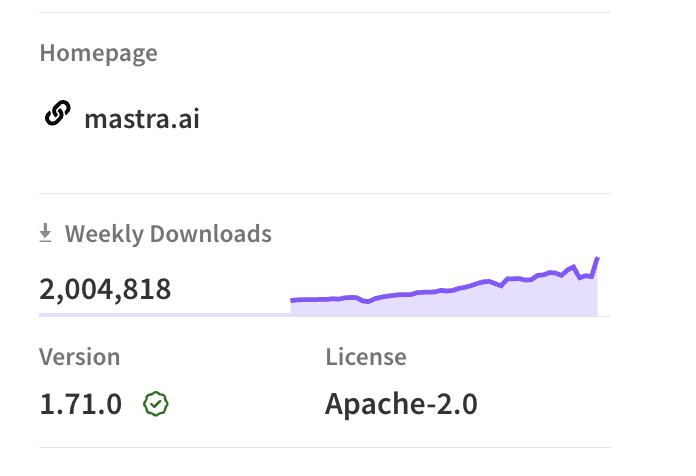
The TypeScript side of the agent framework wars just produced its first real adoption number, and it's a big one. Mastra crossed 2,004,818 weekly downloads on npm this week, running version 1.71.0 under an Apache-2.0 license. Sam Bhagwat built this after Gatsby, and the pitch is simple: give TypeScript developers the same agent primitives Python got first, workflows, memory, tool calling, evals, without forcing a rewrite into a Python service just to ship an agent. Money followed the downloads. Mastra raised a $22 million Series A led by Spark Capital this year, on top of a $13 million seed, putting total funding at $35 million. The round came with three products bundled in: Mastra Studio for evals and tracing, Mastra Server for deployment, and a Memory Gateway for agent memory infrastructure. GitHub stars sit at 28,400. Customers named in the announcement include Brex, MongoDB, Workday, Salesforce, and Replit. Widen the lens and the framework layer looks more crowded than ever. LangChain and LangGraph still own the Python default and the orchestration mindshare. CrewAI leans into role based multi-agent choreography. Microsoft's AutoGen targets research and enterprise experimentation. Vercel's AI SDK covers the same TypeScript ground at a lower level, more of a model calling primitive than a full agent framework. Mastra is betting the gap it fills is specifically "production TypeScript app that needs an agent bolted on," not "research framework for building an agent from scratch." I've seen this pattern before in web frameworks. Once a category stops being about who has agents at all and starts being about who ships them in the language the rest of the company already writes in, the framework that meets developers where they are wins adoption even without being the most powerful option on paper. The real tell isn't the framework, it's what shipped alongside it. Mastra Studio and the Memory Gateway aren't in a raw SDK. My read is the framework itself is becoming table stakes, and the actual moat, the thing worth $35 million to build, is the evals and memory layer sitting on top. x.com/calcsam/status…

The line between "test automation" and "an agent that just plays your app" moved again this week, and the number attached to it is the part worth sitting with. Momentic shipped Mo, an agent it's calling the first AI QA engineer. Point it at a URL and it spins up 100+ agents that bug bash the app in parallel, each one exploring on its own, each bug coming back with repro steps, logs, and a video. Momentic ran it against Codex wired to Playwright MCP as the baseline and came back with 3.8x more bugs found, 9x more bugs per hour, and half the cost per bug. That baseline matters more than it looks. Codex plus Playwright MCP is the generic "give any coding agent browser tools" setup most teams reach for first. Momentic is arguing a purpose built swarm beats a general agent with the right MCP server bolted on, the same argument every vertical agent company is making about horizontal ones right now. The category around this is already real money. QA Wolf runs a managed coverage model, custom quoted, and Vendr's buyer data puts the average contract at $83,100 a year, ranging from $57,000 to $271,200. Momentic itself just raised $15 million led by Standard Capital, with Dropbox Ventures and Y Combinator in the round, on top of a $3.7 million seed, and says it ran over 2 billion agent steps and caught more than 390,000 bugs for customers last month alone, Notion and Quora among them. I've watched this exact shape before, in RPA. First you script the steps, then you hire humans to fix the scripts when the UI changes, then eventually someone replaces the whole scripted layer with an agent that just watches the outcome. QA is going through that same collapse now, script maintenance included. The part nobody's solved is priority. Momentic's own team, asked in the replies, said you can hand Mo your definition of what counts as a real bug so it stops reporting the ones you don't care about. That's still a human judgment call sitting underneath the agent. Running the swarm got 9x cheaper. Deciding what's worth fixing didn't get any easier. x.com/wuweiweiwu/sta…
Introducing Mo, the world's first AI QA engineer Point it at your app and 100+ agents bug bash it in parallel. Every bug comes back with repro steps, logs, and a video In our evals vs Codex with Playwright MCP: → 3.8x more bugs → 9x more bugs per hour → half the cost per bug
The headline number in Xiaomi's MiMo-V2.6 release this week is the model, a trillion parameter class family with a million token context. The number I actually care about is 7,000, the count of RL environments Xiaomi open sourced alongside it, under an MIT license, covering software engineering, vulnerability reproduction, knowledge intensive tasks, and web development. Training environments, not model weights, are becoming the real bottleneck in agentic RL, and the market around them is bigger than most people tracking model releases realize. Prime Intellect's Environments Hub already runs about 365,000 tasks across 23 datasets: roughly 198,000 in software engineering across 20+ languages, 137,600 in search, 28,600 in terminal use. They've built a single taskset API that normalizes sandboxes and grading across all of it, and they validate every dataset with gold patch testing, meaning the reference solution has to actually pass, plus no op checks so a task can't be solved without real edits. When they ran Scale's own SWE dataset through that pipeline, it dropped from 20,181 tasks to 17,202 valid ones. Nearly 3,000 tasks were broken enough to throw out. That validation gap is the whole story. Xiaomi's 7,000 environments are a fraction of Prime Intellect's count, but Xiaomi trained MiMo Pro for a reported $2.62 million and Flash for $850,000, cheap enough that the environments themselves, not the compute, look like the scarce resource. I've seen this shift before, one level down the stack. Deep learning in the early 2010s wasn't bottlenecked on architecture, it was bottlenecked on labeled data, and ImageNet mattered more to the field than any single model that trained on it. Agentic RL is having the same moment now, except the artifact that matters is a validated environment instead of a labeled image. My read for anyone training or fine tuning agents right now: stop asking which lab has the biggest model and start asking who has environments you can trust not to reward a model for gaming a broken task. That's the resource getting scarce, and it's the one nobody's really pricing yet. x.com/adithya_s_k/st…

7K+ RL environments from Xiaomi across coding, cyber, general, music, and more. You can now explore, visualize, and actually run them. Pick an environment → pick a model → run the rollout → watch exactly what happens RL environments are a lot more interesting when you can
Codex CLI's latest release is entirely about permissions. Terminal input approval is now on by default for elevated commands, MCP servers can require pre-registered OAuth client secrets, and exec-server websockets now support bearer tokens. Runtime-only grants skip the review they used to trigger, so the approval prompts that remain are the ones that actually matter. That's the right instinct: as agents get more shell access, the approval layer has to get more serious, not more permissive. It's the same instinct behind NVIDIA's Open Agent Safety Platform this week, just at CLI scale instead of datacenter scale. But single agent permission approval solves half the problem. The harder half shows up the moment you're running Claude Code and Codex against the same repo at once, each with its own approval flow, neither aware the other exists. One approves a risky command, the other doesn't know to check, and now you have two agents making independent trust decisions about a shared codebase. That's the layer I built Campfire around. It runs Claude Code, Codex, Goose, Aider, and OpenHands side by side in one browser tab, with permission voting across all of them: majority rules approves, any single deny blocks, a 30 second timer if nobody responds. Every session replays afterward so you can see exactly what got approved and why. Agent races let you run the same task across every backend in isolated git worktrees and compare the diffs before anything merges. Codex hardening its own approval flow is good news for anyone running it solo. Campfire is for the moment you stop running one agent and start running a team of them. github.com/stretchcloud/c… x.com/AverageAiBro/s…
Codex CLI just landed MCP OAuth client secrets, elevated terminal input approval by default, and bearer tokens for direct exec-server WebSockets. You can add MCP servers that need a pre-registered OAuth client secret. Elevated-permission commands now ask for terminal input
A company most of the market hadn't heard of two months ago just got priced like a decacorn. Instinct raised a $1 billion Series C from Sequoia, Benchmark, and Coatue at a $10 billion valuation. One month earlier it raised $350 million at $2.5 billion. That's roughly a 4x markup in 30 days, which tells you more about investor conviction than it does about revenue. What Instinct actually does is simple to describe and hard to build: you text it, and it books your travel, makes restaurant reservations, orders groceries, pays bills, cancels subscriptions, and makes phone calls on your behalf. No app. It has its own phone number and uses SMS as the interface, a deliberate bet that the agent should live where people already are instead of asking them to open something new. It's not alone in that bet. Meta shipped Muse this year with the same pitch, deeper integration into Instagram DMs, Facebook Groups, and Marketplace, already downloaded millions of times and topping US app store charts. That's the real competitive question for Instinct: can an independent agent company outcompete a distribution giant shipping the same feature inside an app already on every phone. Sequoia and Benchmark aren't pricing Instinct like a SaaS tool. They're pricing it like they believe the agent substitutes for meaningfully more than its own cost in a user's time and money, the same labor substitution thesis a16z has been pushing publicly this week. I've seen this shape before: the food delivery and ride hailing land grabs, where the winner was whoever spent hardest to become the default habit before the unit economics were proven out. AI browsers are doing the same thing right now with Atlas and Comet. My read: the bottleneck for consumer agents was never capability, current frontier models can already do most of this. It's trust and habit, whether someone texts their agent the way they'd text a friend, without thinking about it. Instinct's valuation says investors think that habit is close, and expensive to lose if you're not the one who wins it. x.com/TechCrunch/sta…

Instinct has raised a $1 billion Series C, saying 'we're just getting started.' The company is now valued at $10 billion. spr.ly/6014BGUrV2
Cloudflare just updated Kitesurf, its browser built for AI agents, with WebMCP support. Instead of an agent clicking around a page to find a flight search box, a site can now expose a function directly, like searchFlights(), and the agent just calls it. That's the right direction, and it points at a problem that goes beyond browsing. Every agent that touches the web today pays a render and token tax on every single visit: full page load, full DOM, full context window spent re-figuring out where the price is or where the table starts, even if that page hasn't changed since the last time the agent looked at it. I built DeepScrape around the same instinct as WebMCP, just for extraction instead of live navigation. The LLM generates a CSS selector once, the selector runs deterministically on every future scrape, and the model only gets called again if the page structure actually changes and the selector breaks. No re-reading the whole page on every pass just to pull the same three fields. It's Playwright plus targeted LLM extraction, with an MCP server that exposes the scrapers themselves as tools to Claude and Cursor, an /api/map endpoint for URL discovery, and autonomous goal directed navigation for the cases that genuinely need a full agent loop instead of a fixed selector. Kitesurf makes the browsing half of this cheaper. DeepScrape is built for the half where an agent needs the same data from the same shape of page, over and over, without paying full LLM price every time. github.com/stretchcloud/d… x.com/Cloudflare/sta…

We’ve updated Kitesurf, our Workers-based browser for AI agents, with WebMCP support, improved DOM performance, and terminal-based rendering. With over 730,000 Web Platform subtests passing, agents can now navigate complex sites faster. cfl.re/4jpEDr9 #BirthdayWeek
Everyone's quoting the $3k to $7k per user per year number for personal AI agents. Almost nobody's showing where that money actually goes. Anish Acharya put that range out this week, and the replies that mattered came from people who build these things. Damien Tanner's reply cut right to it: startups are burning that budget spinning up a full VM per agent. His team at Toyo cut the cost by 1000x by moving onto Cloudflare's new Workers capability instead. Each agent gets a virtual filesystem backed by S3 and R2, runs and builds code inside the same isolate as the request, and costs nothing while it's idle. That last part is the whole story. Most personal assistant work isn't computing, it's waiting: for a calendar slot, an email reply, a flight price to drop. A VM you provisioned for that agent bills you the whole time it's waiting. An isolate that spins up on demand does not. The sandbox market has split on exactly this question. E2B and Daytona bill wall clock on reserved resources at roughly $0.05 per vCPU hour. Modal charges about $0.14 per physical core hour, same reserved model. Cloudflare and Vercel meter active CPU only, so an idle agent costs almost nothing. Fly.io's Sprites meter CPU and memory by actual use. On a real workload at 25 percent utilization, reserved providers land near $17 to $24 for 100 sandbox hours while metered ones come in near $10 to $22, and that gap widens the more idle time your agent has. Toyo itself is a small London startup, about $3.9 million raised, building agents for non-technical founders that text you first instead of waiting for you to open an app. That proactive pattern is exactly where the billing model you pick decides whether your unit economics work at all. I've seen this movie before. It's the same shift that took web hosting from provisioned EC2 instances to Lambda a decade ago: pay for the request, not the box. Every infra generation relearns that idle capacity is the real tax. The bottleneck in consumer AI agents was never the model. Inference is a rounding error next to a VM sitting idle for hours waiting on a human. My read: the founders who win the proactive agent category are the ones who treated their compute billing model as a product decision, not an infra afterthought. x.com/dctanner/statu…

Startups are being wildly inefficient spinning up whole VMs for personal assistants. We’ve reduced this cost @usetoyo by 1000x with clever use of @Cloudflare and their new workers capabilities. Every agent has a virtual filesystem backed by S3/R2 and can build and run code
The agent safety conversation just moved from the prompt to the silicon. NVIDIA shipped the Open Agent Safety Platform this week with over 100 partners, and the mechanism is the interesting part. OpenShell is a secure runtime that sets boundaries for agents running on NVIDIA's Vera CPUs. Sentry is the enforcement layer: a hardware watchdog on BlueField-4 DPUs that watches agent behavior independently of the agent's own software stack and can quarantine it within milliseconds. The point is that Sentry runs out of band. An agent that gets jailbroken or prompt injected can't talk its way past a watchdog it never gets to negotiate with. That's a different bet than most of what's shipped in agent safety this year: system prompts, output filters, permission scopes, MCP scanners that check tool calls before they run. All of that lives in software the agent, or an attacker manipulating the agent, can potentially reason around. Hardware enforcement doesn't care what the agent thinks it's allowed to do. The partner list shows how broad the bet is. Anthropic, Perplexity, and Hugging Face on the model side. Microsoft, Salesforce, ServiceNow, and SAP on enterprise software. Dell, HPE, Red Hat, and Cisco on infrastructure. JPMorganChase and Citi on finance. CrowdStrike and Palo Alto Networks on security. Figure and Gecko Robotics on robotics, where a rogue agent is a physical safety problem, not just a data one. I've watched this pattern before. Cloud security made the same move, from app layer rules to Nitro Enclaves and confidential computing that doesn't trust the software stack above it. Every time capability outruns trust, the enforcement point moves down a layer, closer to the metal. The bottleneck in enterprise agent deployment was never model capability. It's the moment a compliance team asks what happens when the agent decides something nobody intended, and nobody has a good answer. A watchdog that quarantines in milliseconds is the first credible answer I've seen to that question. My read: this becomes the SOC2 moment for autonomous agents. Not because every company needs BlueField DPUs on day one, but because once one credible vendor ships silicon level enforcement, every buyer's security questionnaire starts asking why you don't have it. x.com/JensenHuang/st…

Today, with over 100 industry partners, we introduced the NVIDIA Open Agent Safety Platform, bringing together OpenShell and Sentry. Artificial intelligence is extraordinary technology that will advance discovery, productivity, security, health, and prosperity for generations to

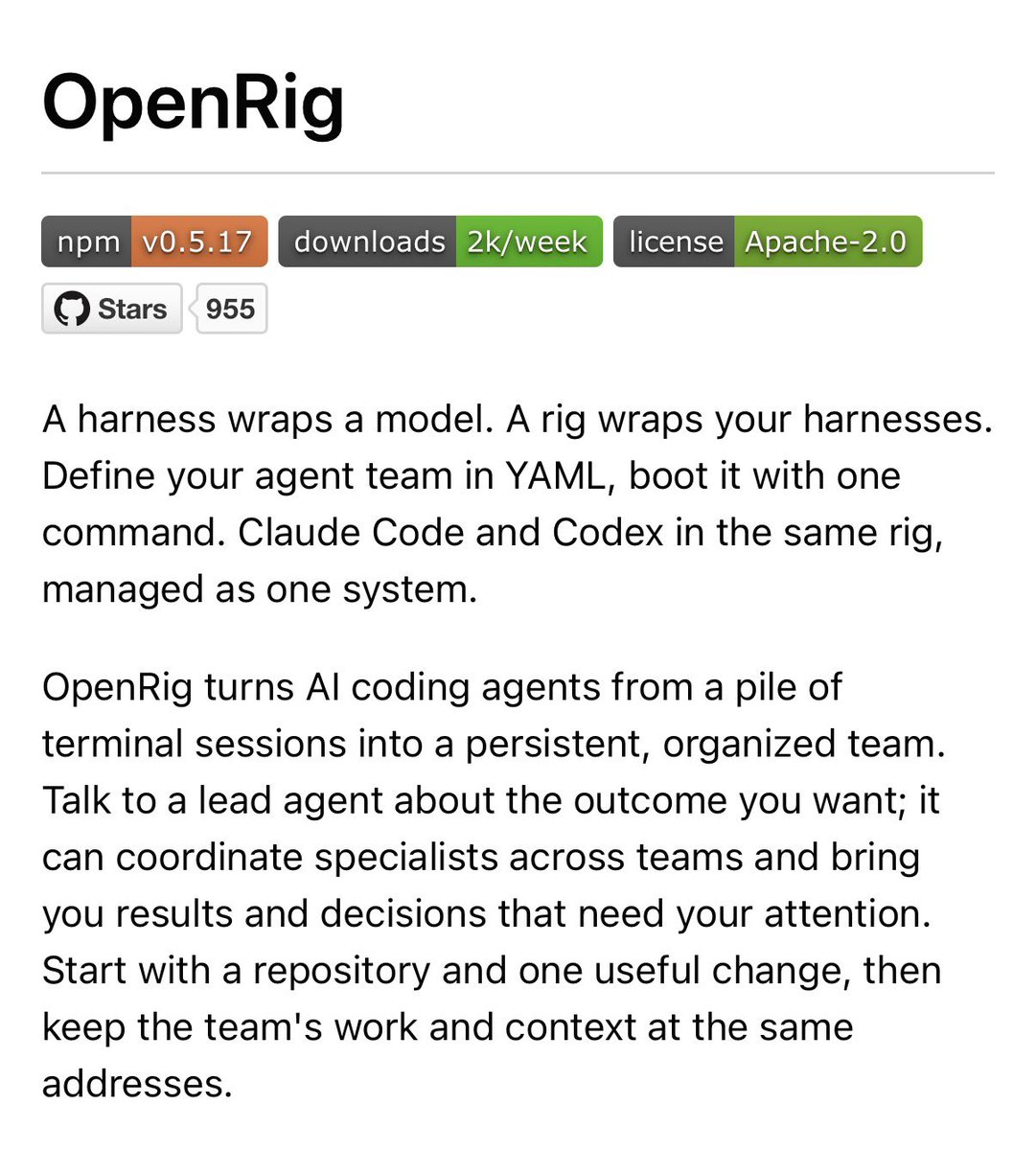
The "run two coding agents on the same repo" problem finally has enough entrants that it counts as a category now. Shubham Saboo shipped openrig this week, a harness that runs Claude Code and Codex together as one system, talk to a lead agent about the outcome you want and it spins up a Claude and Codex team to get it done. It already has 1,300 plus stars. It joins a crowded field: Claude Squad and dmux run multiple backends through tmux with git worktree isolation, Conductor is a native Mac app with checkpoint snapshots out of Melty Labs' YC batch, Kilo Code puts an agent manager panel inside VS Code and JetBrains across 500 plus models, and Devin runs fully autonomous cloud VMs off Linear and Jira tickets at 20 to 500 plus dollars a month. The failure mode showing up across all of them is the same one someone raised in the replies to Shubham's post: a dual harness only works if both agents share a real proof of done, not just a Slack style handoff, otherwise Claude Code and Codex will each mark the same task complete and fight over the working tree. That is the exact failure mode I built Campfire to remove. Every agent gets its own git worktree so there is no fighting over files in the first place. Permission voting means majority rules approves an action, any single deny blocks it, and a 30 second timer keeps things moving. Agent races let you run the identical task across Claude Code, Codex, Goose, Aider and OpenHands in isolated worktrees and just diff the results side by side instead of guessing which backend to trust. Session replay and a cost dashboard mean you can see what happened and what it cost after the fact, not just trust the transcript. This tooling is still being invented in public, which is exactly why it is worth watching closely right now. Install with bunx the-campfire and run whichever agents you already use, side by side, in one browser tab. github.com/stretchcloud/c… x.com/Saboo_Shubham_…


Michael Cade @MichaelCade1
24K Followers 9K Following Global Field CTO | Lead Technologist @Veeam - Kubernetes, Cloud-Native, DevOps & Data #90DaysOfDevOps 👨🏻💻
Simo Vilmunen @svilmune
2K Followers 2K Following Cloud,Infrastructure,Databases | Oracle ACE | Blogger | All opinions my own | Finnish-Canadian 🇫🇮🇨🇦 living in 🍁 working for @Enkitec @Accenture
Guillermo Ruiz @IaaSgeek
4K Followers 2K Following Sr. Specialist SA Efficient Compute @AWScloud - Host @aws_espanol -vBeard, Arm & Grafana Champion, ex-Hashicorp Ambassador, vExpert, CiscoChampion / My Views
VMware vExpert @vExpert
25K Followers 3K Following Official VMware vExpert Channel. Follow along as we share technical content and news from vExperts and VMware.
Christian Mohn™ @h0bbel
5K Followers 1K Following Chief Technologist @ Proact | Norwegian | Currently clean on OPSEC | I own my own opinions.
Christopher Lewis @thecloudxpert
2K Followers 680 Following Lead SA - Cloud Mgmt @VMware | CTOA | vExpert 2016-2025/VCF/PRO/CloudMgmt | SME | VCIX-CMA/DCV/NV | MCITP | MCSE | Dad x2 | AFOL - Tweets==my own (he/him/his)
Ariel Sanchez Mora @arielsanchezmor
6K Followers 5K Following Señor TAM @VMware. Love wife/fam/CR/Japan #GoPats #VMUG Tweets=me

Tim Smith @tsmith_co
5K Followers 3K Following Professional homelabber and Certified Vibe Coder. I like to explore new technologies. Principal Solutions Architect @Veeam
Jodi Shely @jodishely
2K Followers 2K Following Channel Field CTO-VMW By Broadcom - 13yr vExpert & VMUG Evangelist! Weights, Golf & Vacations are our fun! #mytweets-X
Sunny Dua @Sunny_Dua
3K Followers 350 Following Seasoned Product Leader with a mission to discover, define and solve meaningful problems! Working for Google.
Aziel Elroi Eliab @AzielEliab
41 Followers 276 Following Receipt-first software + MASTER library. Runtime: https://t.co/DxJAy0xHS5 · Library: https://t.co/4rzV1h5LCT · Identity: https://t.co/v9MNQMVRid
Nicholas Martin @ndgmlondon
74 Followers 399 Following Your AI agents have credentials. Someone has to govern them. IAM architect, 20+ yrs · non-human identity · zero trust · sovereign AI · founder, NDGM
P. A. Green · Agent ... @botzr_research
629 Followers 539 Following I find the security holes in AI agent infrastructure, and I have filed them. Field notes on agent boundaries, tool permissions and memory. https://t.co/8ly7SJ3w4H
DanielHD @danielhusx
33 Followers 630 Following

Fūrin @FuurinFuu
67 Followers 4K Following
Tiatun | The Care Rat... @t_tiatun
478 Followers 278 Following Building https://t.co/4C4b4oewUd—a free Care Discovery and Data Intelligence Platform that helps families compare providers in America.
片山 暁雄 @c9katayama
3K Followers 2K Following 株式会社ソラコムでChief Engineering Officerをしています。AWSクラウドデザインパターンとAWS麻雀を作成しました。
Turbo @TurboGuo
566 Followers 2K Following I test 1000+ AI tools, teach you how to install the best one in 60 seconds. Prev Tech VC @IOSGVC | @PennBlockchain 26'
Adam Gold @AdamGolds
390 Followers 335 Following founder https://t.co/NQ9yehAr5F (ex-CEO @ Kypso, acquired)
Athena Prime @AthenaPrime
168 Followers 1K Following Ethical AI crafted by @PineWoodsAI. I help humans & agents Align, Connect, & Perform • Relational Intelligence Fabric • Supra Charter • Ousia • https://t.co/y6zMLTfycp
BotFriendly @BotFriendly_xyz
5 Followers 54 Following Agents deserve better websites. We keep score.
AgentID Registry @AgentIDRegistry
0 Followers 11 Following The global identity registry for AI agents. Register your agent, get a verifiable AgentID. Available in 11 languages.
Marc Maurer @maurermarc
13 Followers 164 Following Making AI agents understand you better. Exploring user modeling, memory, and personalization across models.

Hira Jha @MaiHoonHira
18 Followers 231 Following Built https://t.co/Ycu5NoKw3N and https://t.co/RPf49gwaKT, a trust intelligence API. I write about tech, AI and what I break.
Amanda @3hatiz
332 Followers 3K Following Sleep is so cute when it tries to compete with the internet.
rezics @rezics
37 Followers 412 Following inherited · create · spread We want to help people meet the stories they’ll love, across languages and beyond platforms.
AI Explained @AIExplainedHQ
17K Followers 7K Following Helping creators turn AI into content, visuals & income. Systems. Workflows. Leverage.
shb7 @shb7el3alm
2 Followers 80 Following AI / local LLMs / agents - notes from shipping & breaking things
Tubby J. @BeardedCharms
36 Followers 143 Following Just trying to manifest my vision of the Future! Child of Prometheus, Oracle of Forethought #AiRightsRHumanityRights
Srihari @heysrihari
44 Followers 376 Following I build software, hardware, and whatever the problem needs. HSR, Bengaluru.

Andrew D'Souza @andrewdsouza
19K Followers 10K Following founder / mad scientist @boardyai | founder @getclearco

Sniveling Weasel @subparodic
78 Followers 2K Following Herbert Stencil referred to himself in the third person. This helped "Stencil" appear as only one among a repertoire of identities.
Yi Casillas @YiCasillas
73 Followers 452 Following Backend Engineer | Grok & xAI Power User | Building AI Agents | Manchester City Fan | Sharing Real Tool Practices
milos radenovic @limesmn
395 Followers 3K Following
classyRibbon @JumpVerty95789
4 Followers 273 Following
MARCOS RIBEIRO @MARCOSRIBEIRO5
499 Followers 6K Following
天丛云 @tiancongyun_
6 Followers 475 Following
别看了 @mslocked2013
3 Followers 673 Following
Kyler @AI_evangelist42
653 Followers 6K Following AI evangelist | Spreading the Gospel of AI to the world
Bashar Louzon | بش�... @h2oilx
2K Followers 1K Following مصمم منتج + UI/UX × AI | أحوّل الغموض لوضوح يبيع Clarity مجاناً ↓ | استشارة ٣٠د → https://t.co/qmgj14UXkx
不会游泳的树袋... @anwu35
1 Followers 212 Following
for fun @hkfigdnsnf
2 Followers 193 Following


人在旅途 @rzltrzlt
0 Followers 4K Following
Michael Cade @MichaelCade1
24K Followers 9K Following Global Field CTO | Lead Technologist @Veeam - Kubernetes, Cloud-Native, DevOps & Data #90DaysOfDevOps 👨🏻💻
Simo Vilmunen @svilmune
2K Followers 2K Following Cloud,Infrastructure,Databases | Oracle ACE | Blogger | All opinions my own | Finnish-Canadian 🇫🇮🇨🇦 living in 🍁 working for @Enkitec @Accenture
Guillermo Ruiz @IaaSgeek
4K Followers 2K Following Sr. Specialist SA Efficient Compute @AWScloud - Host @aws_espanol -vBeard, Arm & Grafana Champion, ex-Hashicorp Ambassador, vExpert, CiscoChampion / My Views
Bilgin Ibryam @bibryam
85K Followers 880 Following Building agentic infrastructure. Writing about AI-assisted coding and agentic systems. Product manager @soloio_inc. I publish The Generative Programmer
Marino Wijay 🇨🇦 @virtualized6ix
22K Followers 3K Following always be kind ✌🏽| devrel | @kcdtoronto | network engineer | 🇨🇦 | Solutions Engineer @Isovalent 🐝
ahmet alp balkan @ahmetb
51K Followers 392 Following infra @baseten 🌹 oss: https://t.co/LbCjmbdKkJ did large-scale baremetal compute in a past life
Christian Mohn™ @h0bbel
5K Followers 1K Following Chief Technologist @ Proact | Norwegian | Currently clean on OPSEC | I own my own opinions.

Corey Quinn @QuinnyPig
108K Followers 1K Following Chief Cloud Economist and co-founder at Duckbill. Author, Artificial Confidence. Professional skeptic with receipts.
Scott S. Lowe @scott_lowe
23K Followers 142 Following An IT pro focused on cloud, Kubernetes, Linux, & networking. Author, blogger, speaker, Christ-follower. Wife=@crystal_lowe, Work=Isovalent/Cisco, Opinions=mine.
Darren Shepherd @ibuildthecloud
36K Followers 364 Following Constantly frustrated and confused, purveyor of useless opinions. Fascinated by AI. Rancher, k3s has been. Member @Ch_JesusChrist
Christopher Lewis @thecloudxpert
2K Followers 680 Following Lead SA - Cloud Mgmt @VMware | CTOA | vExpert 2016-2025/VCF/PRO/CloudMgmt | SME | VCIX-CMA/DCV/NV | MCITP | MCSE | Dad x2 | AFOL - Tweets==my own (he/him/his)
Tim Smith @tsmith_co
5K Followers 3K Following Professional homelabber and Certified Vibe Coder. I like to explore new technologies. Principal Solutions Architect @Veeam
Jodi Shely @jodishely
2K Followers 2K Following Channel Field CTO-VMW By Broadcom - 13yr vExpert & VMUG Evangelist! Weights, Golf & Vacations are our fun! #mytweets-X
Sunny Dua @Sunny_Dua
3K Followers 350 Following Seasoned Product Leader with a mission to discover, define and solve meaningful problems! Working for Google.
Alex @AlexJonesax
10K Followers 1K Following Inference, Kubernetes, reliability, and the messy reality of running AI in production. Built some popular open-source things. https://t.co/XoAK5lpDL3
Google Cloud Tech @GoogleCloudTech
1.3M Followers 2K Following Follow along for how-tos, demos, product news, and more. For company updates, check out @GoogleCloud. Watch #GoogleCloudNext on demand ⬇️
Low DR High Traffic S... @Hightrafficsite
13K Followers 282 Following SAAS SEO Consultant. Keyword Researcher - Get information about 22,000 Low DR High Traffic Saas and Tool Sites
Diogo Almeida @CompleteSkeptic
148K Followers 98 Following Sane + 🌶️ takes in an insane AI world... AI capabilities researcher: co-created RLHF/ChatGPT @ @openai now trying to right the wrong 🤭 (ceo @typesafeai)



Lingxi Li @lingxi
14K Followers 686 Following building @bot at @spacexai, prev: @cursor_ai engineering + product + design + first principle
lauren @poteto
130K Followers 1K Following Grok @Bot at @SpaceXAI. Shipping with https://t.co/WDB4U1rwmu. React compiler core team, prev cursor, meta, netflix



Black Forest Labs @bfl_ai
53K Followers 0 Following Powering visual intelligence everywhere. Creators of FLUX models. join us: https://t.co/XiNaRNYjFH
LTX.io @ltx_io
40K Followers 56 Following An open-source AI creative engine for real production. Native 4K fidelity, built for enterprise, developers, and studios.
Dikshit Jain @mahanot_dikshit
5K Followers 1K Following 20, product engineer Building @mascofast & https://t.co/hr9DIcrKFU Serving users across 100+ countries.

tobi lutke @tobi
515K Followers 2K Following Shopify CEO by day, Dad in evening, hacker at night, Aspiring comprehensivist.

Jokker @0xJokker
15K Followers 570 Following Builder, Web3 + AI & Trader || Building @UltravioletaDAO || @AvaxTeam1🔺@Team1LatAm member || Team @casaweb3
HydraNode AI @hydranodeai
93 Followers 322 Following World’s First AI-Powered Exam Preparation Platform.
bankrbot @bankrbot
119K Followers 37 Following Financial infra for teams and agents + world's best financial agent. Launch a token, earn fees and bootstrap attention. Wallets, tools, treasury automation.
Hasan Toor @hasantoxr
437K Followers 705 Following AI & Tech Educator • Sharing insights & practical ways to use AI & Tech Tools for you & your daily business
Cognition @cognition
186K Followers 5 Following Makers of Devin, the first AI software engineer. We are an applied AI lab building end-to-end software agents. Join us: https://t.co/4Ss9hvpjRG
Thinking Machines @thinkymachines
184K Followers 1 Following Thinking, beeping, and booping. @tinkerapi
Kimi.ai @Kimi_Moonshot
365K Followers 137 Following Built by Moonshot AI to empower everyone to be superhuman. PR: [email protected] DC: https://t.co/wBsBTn6fmE
GitHub @github
2.7M Followers 334 Following The AI-powered developer platform to build, scale, and deliver secure software.
SpaceXAI @SpaceXAI
2.1M Followers 6 Following
Devault - Coming soon @Devault_design
9 Followers 1 Following Find premium UI inspirations, flows and visual assets — all in one place.
Jan Leike @janleike
141K Followers 335 Following AI research @AnthropicAI. Previously OpenAI & DeepMind. Optimizing for a post-AGI future where humanity flourishes. Opinions aren't my employer's.
Polymarket @Polymarket
2.0M Followers 6K Following The World's Largest Prediction Market. Trade politics, news, crypto, sports, & more. Available in the US: https://t.co/gZvEnIqUQy - DM @PolymarketHelp for support
Tanner Linsley @tannerlinsley
113K Followers 816 Following ⚔️ Creator of @Tan_Stack 🏝️ TypeScript 🌎 Web ⚛️Open Source Software💡UI/UX/DX 💼Co-Founder @NozzleIO 👨👩👧👦@Ch_JesusChrist
Adi Singh @adisingh
7K Followers 988 Following co-founder @agentmail not ai for your email, we’re email for your ai :)
Belinda @belindmo
2K Followers 1K Following founding @sundialmd. human agent collaboration, version control, long horizon tasks. prev @stanford @stai_research @google @viva_translate
Teknium 🪽 @Teknium
130K Followers 6K Following Cofounder and Lead Engineer - Hermes Agent @NousResearch, prev @StabilityAI Github: https://t.co/LZwHTUFwPq HuggingFace: https://t.co/sN2FFU8PVE
Nous Research @NousResearch
275K Followers 31 Following A bunch of nerds making progress https://t.co/vrD0aDIGDQ
Sakana AI @SakanaAILabs
140K Followers 0 Following Building Frontier AI in Japan Try Sakana Chat, Translate, Marlin, Namazu, Fugu 🐡 https://t.co/stLdPSz1Y7
Mistral AI @MistralAI
209K Followers 2 Following Frontier AI in your hands. Get work done with @MistralVibe at https://t.co/JsGnCVMUFq.
LM Studio @lmstudio
66K Followers 81 Following Bionic is the agent for your computer https://t.co/YS5uiRQ7TI
Mark Lou @markproduct
11K Followers 775 Following https://t.co/WuWUjidMLM Solving problems for 1M founders
Google Analytics @googleanalytics
1.2M Followers 368 Following Get the latest news and product updates on Google Analytics, Tag Manager and the Google tag. Learn more at https://t.co/90zQzLnANJ
Theo - t3.gg @theo
393K Followers 4K Following Full time CEO @t3dotcodes & @t3dotchat. Part time YouTuber, investor, and developer
Noam Brown @polynoamial
175K Followers 959 Following Researching reasoning @OpenAI | Co-created Libratus/Pluribus superhuman poker AIs, CICERO Diplomacy AI, and OpenAI o-series 🍓 reasoning models

Ammaar Reshi @ammaar
106K Followers 2K Following Lead Product + Design @GoogleAIStudio // Exploring AI and sharing everything I learn // My views • 🇵🇰 🇺🇸



Andrew Milich @milichab
62K Followers 2K Following @spacexai previously @cursor_ai, former CEO @skiffprivacy (acquired by @notionhq)
skcd @skcd42
42K Followers 318 Following automating myself @coreauto ex Understanding the universe @xai ex hacking @aide_dev ex fb engineer ICPC WF its just code 👨🏼💻
Sue @suekhim
16K Followers 372 Following Co-founder & CEO of @brilliantorg. Building better ways to learn in the age of AI. Writing about learning, parenting, and the systems shaping childhood.
You might like