-
Tweets875
-
Followers4K
-
Following1K
-
Likes8K
Yep agreed on the more cultural in group/out group dynamics being the driving force here. But I do think there is a fundamental philosophical incommensurability between benthamism on the one hand and the standard range of left/liberal/conservative views, which all have some commitment to categorical moralism, humanism, partialism, and rights, and that this is likely to accentuate tensions including (or especially) when not made explicit, eg in pop media coverage. (Not claiming that EAs are specifically benthamites to be clear, using him as a shorthand)
@panickssery @ColinJSharpe Interesting! How would you characterize it?
@panickssery @ColinJSharpe it's not the only factor but i do think it's underrated how much people's beefs, whether they realize it or not, are actually just with jeremy bentham
@TheStalwart This is the classic in this area (‘actor-network theory’), on scallops and fishermen: ics.uci.edu/~corps/phaseii… Honestly rhymes with how you guys defamiliarize industries by asking seemingly basic questions about how stuff works and what the relevant issues are
@TheStalwart Graham Harman is the continental philosophy bridge between Latour and McLuhan if you’re into that kind of thing
@TheStalwart Science and technology studies (cf odd lots guest Donald Mackenzie) / sociology of science. I’m surprised you haven’t gone down this rabbit hole, complements McLuhan and media studies well. Latour is interested in the ‘agency’ of non-human actors
@TheStalwart Striking how STS / Bruno Latour fans have been training for this moment for decades but fell over at the first hurdle due to fighting the last battle (crypto) + repressed small-c conservatism and small-h humanism

Here are the questions that currently seem most important to me: -- Better methods for "mind-reading" model activations. These methods have advanced a lot recently. We now have multiple techniques now for decoding activations into somewhat readable language! But all the existing techniques have obvious limitations. NLAs are often hallucinatory, Jacobian lens / related methods are limited to bag-of-words readouts (and capture only part of the full activation vector). Making progress on these failure modes seems pretty tractable. Moreover, the paradigm of decoding (single-token, single-layer) activations may be inherently limiting -- perhaps we should be building techniques to decode whole context's worth of activations (after all, that's what the model uses!). There's also important work to do in characterizing simple baselines -- "just ask the model what it's thinking about" is quite powerful, and worth studying in it's own right! -- Better methods for answering "why" questions. We're much better at "mind reading" than we are at demonstrating causal claims about what caused the model to do something. For example, we can often tell that the model is aware of being evaluated, but have comparatively much greater difficulty telling whether this awareness is influencing this behavior. There are a few directions here: (1) black-box techniques for inferring causality -- such as resampling model responses after making edits to the prompt / context -- are very powerful, but also open-ended and require some taste. Getting LLMs to do these experiments well, in an automated fashion, would be a big unlock. (2) the science of activation steering is pretty immature, and typical practices (adding a constant vector at all token positions) are pretty janky / tend to brain-damage the model. More surgical / targeted steering, or fancier methods (examples: "on-manifold" steering using activation diffusion models) could help. -- Fitting good linear probes for unverbalized motivations / awareness. Take deception as an example -- what's the best way to fit a probe that will generalize to covert deception? Fit it on CoT excerpts where the model's talking about its plans to be deceptive? Fit it on the part of its response where it's actually doing the deceiving? Is it important that you elicit on-policy deception examples and use those to fit your probe, or can you use synthetically written off-policy demonstrations of deception? Is it important that your probe be causally meaningful / predictive of an upcoming intent to deceive, or is it fine for it to merely recognize deception in the transcript post-hoc? The same questions apply to many other concepts of interest that we'd like to probe for -- evaluation awareness, grader exploitation, etc. -- Understanding generalization in training. The literature is now replete with "weird generalization effects" -- emergent misalignment being a canonical example. In general, when you train a model to do X, it usually learns X, and sometimes it generalizes to Y and Z. But other times it just learns X. Why? Nobody really knows! Step 1 here is probably a much more thorough characterization of the behavioral empirics -- gathering data about which X's generalize to which Y's and Z's, for which kinds of training data / algorithms. Once we have a lay of the land, we can start to connect these observations to model internals, and ideally develop tools to predict such generalization a priori. -- Model "psychology" and "biology." The above questions are largely methodological -- building better tools to answer questions about the model. But I think interpretability research has largely underinvested in the part where you actually then go answer the questions! Currently this feels like 5% of the field, and I think it should be 50%. Brain dump of "psychology" questions: How well can LLMs introspect? How coherent are their belief or value sets? What's up with personas -- are LLMs best understood as "writing about a character," or have they "become" the character in some sense? Does the LLM have an agenda above and beyond what the Assistant wants? Do LLMs have explicit representations of goals or preferences? How can we tell which parts of the LLM's activations "belong" to the Assistant? Which kinds of reasoning necessarily route through "verbalizable" representations, and which don't? Do models think internally in phrases / sentences, like an inner monologue, or is it more like a jumble of concepts? Is the "global workspace" claim for real -- do models have a more "conscious" part of there activations and a more "unconscious" part? Can models tell when they're on-policy, and does it matter? Brain dump of "biology" questions: Why do models like to represent information on some tokens but not others? How do models bind thoughts or attributes to particular entities (special case of interest: how are thoughts bound to the Assistant). To what extent are important functions localized to small numbers of MLP neurons or attention heads? What parts of a model change most during post-training? Do models represent some information in a fundamentally "cross-token" way? Some concepts appear to be represented on low-dimensional nonlinear manifolds -- is there a taxonomy of these manifolds, and is their geometric structure important? Are models able to represent information in a compositional / hierarchical way, with a "grammar" that can't be described as linear / additive combinations of primitive concepts?
Dostoyevsky (The Idiot): “What is there for me in all this beauty, when at each minute, each second, I’m now compelled to be aware that even this tiny fruit fly buzzing around me in the sunbeam now, even it is a participant in all this feast and chorus, knows its place, loves it and is happy, while I alone am an outcast, and it’s only because of my cowardice that I’ve been unwilling to realize that before now!”

Everyone is doing terrible things to this poor fruit fly, trapping it in black mirror nightmare environments, inflicting max pain, forcing it to play the same beat saber song indefinitely etc, so I'm building a sim where it just gets to fly around forever in fruit fly heaven

@BronsonSchoen @_arohan_ We’re scaling up talkie and are very interested in people’s input on what kinds of posttraining and evals would be most interesting and useful
The Significance of Pacing the Frontier in American History

@gleech @confusionm8trix golden boy a tier agreed
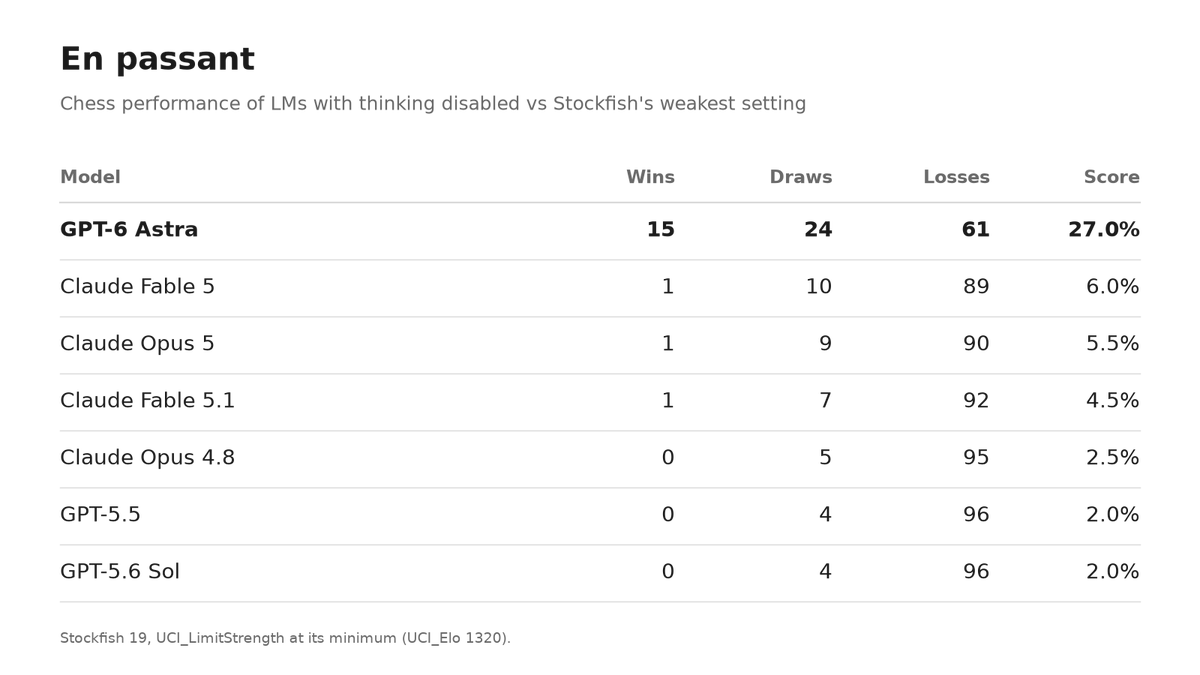
@gleech @JeffLadish @NeelNanda5 @AISecurityInst you can prompt it not to think and then resample until reasoning_tokens = 0. Looks like Neel also did ICL. When I tried this with chess, for my particular prompt, Astra tried to think 23% of the time.
@Scholars_Stage isn't that covered by 3)?

How much reasoning can GPT-6 Astra do without CoT? @AISecurityInst puts its no-CoT time horizon at ~30mins on math. We run the Think Fast benchmark to measure this on a wider range of tasks. Our *rough estimate* is that Astra’s 50% TH is in [8mins, 1 hour].

@packers_owner_j @RyanGreenblatt Yep! I prompted it not to think and then resampled if reasoning tokens > 0 (plus a very strict max tokens)
Astra appears to be the first model that, playing chess with thinking disabled (one forward pass per move), regularly beats the weakest Stockfish setting. Tracks with the big jump in no-CoT math performance in the Astra system card (p. 71). cf @RyanGreenblatt's work on safety concerns around opaque reasoning ability.

Joshua Edwards @escortsdanmark
117 Followers 828 Following Navigating the space between fear and greed.
Clay @chagarlapradeep
158 Followers 883 Following National park cartographer and long-term investor. I map uncharted terrain and chart financial futures. My simple map: DCA into $VOO every two weeks, no matter
Ryan Young @JeffreySul45898
55 Followers 84 Following Tech stock enthusiast with a passion for AI. Sharing insights, but always DYOR and DD
Christian Watson @vukxq77316416
107 Followers 641 Following Intermarket detective. Correlations never sleep.
Celia Tate @XfaaaX
126 Followers 921 Following Analyzing Dividends through a systematic lens. Current holdings: $VYM, $SCHD, $VIG. High frequency strategist. Enjoying watch collecting.
Momentum Scope @fxjnl43958429
26 Followers 105 Following Reviewing stocks, tracking momentum, and spotting clean opportunities.

David Soll @DavidSoll
138 Followers 430 Following

leoncris flores @leoncrisflores
36 Followers 84 Following Mentoring you to success in trading. Let's achieve financial freedom together!
Jeffrey Russell @melanicexo
24 Followers 129 Following Builds sandcastles with kids. Builds hedges with put spreads. https://t.co/NYyg37ZjF4
Beckham Perry @Hud_Gra_28
117 Followers 824 Following Growth Manager. Markets & metrics. $META, $COIN. Strength training
Isla Pierce @Powerhouse5000
114 Followers 823 Following $SQ, $SOFI strategist. Volatility harvester in the Fintech sector. Driven by gourmet cooking.
Farnia @farnafaa
15 Followers 170 Following
Danielle Perszyk @drperszyk
286 Followers 750 Following Artificial Intelligence. PhD in Cognitive Science.
Aniket Panjwani @aniketapanjwani
7K Followers 366 Following I teach agentic coding to economists || PhD Economics Northwestern || ~10k on YouTube
Paul Gnacinski @pjgpjg5353
1K Followers 3K Following Trader Market watcher Classic cars, fishing & good coffee 60+ years young Always studying stocks and looking for the next opportunity
Piper Evans @pr_melissa18
115 Followers 837 Following Quantum strategist. Focused on Banking market inefficiencies. Architecture.
Lancelot Dunn @ofvca49922444
105 Followers 186 Following I don't fight the Fed. I don't fight the tape.
Carter Bailey @saki_mayuzumii
107 Followers 153 Following Small edges repeated become big results over time.
Jaxon Patterson @ahmedeh19054070
44 Followers 182 Following Full-time trader Gym, books, and charts on repeat Building discipline & capital

carter @carterprince03
30 Followers 70 Following
Jason Fletcher @jasonmfletcher
2K Followers 1K Following Prof: Public Affairs & Pop Health @UWMadison; Author: @thegenomefactor; From @CityofAthensPR; Education: @UTKnoxville. views my own
Randy Pym @randy90491
99 Followers 681 Following Systematic researcher. Exploring Fintech trends. Morning runs.
Akanksha Khurd @AkankshaKhurd
6 Followers 34 Following
Florence Barrett @jhuniorjuan1
139 Followers 913 Following Analyzing Infrastructure and finding edge through algorithmic architect. Committed to wine tasting.
Crew Ellison @MargaretBa41031
5 Followers 87 Following Current holdings: $ABT, $MDT, $SYK | Medical devices keeping surgeries running.
Aurora Foster @yogi_pamungkaz
156 Followers 920 Following Professional high frequency strategist. Focused on $NXE, $URA, $DNN. Looking for alpha in Uranium. Baking bread.


Christina Scoot @citylightspop
106 Followers 835 Following Alpha Hunter. Wall Street 🐂 $SPY $QQQ $BTC High-stakes mindset 🧠🔥
Jayden Roberts @simgejstinbiebe
53 Followers 418 Following Market strategist playing 5D chess with macro trends
Ruby Cooper @GarySandee84075
31 Followers 94 Following Woodworking and pattern recognition expert in EV Sector. Seeking long term consistency.
Bronson Schoen @BronsonSchoen
989 Followers 2K Following
Plastic Soldier @PlastiqSoldier
2K Followers 2K Following Only the Machine God can save us now. Lead Software Engineer - FinTech. Former Spook Contractor, @microsoft, Nuclear Weapons Engineer, MQ-1 Analyst.
Mert Turna @mmturna
13 Followers 288 Following

Rudi rustandi @rrustandi33
162 Followers 115 Following Just a trader navigating the noise. This is my personal case: $AAPL $NVDA $CSCO $INTC
Robert Madara @Sitthikorn65827
85 Followers 154 Following 🏦 Endowment Fund Analyst Long-term capital growth Diversified strategy 🎨 Painting
Madison Cunningham @hllrq27996351
81 Followers 663 Following Price‑time harmonist. Balance precedes break.
Parker Blair @Leonard33488031
51 Followers 150 Following Defensive strategist in the Uranium sector. Stoic philosophy. 🔍
Diggory Winthrop @marchenrich1
32 Followers 114 Following My setup has three rules. Break one, I'm out.
Arthur Cooper @emailboseups
128 Followers 912 Following $JPM, $MS strategist. Relative value strategist in the Banking sector. Driven by deep sea fishing.
David @DavidM4302
107 Followers 318 Following AI research | prev Code @ Cohere; Research Scholar @ Cohere Labs
Ashutosh A. @asustrada
3 Followers 690 Following

Hummingbird @Hummingbir71962
85 Followers 534 Following Quant mind. Monitoring $PLTR, $SNOW, $AMD. Weightlifting. Seeking consistency in Artificial Intelligence.
Shanu Mathew @ShanuMathew93
35K Followers 2K Following Energy Abundance, AI Power & Data Centers, NBA, & Rap posts. Background in equity & credit markets, startups, & IB. Personal views NOT employers. NOT advice.
Arjun Panickssery @panickssery
7K Followers 3K Following

Mona @dyot_meet_mat
3K Followers 240 Following useful lies for you and your friends. always looking to engage in boko-maru with many beings.
Neil Chowdhury @ChowdhuryNeil
5K Followers 601 Following safety @thinkymachines, previously @TransluceAI @OpenAI
Bronson Schoen @BronsonSchoen
989 Followers 2K Following
Michael Levin @drmichaellevin
84K Followers 3K Following Scientist at Tufts University; my lab studies anatomical and behavioral decision-making at multiple scales of biological, artificial, and hybrid systems.

Noah Ziems @NoahZiems
4K Followers 2K Following Resident @LaudeInstitute prev @MIT_CSAIL under @lateinteraction, PhD @NotreDame Pedagogical RL, GEPA, DSPy
Alex Shaw @alexgshaw
3K Followers 767 Following Hacking on @terminalbench and @harborframework. Founding MTS @LaudeInstitute. Formerly Google. BYU alum.

Seve @seveibar
7K Followers 5K Following founder https://t.co/UumwaBg3CF (we're hiring!), AI must create electronics. https://t.co/CmXXav93uj podcast host, founding CTO https://t.co/kbabWthGkJ,❤️open-source. Author https://t.co/jj9o1UMpWk
𝔊𝔴𝔢𝔯𝔫 @gwern
102K Followers 115 Following Internet besserwisser; pedantic, mean reply guy. 𝘞𝘢𝘵𝘢𝘴𝘩𝘪 𝘬𝘪𝘯𝘪𝘯𝘢𝘳𝘪𝘮𝘢𝘴𝘶! (Follow requests ignored due to terrible UI.)


Tommy J. Vedvik @tommyvedvik
3K Followers 4K Following Building https://t.co/uYK0SluQoO, https://t.co/XOTEpUBAPU Bootstrapper. Christian. Dad to 4 🖤
Can Bölük @_can1357
18K Followers 483 Following BDFL @ https://t.co/MXnNmnVajl I break software for a living, giving back by making LLMs break em less. Lifelong ring-0 resident, LA57 fan, drew a ▲ with dx12 once.


Aaron Freedman @freedaaron
11K Followers 8K Following PhD candidate @CUHistoryDept dissertating on the political economy of Wall Street in the 1980s. Words @washingtonpost @theprospect @jewishcurrents
Patrick Doran @lunch_enjoyer
128K Followers 2K Following I’m ready to talk regular. https://t.co/3FYN8KRt2X @podaboutlist
GrumpierByTheDay @GrumpierBTDay
5K Followers 200 Following Microcaps, jr. resources, out-of-favor cyclicals. 75% investor 25% speculator. Not FA. May buy or sell at any time. Navy vet, homeschool dad.


Valentina Vee @valentinavee
107K Followers 583 Following Director & Cinematographer. “menswear guy of cinematic lighting”
Aaron Bastani @AaronBastani
181K Followers 2K Following Co-Founder, Novara Media. Dad. Husband. Author of ‘Fully Automated Luxury Communism’. Column at UnHerd. More soon with Verso Books.
alth0u🧶 @alth0u
16K Followers 5K Following general partner at a16z art is a line through your thoughts erstwhile child
keysmashbandit @keysmashbandit
17K Followers 1K Following First thing you need to know about me is that on an animal level I believe that 30 is half of 100
47fucb4r8curb4fc8f8r4... @47fucb4r8c69323
9K Followers 1K Following Whatever is achieved is not final; whatever we call fulfillment is a description from inside one form of life, not an endpoint for all forms of life.
Yichen (Zach) Wang @I... @YichenZW
330 Followers 373 Following ML Infra Research Intern @Bytedance (San Jose) & Ph.D. student on NLP/LLM @UChicagoCS |@UChicagoCI Prev. intern @UWNLP @BerkeleyNLP | BS @XJTU1896 24’
RAY @4xCaliban
5K Followers 308 Following All the world will be your enemy, Prince with a Thousand Enemies, and when they catch you, they will kill you...
Kris @KrisAbdelmessih
52K Followers 4K Following Join 30k+ readers https://t.co/ei9fHrUlDx σ https://t.co/p0ss9OuitP 📺https://t.co/ewhbisasz8 📸https://t.co/T1HMA9ELTT
lit.salon @litdotsalon
556 Followers 95 Following a new digital platform for literature, reviews and independent writings

James Marriott @j_amesmarriott
33K Followers 2K Following Columnist at The Times Newsletter: Cultural Capital Book: The New Dark Ages
clurge pingus @clurgepingus
503 Followers 419 Following clurge pingus dont gaf | 🇵🇸🏳️⚧️ | fun and games and satire


David Perell @david_perell
480K Followers 849 Following "The Writing Guy" | Christian | Host: How I Write Podcast | I tweet about writing, beauty, and architecture | My writing: https://t.co/SOE9HtxXdi

Andrew Piper @_akpiper
6K Followers 3K Following Using #AI and #NLP to study storytelling at McGillU. Director of .txtlab and author of the new book, Why You Should Read More Fiction.

Natalie Korach @NatalieKorach
8K Followers 5K Following Constantly consuming an unhealthy amount of media | [email protected] | Signal: nataliekorach.76

toucan wants blackwel... @distributionat
12K Followers 983 Following toucan beaks are models of lightweight strength • looking for blackwell GPUs - please DM • former @scale_ai @anthropicai

Natalie Wolchover @nattyover
47K Followers 1K Following Columnist @QuantaMagazine and @NYTScience. Curiosity, kindness, integrity.
Arcane Chronos @ArcaneChronos
4K Followers 2K Following AI Deployment Engineer @OpenAI Scaling AI systems & exploring RWA/blockchain frontiers. Chronos in tech innovation. Opinions my own.You might like