Arvind Narayanan @random_walker
Princeton CS prof and Director @PrincetonCITP. Coauthor of "AI Snake Oil" and "AI as Normal Technology". https://t.co/ZwebetjZ4n Views mine. cs.princeton.edu/~arvindn/ Princeton, NJ Joined December 2007-
Tweets13K
-
Followers131K
-
Following566
-
Likes25K

Agree with essentially everything here. Bottlenecks are common, even when technological capability growth is very fast.
I appreciate Anthropic’s transparency in sharing this chart but unsurprisingly it has led to speculative interpretations about intelligence explosion and superintelligence. I don’t think the chart implies we’re anywhere close to either. In short, task delegation ≠ task
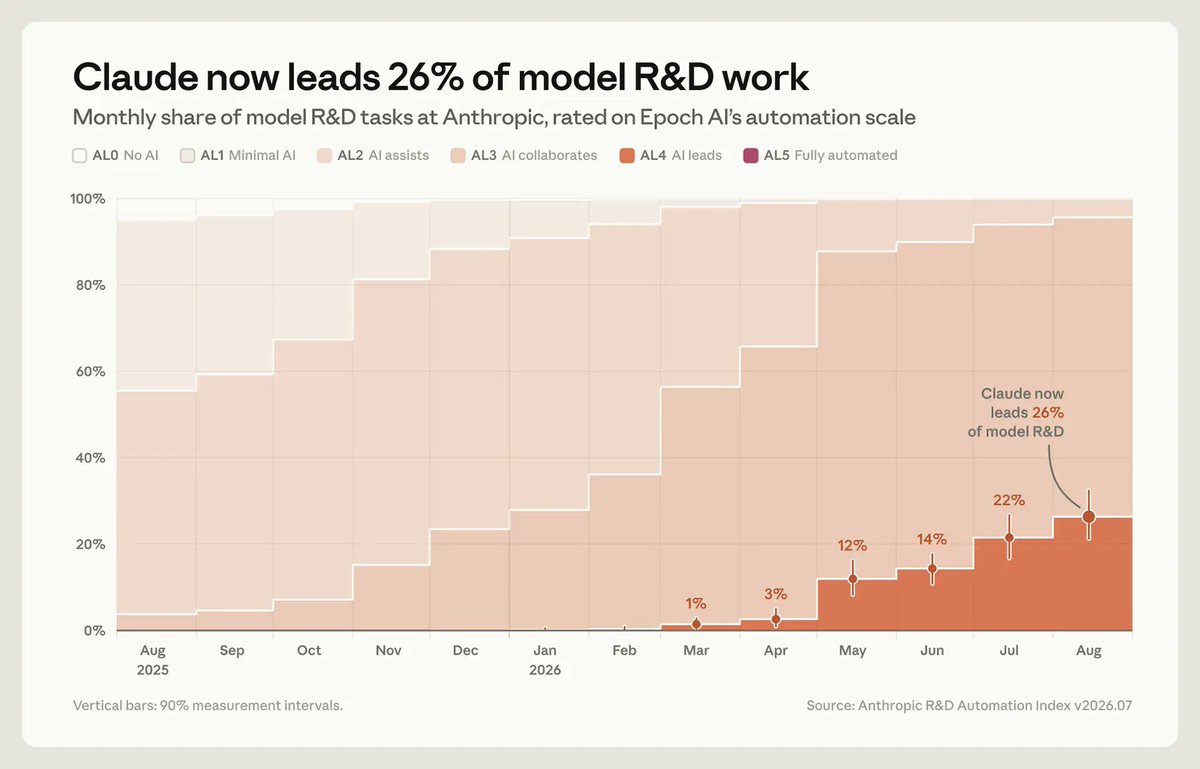
I appreciate Anthropic’s transparency in sharing this chart but unsurprisingly it has led to speculative interpretations about intelligence explosion and superintelligence. I don’t think the chart implies we’re anywhere close to either. In short, task delegation ≠ task automation ≠ process automation ≠ faster progress ≠ recursive self-improvement ≠ intelligence explosion. Source: anthropic.com/institute/meas… 1) The software engineering precedent: a year ago there were widespread hopes / fears that once AI can write ~100% of the code, software engineering output would explode (SaaSpocalypse! Everyone would create their own SaaS and dump their vendors) and that this would make software engineers obsolete. Since then, many companies and teams have basically hit that milestone, but neither of the assumptions proved true. Turns out we still need humans, and while shipping velocity has increased moderately, improvements in terms of actual outcomes for software users remain unclear. Besides, we’re still getting a better grasp on the negatives: code quality, long-term maintainability issues, and burnout. While the precedent is no guarantee, this should be our default expectation for what happens as the “Automation Level 4” line trends towards 100% — it won’t be a phase change. normaltech.ai/p/why-ai-hasnt… 2) The “production-progress paradox” is the fact that individual researchers’ productivity has been increasing while the rate of collective scientific progress has been slowing by most measures. AI exacerbates this because everyone uses the same or similar AI models, and ideas become homogenous over time. I suspect it’s too early to tell if this is going to bite companies that are plunging into AI-led research. normaltech.ai/p/could-ai-slo… Note: our own research on AI agents doing open-ended research shows limitations in creativity, judgment, and other areas. cruxevals.com/crux/can-ai-ag…. But it is possible that these could be overcome in the near future, so I’m discounting those limitations here. The production-progress paradox is a deeper issue that’s not AI-specific, though particularly applicable to AI-driven research. It’s about the fact that productivity increases are self-evident but true progress is not measurable as it happens (and only becomes clear in retrospect), so we end up optimizing for the wrong thing. 3) Let’s talk about automation level 5, which is still at 0% in Anthropic’s graph. It’s a bit unclear what Level 5 would look like, but it seems to be about full autonomy at the task level, and not the “AI builds its own successor” vision. My prediction for a while has been that even 100% task automation in most cognitive jobs won’t lead to any kind of discontinuity. youtube.com/watch?v=uiTwQG… What I expect will happen: if anything is understood well enough to be specifiable as a task, it can be handed off to AI, whereas the role of humans is entirely in the interstitial tasks — hard to formalize but still essential. So there will still be a human bottleneck. 4) This human bottleneck is a good thing and is essential for remaining in control. Humans don’t have to be in the loop on every task, but as long as there are enough touch points for oversight in the overall process, and adequate investment in improving human understanding and AI control, increasing AI capabilities doesn’t have to be bad for safety and, more broadly, collective human agency over AI. But “full RSI” is where this balance of agency can break. This kind of closed-loop process is arguably a much more important and tractable target for regulation than compute thresholds, superintelligence, or harm thresholds. I’m glad that OpenAI agrees that fully autonomous RSI may not be a good idea, in a just-released post: openai.com/index/building… “Fully autonomous RSI is not happening today, and we should not pursue it unless and until it can be done safely. Whether and how to proceed must depend on our ability to preserve human control and on informed democratic choices about the benefits and risks. Done without appropriate care and caution, RSI could result in humans losing practical control over AI development, unable to provide oversight on research processes they no longer understand.” 5) Finally, many people have written about why Recursive Self Improvement, even if achieved, won’t necessarily lead to superintelligence. Here’s my argument: normaltech.ai/p/what-will-be… The bottlenecks are external.

@PoliticalKiwi ... do we need to start publishing graphs of indicators of AI impact on the world that show no change. We could publish a lot of those. Here are some (very vibe coded) examples:


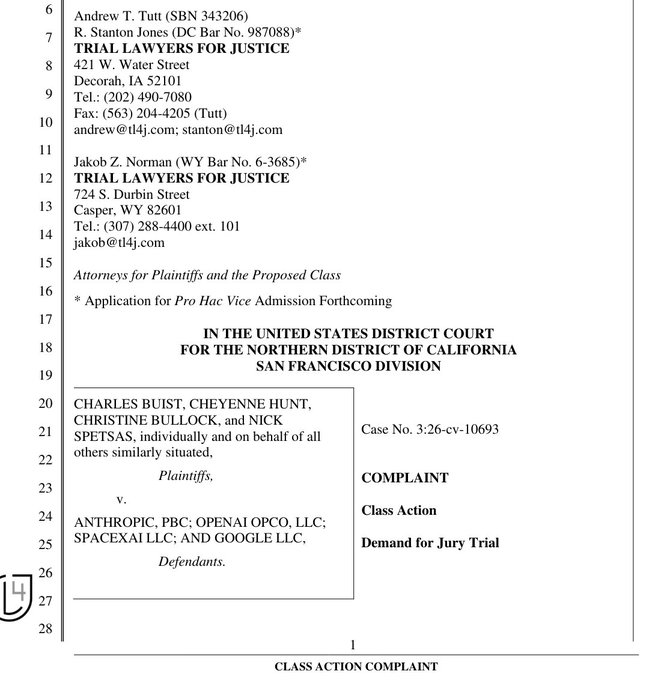
Perhaps unsurprisingly, and as many predicted, AI companies are sued under antitrust law for "pacing the frontier" efforts.

“When companies promise that they’re going to do a better job on safety, we shouldn’t have to take their word for it.” - @random_walker on @CBSNews discussing today’s AEF letter and our call for credible, independent AI evaluations. cbsnews.com/video/expert-a…


OpenAI has talked a big game about AI for cyberdefense. But when @HacktronAI broke into their internal repository and reported it, they received a bug bounty of just $6,500 because one of the vectors for the attack was "out of scope". This is atrocious. If we actually want a flood of defenders auditing these systems, companies need to take bounties more seriously. Signing letters isn't enough.

On July 25, we hacked OpenAI. Two bugs let us take over ChatGPT/Codex accounts of OpenAI employees (+some unaffiliated users) and reach connected services: Outlook, Slack, GitHub, etc. We proved it with a PR in OpenAI’s internal codebase . It took us <72h. 🧵

Today, more than 100 leading AI experts endorsed a set of minimum requirements to take seriously AI companies' recent call to embed external evaluators. These evaluators need to be genuinely independent, transparent, and represent a range of expertise areas. They also need to be guaranteed employee-level access and to be protected from retaliation for findings that make companies look bad. We welcome model developers’ recent calls for independent oversight, but it’s what they do next that matters. The labs must be accountable for ensuring these requirements are met, so that the public can have faith in the process and the outcomes. Over the past week, the AI community has debated the appropriate role of external evaluation, including who should do it and on what terms. We may not agree on everything, but there is a lot of common ground. To make embedded evaluations credible, more than 100 experts with varying backgrounds and ideas about AI risk agree in today’s letter that frontier AI developers should: 1. Guarantee embedded evaluators full editorial independence and mitigate conflicts of interest 2. Rely on multiple evaluators with differing viewpoints and areas of expertise 3. Publicly document the terms under which evaluators operate, as well as facilitating permissive publication of methods and findings 4. Shield evaluators from retaliation 5. Grant access equivalent to that of highly privileged employees There is a thriving and growing ecosystem of independent AI evaluators who are advancing this science every day – but we need aligned standards, guaranteed protections, and independent funding. That’s why we created the AI Evaluator Forum. Today we are entering our next phase. We’re launching an open call for new members, collaborators, and independent funding sources to help evaluators meet this moment and demand accountability from developers. Join us in building the evaluator ecosystem. See the public letter here: aievaluatorforum.org/initiatives/em… Learn more at aievaluatorforum.org/path-ahead

Anthropic and OpenAI need truly independent safety evaluators, experts say in public letter cnbc.com/2026/09/18/ai-…
I'm one of 100+ signatories to a public letter calling for five minimum requirements to make embedded evaluations credible, by establishing evaluator independence, protection from retaliation, and real access. ———— We, the undersigned, are encouraged to see frontier AI companies call for embedding third-party organizations to evaluate rapidly escalating AI capabilities and risks. We believe that all frontier AI companies should embed evaluators to independently assess AI risks, including evaluating the systems themselves and any significant incidents of real-world harm, as well as the companies’ training, deployment, oversight, operational, and safeguard practices. To be credible, embedded third-party evaluations must have scientific objectivity, transparency, independence, and robust protections against interference from the evaluated companies, including at least: 1. Frontier AI companies should rely on evaluators that are meaningfully independent, that maintain full editorial control, and that disclose and mitigate potential conflicts of interest. This includes at a minimum that embedded evaluation organizations should not be owned or governed by frontier AI companies, should not have other significant commercial business with them, and should not accept any form of payment or other reward contingent on the evaluator’s findings. 2. Frontier AI companies should incorporate differing viewpoints and areas of expertise, including by embedding multiple evaluation organizations across a range of priority risk areas, each with deep relevant technical expertise, as well as by allowing and encouraging evaluators to share how conclusions differ among evaluators and between evaluators and company employees. 3. Embedded evaluators should be transparent, including transparency about their methods and findings, the nature of their access, and the broader terms of the evaluation. Frontier AI companies should actively facilitate this transparency, including limiting the scope of non-disclosure agreements. They should also allow evaluators prompt and unfiltered communication with the companies’ boards and other privileged oversight bodies, as well as public release of findings and evidence, subject only to a time-limited redaction process restricted to protecting critical interests in intellectual property, customers’ sensitive information, individual privacy, security, and public safety. 4. Embedded evaluators should be shielded from retaliation from the companies they embed with for choosing reasonable evaluation methods, discovering information, or drawing conclusions that are unflattering to those companies. This includes reasonable protections against retaliatory litigation, as well as funding mechanisms that give them confidence they will remain funded even in these cases. 5. Frontier AI companies should grant embedded evaluators access equivalent to that of their own highly privileged employees for the purposes of their evaluations, and with exceptions to protect sensitive data belonging to the company’s customers and other third parties. This includes access to the same relevant systems, data, tools, and physical spaces as those available to senior internal company employees responsible for carrying out comparable risk assessments, as well as candid and direct one-on-one communication with relevant staff. This list is not comprehensive, and conditions like these to ensure credible evaluations should be increasingly standardized, codified, and enforced. One example is the set of terms defined in the AEF-1 standard, which has already seen early adoption, but far more work will be necessary to ensure that embedded evaluators are effective and meaningful. Embedded evaluations cannot address all oversight needs and should be treated as a complement to, rather than a replacement for, broader efforts by frontier AI companies to expand external oversight, including greater public transparency and additional, broader forms of access for independent researchers. ———— Full letter with links and signatures: aievaluatorforum.org/initiatives/em… I'm grateful to the AI Evaluator Forum (@aievalforum) for organizing this.
A post on risk management in the marketplace of ideas x.com/random_walker/…
Back in grad school, when I realized how the “marketplace of ideas” actually works, it felt like I’d found the cheat codes to a research career. Today, this is the most important stuff I teach students, more than anything related to the substance of our research. A quick
A thread on how elite research universities are a tournament system: x.com/random_walker/…
Professors at top universities are lottery winners, but rarely acknowledge the role of luck in their success. Be skeptical when they give you advice suggesting that the path they took is a repeatable one. If you aspire to an academic research career, have a backup plan.
Students sometimes tell me they’re applying to PhD programs as a backup in case they don’t get a job as a software engineer or whatever. I get that the job market is rough but this is like saying you’ll start a company if you don’t find a job. Like starting a company, a PhD is the far *more* risky path and requires incredible grit over a long period. It isn’t just that you might realize after a couple of years that a PhD isn’t for you. The bigger risk is that you complete a PhD but end up overqualified on a niche topic after having spent 5-7 years on it. The research world, like acting, sports, music, or book publishing, is set up as a tournament, with lots of extremely competent people competing for a small number of highly desirable slots. We can talk about whether that’s fair and whether it’s inherent or can be changed, but as a professor I feel the least I can do is loudly and repeatedly warn people about what they’re getting into.
This is one of the central points in my ICML keynote, with a lot of detail — see part 2. normaltech.ai/p/what-will-be… Note: I take RSI seriously! One of our big empirical projects is evaluating agents' ability to do open-ended AI research. But it doesn't imply much about superintelligence, labor displacement, or doom.

We frequently conflate RSI with a fast-takeoff to super-intelligence (ASI). They are not the same. RSI means a model can improve on itself. That does not mean that it can do so more at each iteration, which is what would be required for a singularity. Far more likely that
Over 2 years ago @sayashk and I wrote a detailed deconstruction of p(doom) and argued that its primary function is to launder vague, evidence-free intuitions and fears through a facade of quantification. It remains 100% relevant today. normaltech.ai/p/ai-existenti…

There is a strange laundering of this number. It was floated by Anthropic employees without public justification. Then mathematicians pick it up and now it is attributed to their judgment. It’s fine to survey AI practitioners, but posts like this are a bad epistemic practice.

I think we have pretty good reason to accept that “AGI” is a meaningless term and a useless idea which should be retired. No one ever managed to agree on how you define AGI, but AI capabilities have improved enough to stress out Fields medalists, while the frontier is so “jagged” that regular users hate AI writing, and @random_walker was completely right about there being no discontinuity.

When forecasting about AI (or any topic really) you should be skeptical of sharp discontinuities. People used to think we'd "achieve AGI" and everything would suddenly change. Now that we're closer the concept seems very fuzzy. I view recursive self-improvement the same way.
I've been using Pangram's Gmail inbox labeler for about two months now. It's been pretty huge to be able to see cold emails labeled as AI and use this info to inform how I want to engage. With this feature, there was a big discussion internally about privacy. Zero data retention (ZDR) -- where Pangram doesn't store the result after processing -- is a policy typically reserved for enterprise customers. However, since email data is much more sensitive, we ended up deciding to turn on ZDR for all email inbox scans. No email inbox data will be retained by Pangram, and this applies equally to everybody. The other really important thing here was to give users a choice of what happens to their email. My preference today is to simply label AI emails but leave them in my inbox. This may shift In the future if AI emails ramp up in volume, so we have the option to make fully AI emails skip the inbox or go straight to spam. Please try it out and let me know any feedback you may have!

Yes. Bio-risk exists today, from zoonotic outbreaks, accidents, and bio-terror. We know a great many things we can and should do to increase societal resilience, and have done almost none. Independent of how AI changes the risk, we should be doing the basics here. 1. Pathogen detection in waste streams, water supplies, and perhaps even indoor air. 2. Proactive design of template vaccines for every known virus family. 3. Pre-build vaccine manufacturing capability to have on standby. 4. Physical countermeasures: UV in the HVACs of all large buildings, airports, etc..; Stockpiling PPE. 5. R&D into new approaches like PCANS and other techniques that block viral transmission. These are all no-regret bio-defense policies that increase our resilience to natural pandemics, lab leaks, or intentional bio-attacks (AI augmented or not). Defense in depth.

Your position on AI should not affect your support for biodefense measures. Even if you do not think AI will make a difference, the problem is urgent today.
Nihar Shah did a heroic experiment for TMLR: he spent 20-25 hours over two weeks interviewing authors of seemingly low-quality submissions about their own papers. He confirmed what we all suspected: people submitting these papers have *no idea* what is going on in them.

TMLR has faced a deluge of submissions, necessitating stricter desk rejection policies due to limited reviewer capacity Co-EiC Nihar Shah reached out to authors of 10 papers slated for desk reject. Could they answer questions about their *own* submission? medium.com/@TmlrOrg/askin…
@MackenZ_arnold @sayashk Incredibly useful feedback! We'll chew on these. Thank you so much.

My toxic trait is loving even-handed, ecumenical takes. And @sayashk and @random_walker supply them in spades. A few thoughts and reactions: (1) This is what virtue looks like. Actual humility, a deep appreciation for uncertainty, openly updating their beliefs, and finding actionable areas of common ground. (2) Best line in the whole piece: “we do not need consensus on worldviews to have agreement on policy” — I’d put it even more strongly, such consensus is not possible; we have to work within that constraint. (3) Luckily many policies are robust to different assumptions. Their policy recs hold up, and that’s largely because they choose the right focus areas—Managing uncertainty and building resilience. I wrote more on the original policy recs in another post; I’ll link in the comments. (4) It’s striking how much their policy recs parallel the major AI policy proposals to date (including newer additions like embedded auditing and additional emphasis on liability reform). That still surprises many. (5) Despite these policies being chosen specifically for their robustness, most are hotly contested when actually proposed. I think the authors ought to ask why policies they’ve selected specifically for being agreeable no-brainers have not gotten traction amongst policymakers who like and cite their work. (6) I want to challenge the authors to consider whether they have unique leverage in unsticking some of these policies, and to act on it. (7) I do wonder if the AI as normal tech meme obscures the policy recs and encourages misreadings. I’d be curious for the authors to at least try writing some work that leads with the policy recs, and presents them in pithier form. The authors recognize this issue: “we are often mistaken as downplaying Al risks, though we have repeatedly clarified that that is not our position. Still, it is important for us to be explicit about how much urgency there is.” — but even now, I don’t think the urgency comes through to the average skim reader. (7) I’d like to see them incorporate ~adaptation/flexibility into their policy recs. Uncertainty = surprises and updates, and so many policies are too rigid to adapt. Maybe I’m just being a lawyer, but I’d like to see them stump for rulemaking authority, updating mechanisms for standards, etc. This is one of the most frequent errors in current policymaking and it seems very consistent with their thesis. (8) I think the authors, at times, underestimate how widely their takes are held amongst people they lump into the “AI Safety” category. I think a much larger portion of those folks agree with the diagnosis that the Hugging Face incident displayed large cultural and procedural safety lapses and an under-investment in control. There are legitimate disagreements, but I see the authors reaction as closer to the modal reaction than they seem to think. (9) I see this policy portfolio as highly overlapped with that of @law_ai_, and the emphasis on robustness to different assumptions has strong overlaps with both my own way of thinking and Radical Optionality radical-optionality.ai

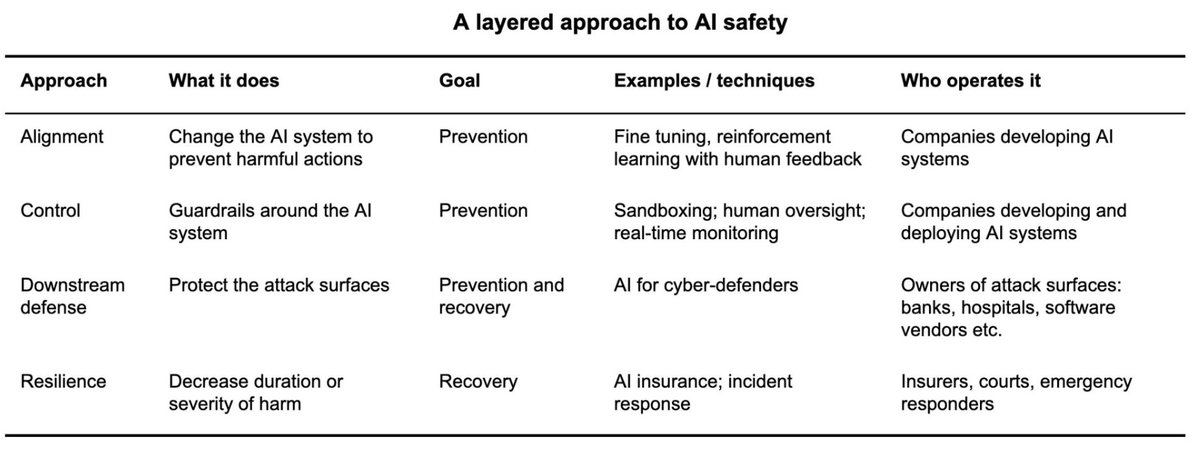
What does it mean to pace the frontier? Over the last month, @random_walker and I have analyzed the loss-of-control incidents at AI companies to understand what technical and policy interventions can improve safety and what companies should do to pace the frontier. The result
AI flooding of administrative agencies and trial courts is a huge problem, and is driving adjudicators to use AI tools in response. Slop for slop, and the whole world goes blind.
Floods might be the most under-recognized AI harm. By AI flood I mean overwhelming communication channels, forcing them to shut down or imposing a huge time cost on recipients. Three reasons we don’t talk about them much: 1) There are 50+ kinds of floods, so it registers as 50

Gautam Kamath @thegautamkamath
68K Followers 627 Following Assistant Prof of CS @NYU_Courant. Co-EiC @TmlrOrg. I lead @TheSalonML.
Shreya Shankar @sh_reya
56K Followers 807 Following Incoming assistant professor @CSDatCMU @CMUDB. Putting LLMs in databases and BI tools. Created https://t.co/PmuOqAXVgS and https://t.co/8MQt4na2cj.
Dan Roy @roydanroy
68K Followers 2K Following @Google DeepMind. On leave, Canada CIFAR AI Chair and Former Research Director, @VectorInst. Professor, @UofT (Statistics/CS). Views are my own.
Kristian Lum @KLdivergence
24K Followers 1K Following Research Scientist at Google DeepMind | @FAccTConference OG | Past Twitter META, @hrdag & UPenn, UChicago faculty |
Deb Raji @rajiinio
31K Followers 559 Following AI accountability, audits & eval. Keen on participation & practical outcomes. CS PhDing @UCBerkeley. forever @AJLUnited, @hashtag_include ✝️
Zachary Lipton @zacharylipton
69K Followers 2K Following Professor: CMU/@acmi_lab, Cofounder: @AbridgeHQ, Creator: @d2l_ai & https://t.co/QQt98VNLUp, Relapsing 🎷
Thomas G. Dietterich @tdietterich
64K Followers 659 Following University Distinguished Professor (Emeritus), Oregon State Univ.; Former President, AAAI; ArXiv Editor in Chief & Chair CS Section
Danish Pruthi @danish037
14K Followers 794 Following Faculty at the Indian Institute of Science, Bangalore. PhD from @LTIatCMU.
Prof. Anima Anandkuma... @AnimaAnandkumar
46K Followers 2K Following AI+Science, Co-Founder @accelerated_u, Bren Professor @caltech, Time100, Fmr Sr Director of #AI research @nvidia Fmr Principal Scientist @awscloud
Boaz Barak @boazbaraktcs
36K Followers 867 Following Computer Scientist. See also https://t.co/EXWR5k634w . @harvard @openai opinions my own.
Aaron Roth @Aaroth
13K Followers 669 Following CS prof at Penn. Amazon Scholar at AWS. Author of The Ethical Algorithm (w/ Michael Kearns). I study machine learning, privacy, game theory, and uncertainty.
Subbarao Kambhampati ... @rao2z
28K Followers 67 Following AI researcher & teacher @SCAI_ASU. Former President of @RealAAAI; Chair of @AAAS Sec T. Here to tweach #AI. YouTube Ch: https://t.co/4beUPOmf6y Bsky: rao2z
Benedikt Bünz ☕️ @benediktbuenz
13K Followers 787 Following Chief Scientist @espressosys ☕️ Professor Computer Science @NYU_Courant
Gaurav Aggarwal @fooobar
16K Followers 1K Following Chief AI Scientist@Reliance Intelligence, Volunteer@iSPIRT. Visiting Faculty @ ISB, 2x founder, Prev: Google Research, Fashiate, Yahoo Labs. Views personal!

Naomi Saphra @nsaphra
11K Followers 1K Following Waiting on a robot body. All opinions are universal and held by both employers and family. Now a dedicated grok hate account. (I post more elsewhere.)
Dr. Gabriela Zanfir-F... @gabrielazanfir
17K Followers 1K Following Data Protection Geek; PhD in #EUDataP; https://t.co/ahAxz7dVsT; Co-author of the Big GDPR OUP Commentary; 🇷🇴 🇪🇺 🇺🇸 Opinions all mine
Sebastien Bubeck @SebastienBubeck
93K Followers 2K Following I work on AI at OpenAI. Former VP AI and Distinguished Scientist at Microsoft.
billions of packets @justinesherry
10K Followers 2K Following Computer person. I like middleboxes, systems, and Internets. Assistant Prof @ AS9. she/her, [email protected], @[email protected], 🇺🇲❤️🇵🇹
Lilian Edwards @lilianedwards
10K Followers 2K Following Director, Pangloss Consulting and Emerita Prof at @NCLLawSchool. Honorary Professor, Glasgow/@CREATe. AI/GDPR nerd. RTs not endorse. [email protected]
Aaditya Mathur @aaditya_mathur1
2 Followers 10 Following Building @fallyai - personal intelligence that catches what you forget, understands what you need, and takes action before you ask.
Michael Rose @mrose00
167 Followers 6K Following
Oliver Gode @OliverGode
3 Followers 33 Following
Saptarishi @rishhhh47
2 Followers 42 Following website under maintenance, visit https://t.co/wzgZSmsHPa in the meantime

Parth Sarker @Parth_sarker
32 Followers 1K Following
Draniarb @Draniarb89
0 Followers 81 Following
Alex Goldman @AGoldmund
104K Followers 4K Following Journalist. host of @hyperfixedpod. co-host of @amityvilleville. used to host @replyall. the P on my hat is for Perfect Sweet Boy
Graeme Wood @gcaw
43K Followers 5K Following Staff writer, @TheAtlantic. Lecturer, @Yale political science. Formerly: @newrepublic, @DeutschePostDHL
Mikaela Beardsley @storymattersMB
37 Followers 158 Following
Hassan @HALAS_Syed
0 Followers 24 Following
ψευδοπροφη�... @oasis4ever24
50 Followers 234 Following
Celeste @AAnna2470049763
3 Followers 109 Following
Marietta GBAGUIDI @GBAGUIDI_Houefa
116 Followers 852 Following Agronomist, Content Writer, Data Analyst.
AI Doomer Academy @AiDoomerAcademy
11 Followers 245 Following Tag us when you find a doomer. We print diplomas.
Dan Ancona @DanAncona
4K Followers 5K Following Standing athwart history yelling wtf, can we please get moving again. Deep voter research for AWARD WINNING left and Dem ads.
Jelle van Geuns @jgeuns
83 Followers 770 Following Founder and CEO at Cirra AI. Building AI that lets enterprise software manage itself.
Shaun Campbell @lepreshaun89
0 Followers 48 Following Made in Scotland, adopted by Canada. Full-time coder, part-time explorer.

Jon Edward @kobedryman
79 Followers 405 Following the Savannah Bananas are Hamilton for conservatives

Wes Sternberg @wes_sternberg
67 Followers 997 Following I play an Urban Planner on television. Doughy/Balding/16 Year Old Minivan
EngineerTrades @AnoopJce
11 Followers 17 Following
Maxime Quéro @maxime_quero
5 Followers 34 Following
Michael Shapiro @mpshapiro
4K Followers 3K Following Noah & Ellie’s Dad. Husband to Jess. MD @Blackstone. Was @USDOT & White House Infra Task Force, @sidewalkinfra, Econ policy @Whitehouse
Rod Bee @RodToo
33 Followers 791 Following
slugella @slugell
177 Followers 2K Following cybersecurity / medieval history fan girl I also make art
Ryan of NYC @ryanofnyc
57 Followers 2K Following
Jim Williamson @JamesWilli83381
176 Followers 628 Following Interested in history, science and politics. Biomedical researcher exploring how cognitive and physical states affect motor behavior. Avid pickleball player.
Angus Roven @angusroven
123 Followers 1K Following
Julian Graef @JulianGraef1
49 Followers 2K Following
A. Taylor @FunFunFun120
1 Followers 32 Following
A A @burdockrutabaga
8 Followers 525 Following
Eric Florenzano @ericflo
7K Followers 2K Following Building assistance! Used to make AR/VR. Before that made mobile apps. Before that made web things. People first, then products, systems, data. he/him
Steve Endow @moresteveendow
255 Followers 283 Following More Steve Endow! Coffee. Palm trees. Sunshine. BBQ. El Salvador 🇸🇻. Work stuff: @steveendow
Vivienne @vivienneH2O
87 Followers 2K Following

amoylan @amoylan
2K Followers 1K Following Husband, father, fighter for smarter policy. Boxing, University of Michigan, F1 fan. Once aptly described as “grumpy happy.”
macinatorduke @macinatorduke
1 Followers 2K Following


Jimmy Li @JimmyLi281740
3 Followers 26 Following


Yaroslav @skidarkx
0 Followers 15 Following
sayna @asdsayna
1 Followers 33 Following

Shreya Shankar @sh_reya
56K Followers 807 Following Incoming assistant professor @CSDatCMU @CMUDB. Putting LLMs in databases and BI tools. Created https://t.co/PmuOqAXVgS and https://t.co/8MQt4na2cj.
Kristian Lum @KLdivergence
24K Followers 1K Following Research Scientist at Google DeepMind | @FAccTConference OG | Past Twitter META, @hrdag & UPenn, UChicago faculty |
Deb Raji @rajiinio
31K Followers 559 Following AI accountability, audits & eval. Keen on participation & practical outcomes. CS PhDing @UCBerkeley. forever @AJLUnited, @hashtag_include ✝️
Zachary Lipton @zacharylipton
69K Followers 2K Following Professor: CMU/@acmi_lab, Cofounder: @AbridgeHQ, Creator: @d2l_ai & https://t.co/QQt98VNLUp, Relapsing 🎷
Thomas G. Dietterich @tdietterich
64K Followers 659 Following University Distinguished Professor (Emeritus), Oregon State Univ.; Former President, AAAI; ArXiv Editor in Chief & Chair CS Section
Prof. Anima Anandkuma... @AnimaAnandkumar
46K Followers 2K Following AI+Science, Co-Founder @accelerated_u, Bren Professor @caltech, Time100, Fmr Sr Director of #AI research @nvidia Fmr Principal Scientist @awscloud
Boaz Barak @boazbaraktcs
36K Followers 867 Following Computer Scientist. See also https://t.co/EXWR5k634w . @harvard @openai opinions my own.
Aaron Roth @Aaroth
13K Followers 669 Following CS prof at Penn. Amazon Scholar at AWS. Author of The Ethical Algorithm (w/ Michael Kearns). I study machine learning, privacy, game theory, and uncertainty.
Subbarao Kambhampati ... @rao2z
28K Followers 67 Following AI researcher & teacher @SCAI_ASU. Former President of @RealAAAI; Chair of @AAAS Sec T. Here to tweach #AI. YouTube Ch: https://t.co/4beUPOmf6y Bsky: rao2z
Sebastien Bubeck @SebastienBubeck
93K Followers 2K Following I work on AI at OpenAI. Former VP AI and Distinguished Scientist at Microsoft.
Fernando Diaz @841io
6K Followers 1K Following Associate Professor, CMU. Researcher, Google. Evaluation and design of information retrieval and recommendation systems, including their societal impacts.
Suresh Venkatasubrama... @geomblog
12K Followers 916 Following AI Bill of Rights coauthor. Prof@BrownUniversity. Former tech advisor to President Biden @WHOSTP. He/him/his. Tweets my own.
Nicolas Papernot @NicolasPapernot
11K Followers 631 Following Security and Privacy of Machine Learning @Uoft @VectorInst @Google 🇫🇷🇪🇺🇨🇦 Co-author https://t.co/VJF39DQPCu; @CentraleLyon + @PSUEngineering alumnus. Opinions mine
Jenn Wortman Vaughan @jennwvaughan
10K Followers 567 Following Sr. Principal Research Manager, Microsoft Research, NYC. Machine learning transparency, intelligibility, fairness, evaluation.
Emma Pierson @2plus2make5
10K Followers 813 Following Assistant prof @Berkeley_EECS, core faculty @UCJointCPH. Developing ML methods to study health & inequality. https://t.co/ok5Ap93rre
Ryan Calo @rcalo
23K Followers 438 Following Prof @UWSchoolofLaw @UW_iSchool @UWCSE | Co-Founder @TechPolicyLab @UWCIP | Privacy @WorldBank | Alum @StanfordCIS @CovingtonLLP | Bluesky @rcalo
Laura Edelson @LauraEdelson2
11K Followers 454 Following Assistant Professor, Northeastern University Co-Director, C4D Formerly: Chief Technologist, DoJ Antitrust Division, DOJ Civil Rights Division

𝙷𝚒𝚖𝚊 𝙻... @hima_lakkaraju
16K Followers 1K Following AI Professor @Harvard; Senior Staff Research Scientist @GoogleAI; @trustworthy_ml #AI #XAI; AI PhD from Stanford; Sloan/Kavli Fellow, MIT TR #35Under35
NYC Tw*tterati @prisonculture
172K Followers 3K Following Founder (@sojourn4justice) & Project NIA (@projectnia) sunsetted in 2023 / Co-Founder (@interruptcrim), (@ChiFreeSchool) & (@survivepunish)
Anka Reuel | @ankareu... @AnkaReuel
5K Followers 1K Following Incoming Assistant Prof @ Harvard (Public Policy & Computer Science) | CS PhD Candidate @ Stanford | Former Vice-Chair GPAI CoP @ European Commission
Carter Leffen @carterleffen
2K Followers 1K Following We are here to learn, make a difference, and have fun. - Deming | my opinions are my own.

Charles Foster @CFGeek
4K Followers 623 Following On policy @METR_Evals 🧪 “excels at reasoning & tool use” 🪄 CoI disclosures on my Substack “About” page.
chrisrohlf @chrisrohlf
12K Followers 945 Following Waging algorithmic warfare since 2003. Engineer, Researcher. Non-Resident Research Fellow @CSETGeorgetown CyberAI
Abi Olvera @Abi0lvera
2K Followers 1K Following I write about AI and progress. I lead DC Abundance and work on resilience. https://t.co/tLN9OZgzDd Emergent Ventures grantee. Ex-diplomat. Views my own.

Joe Weisenthal @TheStalwart
449K Followers 7K Following One half of Bloomberg's Odd Lots Podcast. One quarter of Light Sweet Crude.
The Burning Glass Ins... @TheBGInstitute
592 Followers 86 Following Mobility, opportunity, and equity through skills

Jesús Fernández-Vil... @JesusFerna7026
82K Followers 175 Following Howard Marks Presidential Professor of Economics at @Penn and Senior Fellow at @AEI. Demographics, AI & macro. All opinions are my own.
Michael R. Strain @MichaelRStrain
25K Followers 544 Following Director of Economic Policy Studies and Senior Fellow at @AEI. Professor of Practice at @Georgetown. Contributing Columnist for the @FT.
Center for Technology... @techstatecraft
473 Followers 7 Following CTS is a non-partisan policy research initiative solving unexplored AI policy challenges through technical, forward-looking research.
Pax Machina @PaxMachinaMag
3K Followers 56 Following Proposals and debate for institutions in a world with powerful AI.

Reliability Index @reliability_idx
3 Followers 0 Following
Qiushi Journal @QiushiJournal
16K Followers 463 Following Qiushi Journal provides you with authoritative theory and policy of China.
Divya Siddarth @divyasiddarth
7K Followers 992 Following democracy + alignment @AnthropicAI, cofounder + collective intelligence accelerationist @collect_intel
Abhishek Nagaraj @abhishekn
13K Followers 6K Following Associate Prof @berkeleyhaas, NBER RA. Dad to 2 girls. he/him/his. Interested in using tech, AI and data to drive progress. Using ideas as my maps.

Sanmi Koyejo @sanmikoyejo
4K Followers 108 Following I lead @stai_research at Stanford. Co-founder @VirtueAI_co
Ava Iranmanesh @Avameanssong
14 Followers 91 Following CS @ Penn State | AI Safety, Interpretebility, alignment
Eve Fleisig @enfleisig
793 Followers 480 Following Postdoc fellow @PrincetonCITP | PhD @Berkeley_EECS | Princeton ‘21 | NLP + AI ethics | bilingüe 🇦🇷
Alexander Wan @alexwan55
757 Followers 2K Following Incoming Stanford CS PhD; Formerly @BerkeleyML @BerkeleyNLP; https://t.co/YqhKUqpSBW


Hayoung Jung @hayounggjung
375 Followers 337 Following PhD @PrincetonCS @PrincetonCITP. Research Intern @AbridgeHQ. Previously @uwcse @uw_ischool @uwnlp. Views reflect my own.

Seema Amble @seema_amble
21K Followers 3K Following partner @a16z // investing in b2b AI companies // strong opinions on 🍕
Peter John Lambert @pj_lambert
1K Followers 867 Following @LSEEcon @warwickecon Economist studying companies, industries, jobs, technology, and growth. 🇦🇺🇨🇦 Website: https://t.co/m0vapuB3xE RT≠Endorsement.
Brad Smith @BradSmi
109K Followers 915 Following Vice Chair and President @Microsoft, Co-author of #ToolsAndWeapons. Host of Tools And Weapons podcast. Husband. Dad. Proud native of Appleton, Wisconsin.
Hilke Schellmann @HilkeSchellmann
2K Followers 1K Following Author of "The Algorithm" | Emmy-award winning Reporter | NYU Prof | @WSJ, @Frontline PBS @Columbia J-School alumn | 🏂 | website: https://t.co/PSNcPaFyo2
Stanford Digital Econ... @DigEconLab
12K Followers 311 Following Bringing together the world's best minds, whether human or machine, to study how digital technologies can transform the economy @StanfordHAI Director: @ErikBryn
Chad Jones @ChadJonesEcon
17K Followers 964 Following Economics professor at Stanford GSB working on AI and economic growth.

Will Rinehart @WillRinehart
8K Followers 5K Following Senior Fellow @AEI. AI policy, regulatory statecraft & attention markets. Husband to @CharDreizen. Midwesterner at heart.
CRUX Evals @cruxevals
9 Followers 0 Following
Tyna Eloundou @ThankYourNiceAI
2K Followers 413 Following
Cozmin Ududec @CUdudec
594 Followers 2K Following @AISecurityInst Science of Evaluation lead. Ex quantum foundationalist.
Michiel Bakker @bakkermichiel
6K Followers 1K Following LLMs and AI alignment. Assistant Prof @MIT. Ex @GoogleDeepMind @GeminiApp.
Kyle Chan @kyleichan
51K Followers 2K Following Fellow at @BrookingsInst China tech: AI, chips, robotics, EVs, clean energy High Capacity newsletter & podcast: https://t.co/D6k0b2dJgZ
Jonathan Haidt @JonHaidt
470K Followers 2K Following Social psychologist at NYU-Stern, working to roll back the phone-based childhood. Please visit https://t.co/ZjBuXdDYYg & https://t.co/7aVAmOTTcT
David Oks @davideoks
5K Followers 742 Following I do stuff @OpenAI, I occasionally write essays at https://t.co/fTZS8ficcu
Micah Carroll @MicahCarroll
8K Followers 812 Following RSI Preparedness lead @openai Prev @berkeley_ai /w @ancadianadragan & Stuart Russell
Saffron Huang @saffronhuang
10K Followers 1K Following how shall we live together? societal impacts researcher @AnthropicAI • ex @GoogleDeepMind @AISecurityInst⋅ @collect_intel co-founder • views mine
Patrick McKenzie @patio11
200K Followers 810 Following I work for the Internet and am an advisor to @stripe. These are my personal opinions unless otherwise noted.

Andy Masley @AndyMasley
18K Followers 2K Following When the going gets weird the weird turn pro. Researching and writing on AI and other topics from a broadly EA perspective. On a grant from CG.You might like