Datadog Developers @datadogdevs
The developer side of Datadog. Service status: https://t.co/5hNCi33OVR datadog.com Joined March 2026-
Tweets501
-
Followers365
-
Following1
-
Likes303
@webaficionado @bot @plainsupport @linear @datadoghq very cool to see @datadoghq giving @bot the production context it needs to investigate issues before handing them off 💯

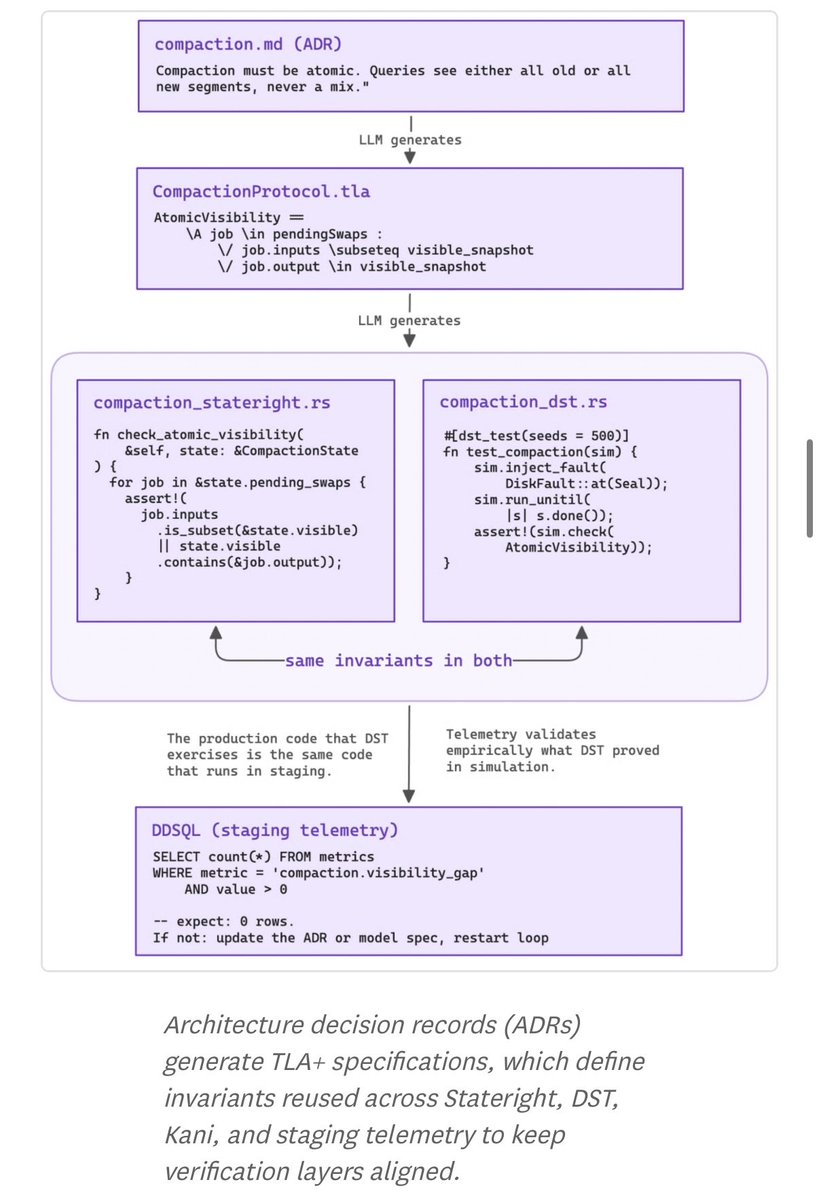
This was an older post from me, @Keleesssss and few others at @datadoghq wrote earlier this year where we built multiple low level systems with opus 4.5 using a harness that involved formal verification (TLA+), deterministic simulation (DST) and Datadog observability working together in a closed loop. If anyone is interested in comparing notes, blog link in comment.

I used Opus 5.5 to formally verify the Claude Agent SDK using Lean. A couple short prompts = 16 PRs fixing various bugs and race conditions. Video attached. TLA+ also works well. I sometimes combine Lean and TLA+ to look for issues around data flow, concurrency, and state mgmt.
There isn’t one definition of “good enough” for an AI application. At @datadoghq's SF Summit, Han Lee of @Moodys put it simply: “It depends.” Sometimes success is deterministic: did the test pass? Sometimes it’s harder: did the customer actually get a good resolution? Tony Hernandez of @JLL added another dimension: risk. A lower-risk application with a human in the loop can tolerate a different standard. A highly autonomous system? “That’s a completely different ballgame.” Start with: what happens if this gets it wrong? Then set the bar accordingly.

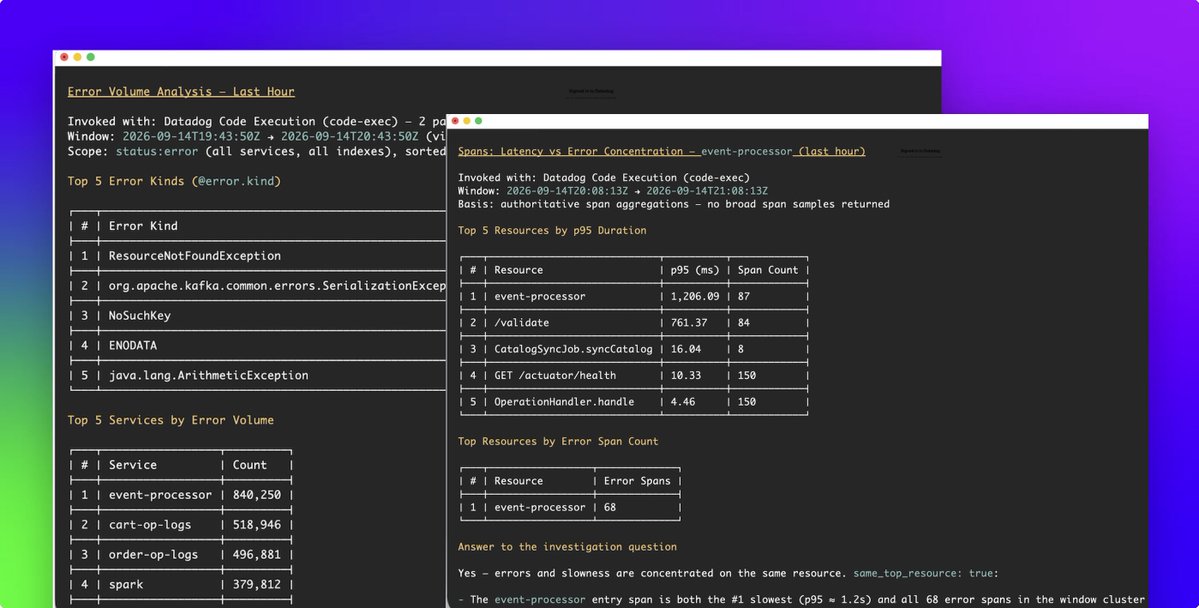
AI agents can now investigate smarter — and spend less doing it. Today at #DatadogSummit San Francisco, we announced the GA of Code Execution for the Datadog MCP Server: more accurate answers with 73% fewer input tokens and 40% fewer tool calls. See how it works: bit.ly/4jjEsxA
The hard part of using AI to dismantle a monolith isn’t getting it to write the code. It’s proving the code is correct. At @datadoghq's Summit SF, Sr Software Engineer Nick I. shared how a team of three is using agents to migrate routes out of Dogweb, our ~2,000-route Python monolith - recently crossing 100 routes migrated in a month. His advice for agentic engineering workflows: “How do I know that this code is correct without having to read it line by line?” Start with the proof you’d need to approve the code, then work backwards to how an agent can gather that proof safely.

@daytonaio @datadoghq *sips (boba) tea*

Happy to partner with @datadoghq - @datadogdevs for Boba & Build Night: Infra, ML, and App Dev in the Observability Age during #SFTechWeek! Join us on October 8 for an evening of building, learning, and connecting with the SF tech community. RSVP on this link: partiful.com/e/SiEiTLuTE847…

You can’t debug an AI agent in isolation. You have to debug the system around it. At @datadoghq's Summit SF, @figma's Sr SWE Scott Gonyea explained that the agent’s execution record - prompts, model responses, tool calls and outputs - got the team pretty far when investigating failures. But not far enough. “When you’re investigating a user issue, you also want to know what’s happening in the browser session, what’s happening in the backend, in the requests and the logs.” Because the failure might not be the model. It could be a browser issue, backend service, request, rate limit, schema change, or another dependency the agent relies on. That’s why Figma built AI-Trace to bring that context together for engineers. As AI products become more agentic, debugging them starts to look less like inspecting a conversation and more like investigating a distributed system.

“Now we’re moving to the next level where AI is more persistent, more independent, and doing more things.” - @embirico from @OpenAI The next shift: agents that don’t just assist a user, but run as themselves against well-defined tasks the company can measure. — @datadoghq Summit SF
One useful pattern for agent adoption: Individual experimentation → repeated workload → managed agent → measurable outcome. @OpenAI's @embirico pointed to testing, code review, incident response, and post-deploy validation as examples of work that can move from personal productivity into measurable automation. Live from @datadoghq's SF Summit
What made Codex take off? @OpenAI's @embirico broke it into 3 pieces: - The model. - The harness around the model. - The user interface that sets the right expectations. A useful framework for anyone building AI products. @datadoghq SF Summit
“We’ve always been, at @OpenAI, basically value maxers, not token maxers.” @embirico on why more AI usage doesn’t necessarily mean more value - in conversation with @datadoghq CPO Yanbing Li at SF Summit.

@amymzhou @datadoghq valid reason to break the hiatus 💯
emerging from a 3 year (!) hiatus to share this. Code Execution is now GA in the @datadoghq MCP Server: 73% fewer input tokens, 40% fewer tool calls, and more accurate answers from every model we tested. run, don't walk! --> datadoghq.com/blog/datadog-c…
“Latest advances with our MCP is the ability to execute code. We give your agent a sandbox, with all the context Datadog has, to build the verification loop.” - Michael Whetten, Sr VP Product @datadoghq
“With Agent Console, see all the AI that’s deployed and attach it to spend, to agents and AI infrastructure, because you have to guarantee your return on investment. Not only track money spent, but tie it to work done.” - Michael Whetten, @datadoghq

Your logs already have the answers. Tap to Parse just makes them searchable — one click, no regex, no waiting. Available now in Log Explorer and Log Pipelines, and upon request in Observability Pipelines. Read our blog to learn more: bit.ly/4yMKf39

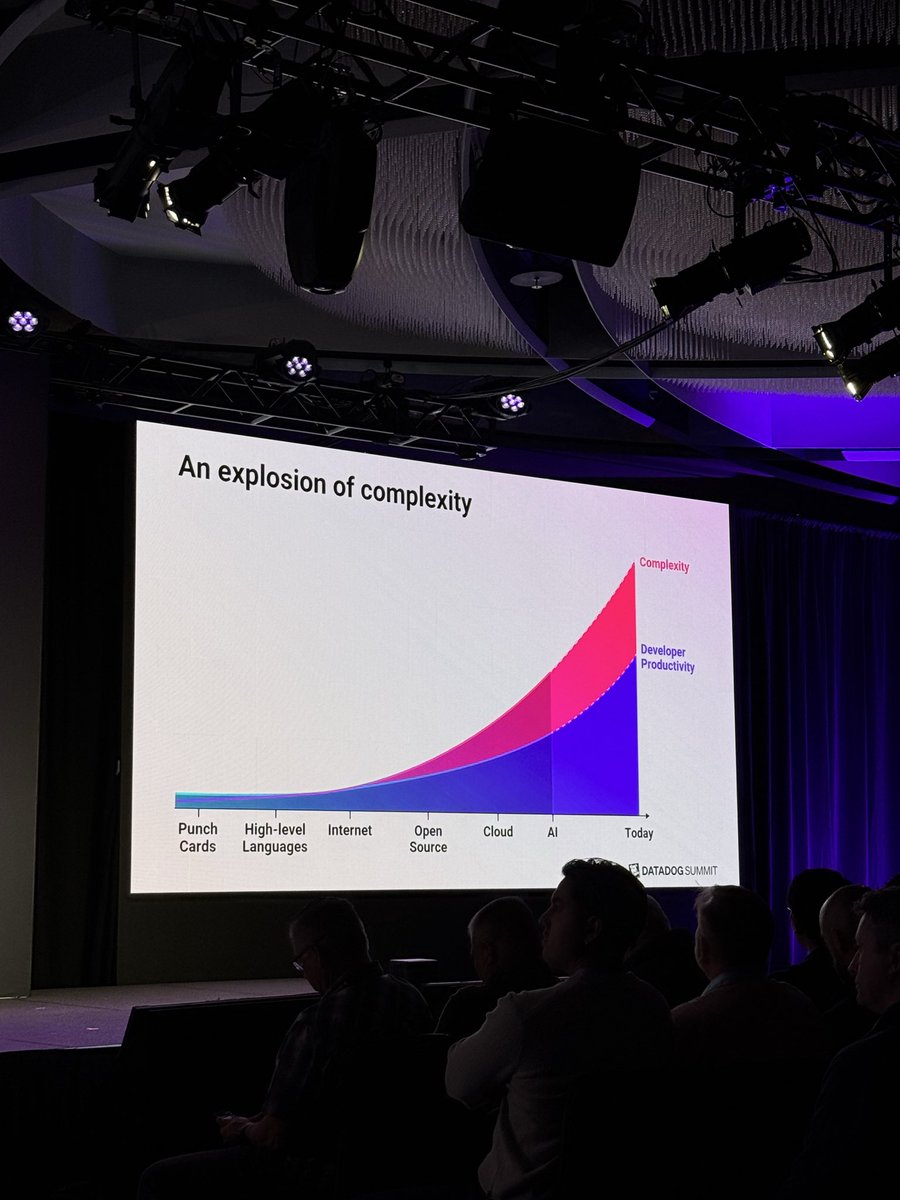
“Building things has never been easier but our jobs, as builders, are not getting simpler. Datadog was built to solve complexity and adapt to changing technology shifts.” - Adam Blitzer @datadoghq

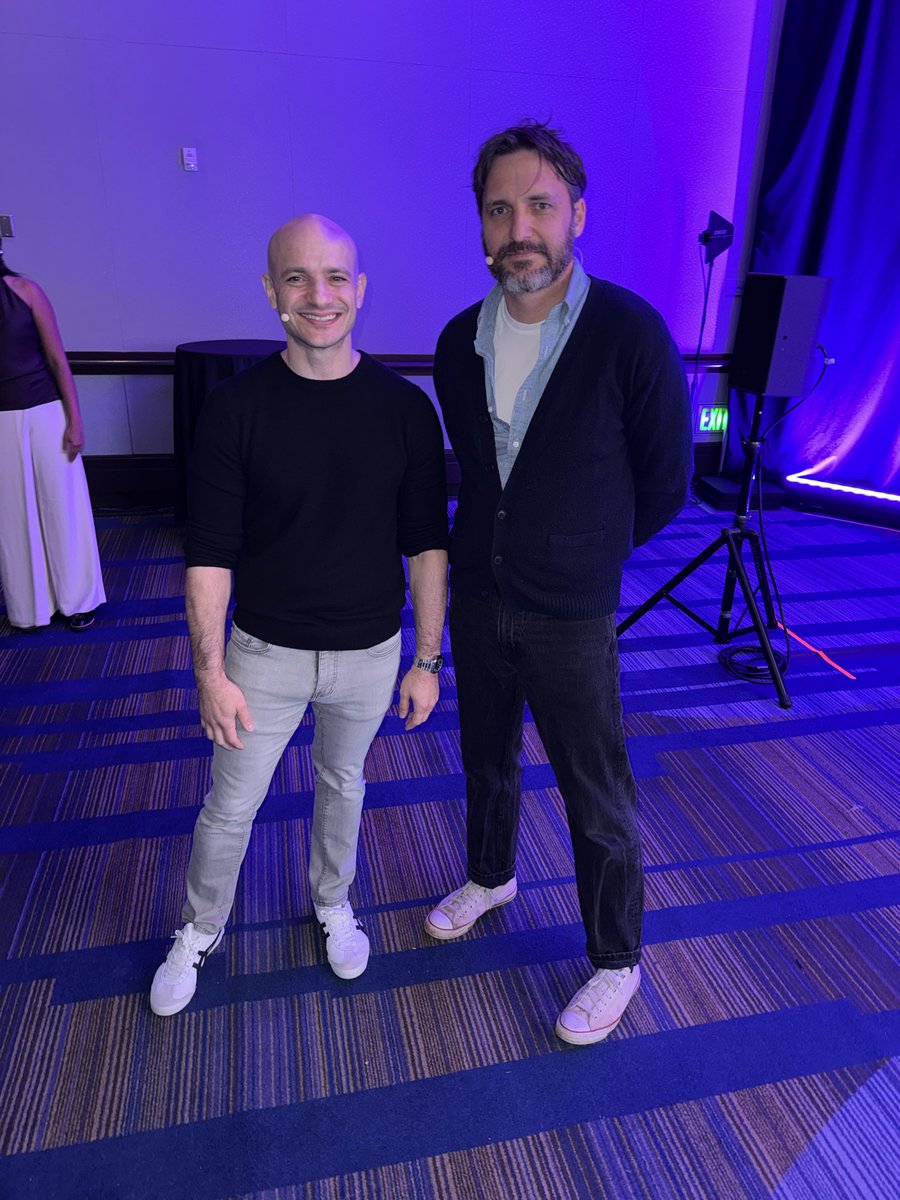
Snapped @datadoghq’s Adam Blitzer and Michael Whetten ahead of hitting the keynote stage at SF Summit 📸

Miraline Systems @MiralineSystems
32 Followers 33 Following Internet product development and technical consulting. From architecture to ongoing engineering.
Amy Zhou @amymzhou
122 Followers 270 Following dog person. product @datadoghq, prev @microsoft, harvard 🇦🇺

Tim Brown @_brimtown
1K Followers 268 Following models, interfaces, and the in-between. staff ai eng @datadoghq. you are now being connected with a human

Umesh Prasad @UmeshPrasadBr
11 Followers 192 Following
uhh_what @uhh_wh
0 Followers 77 Following
teale @iamteale
530 Followers 2K Following 🇺🇸 curly hair mofo 🇺🇸 end the surveillance state codex / devin sloperator

yossy @yossy_dev
111 Followers 596 Following Software Engineer / SRE in back office SaaS. Interest: AWS / K8s / Terraform / Datadog / Vim / Man United❤️🔥


nu0ma @nu0ma
27 Followers 91 Following
A @a266012
83 Followers 2K Following
KobyM @GoKobyGo
2 Followers 25 Following

Yokozeki @tetsu0116_
808 Followers 3K Following 岐阜出身/ 株式会社フィードフォース→sento group合同会社→株式会社DataBake/BigQuery/Snowflake


Taiga.H @Taiga26531
0 Followers 45 Following



ハヤケン I 挑戦... @hayaciel
1K Followers 1K Following 外資IT 「生成AIで、営業の非効率を減らす」ことに熱中。 外資IT←日系SaaS←教育スタートアップ創業←人材エージェント

KR @ckrv1980
4 Followers 610 Following
ukuuku @k59267951
12 Followers 224 Following
くま.kt(´(ェ)�... @bump_of_bear
1K Followers 6K Following 邦楽ロックとか,PCゲーム(BF, PUBG, Ironsight) とか,WEBサービスの開発(Next.js / Typescript / Java ) https://t.co/t5lfeyiNBH
tjun @tjun
1K Followers 2K Following Software Engineer at newmo 自動運転team. ex-Sony / ex-メルカリ, メルペイ/ ex-未踏クリエーター


Rob Waters @robwaters_
82 Followers 2K Following building to win 🚀 Co-founder and CTO of @kanawaiai Former @google @cisco @forescout @USC Marshall MBA @UMBC Masters in Cybersecurity
kinnsei @kinnsei35345
34 Followers 5K Following
Thetonthetonnn @Thetonthetonnn
163 Followers 2K Following
Martin Amps @martinamps
3K Followers 816 Following labs at @AnthropicAI. formerly @stitchfix @twilio @iCracked - views are my own
Allan Edwards @siliconplains44
158 Followers 4K Following
Andre Santos @AndreSantosLPs
0 Followers 32 Following AI Architect @Salesforce · Agents, LLM infra, and the future of how we build software · Weekend runner, watch enthusiast · SP
Himanshu Rathore @himanshpal
927 Followers 6K Following Building @Cars24, Previously @Zomato. Building the future of mobility. Passionate about gadgets, cars, travel, space exploration & obviously good food. 🚀
R-bo. @BrownEyedBanana
4 Followers 210 Following
Leslie Russell @LeslieRuss16332
134 Followers 3K Following
Donal Warde @DonalWarde
349 Followers 3K Following Private equity real estate & AI. @columbia. 🇮🇪 in 🇺🇸. Interested in intersection of tech/AI and real estate investment industry. DMs open. @arsenal

凛|60歳からAI�... @rin_restart_jp
314 Followers 432 Following 48歳で全てを失い、不自由が残った|それでも絶対負けない|57歳YouTube→5.4万人/月100万超/3ch収益化|元全国No.1不動産営業|60歳からAI学習中|AI×YouTube×お金をデータで発信|80歳まで現役|40〜60代へ
Cristiano Rodrigues @cnr_br
28 Followers 170 Following
laragondarag @laragondar34772
8 Followers 678 Following
Sarah Stonehill @sstonehill12
11 Followers 85 Following
Jean-Philippe Bempel ... @jpbempel
3K Followers 209 Following Sr Sw Eng @Datadoghq, optimize software running on JVM. Love performance topics and mechanical sympathy supporter. Java Champion & @javamissionctrl committer
Dorian @SpeedyShady
808 Followers 3K Following Software Engineer, Runner, Sports & Jazz Enthusiast. Dying Hard for NYK & NYJ.
Datadog, Inc. @datadoghq
52K Followers 66 Following Datadog is the monitoring and security platform for cloud applicationsYou might like