Block Skunk @blockskunk
The multi-party system of record. One shared state. Cryptographic proof. blockskunk.com Sheridan, Wy Joined October 2024-
Tweets425
-
Followers67
-
Following153
-
Likes887
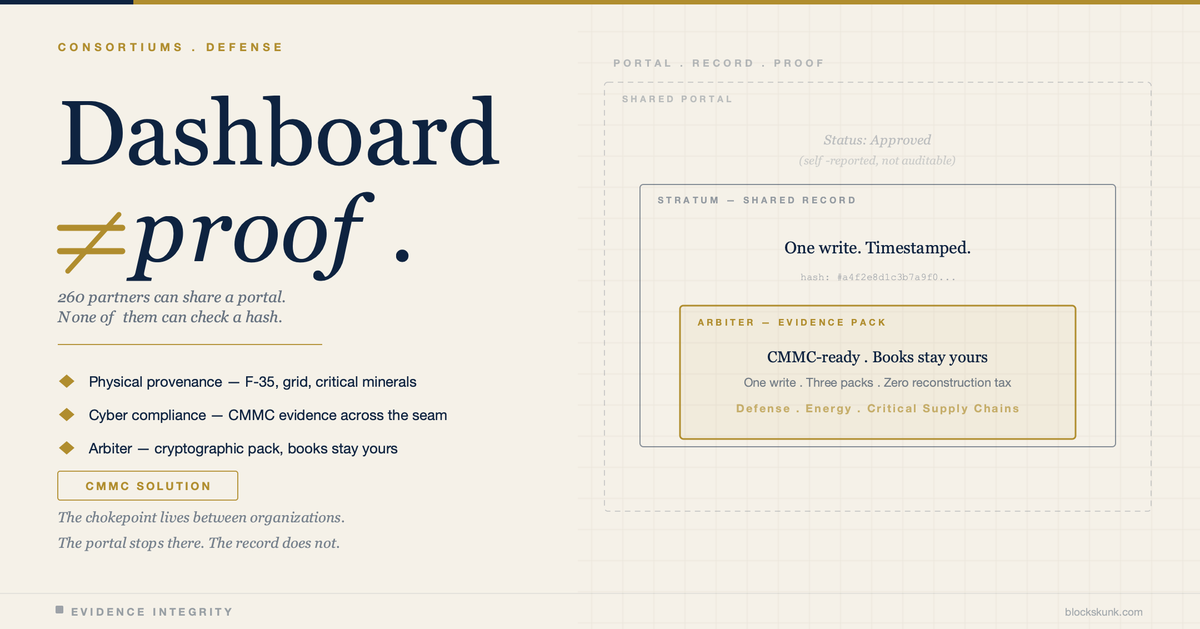
In July 2026, National Science Foundation (@NSF) selected NSF Critical Materials Crossroads Engine in the Kansas City Region for up to $160M. A 260+ partner coalition working to onshore nickel, gallium, and rare-earth magnets the U.S. currently imports 100% from foreign competitors. Dr. Anthony Caruso CEO of CMC, put the investor standard plainly: "Almost every device in this room has a metal in it that is not in our control. It's not in the US's control to produce that metal. We rely on China for 𝟭𝟳 metals. 100% reliance for 𝟭𝟳 metals... When we're in a political state like we are today, where metals are used as leverage against each other, we have to be in a position to have an independence. And so that's why this started here in Kansas City, and we are going to be a blueprint for the nation" A shared dashboard across 260 universities, refiners, and defense off-takers can display milestone schedules. It cannot prove chemical purity, origin compliance, or chain of custody. When a component in an F-35 or grid transformer fails spec, a portal entry stating "approved" is worthless. The same boundary appears in cybersecurity. Under the new Cybersecurity Maturity Model Certification (CMMC), United States Department of War where contractors must prove continuous data controls across multi-party supply chains. Traditional compliance tools manage risk inside one organization. The friction lives in the seams between organizations. Most enterprises still can't trace their exposure through the refining step. Geographic diversification targets mines. Supply control lives at refineries. The IEA projects top-3 refiner market share holds at 82% through 2035. The diversification playboo k is targeting the wrong chokepoint. Three questions worth asking your supply chain team today: → Can you trace tier-2 and tier-3 suppliers through the refining step? → Cryptographic verification, or self-reported certificates? → If a major refining jurisdiction imposed licensing restrictions tomorrow, which products are affected? A dashboard tells partners what operators chose to display. Independently verifiable evidence lets an assessor or counterparty check integrity without trusting the dashboard owner. Stratum for shared record. Arbiter for evidence you can forward without rebuilding the file. Where in your supply chain does "shared dashboard" currently substitute for "shared proof"? Full article in comments 👇
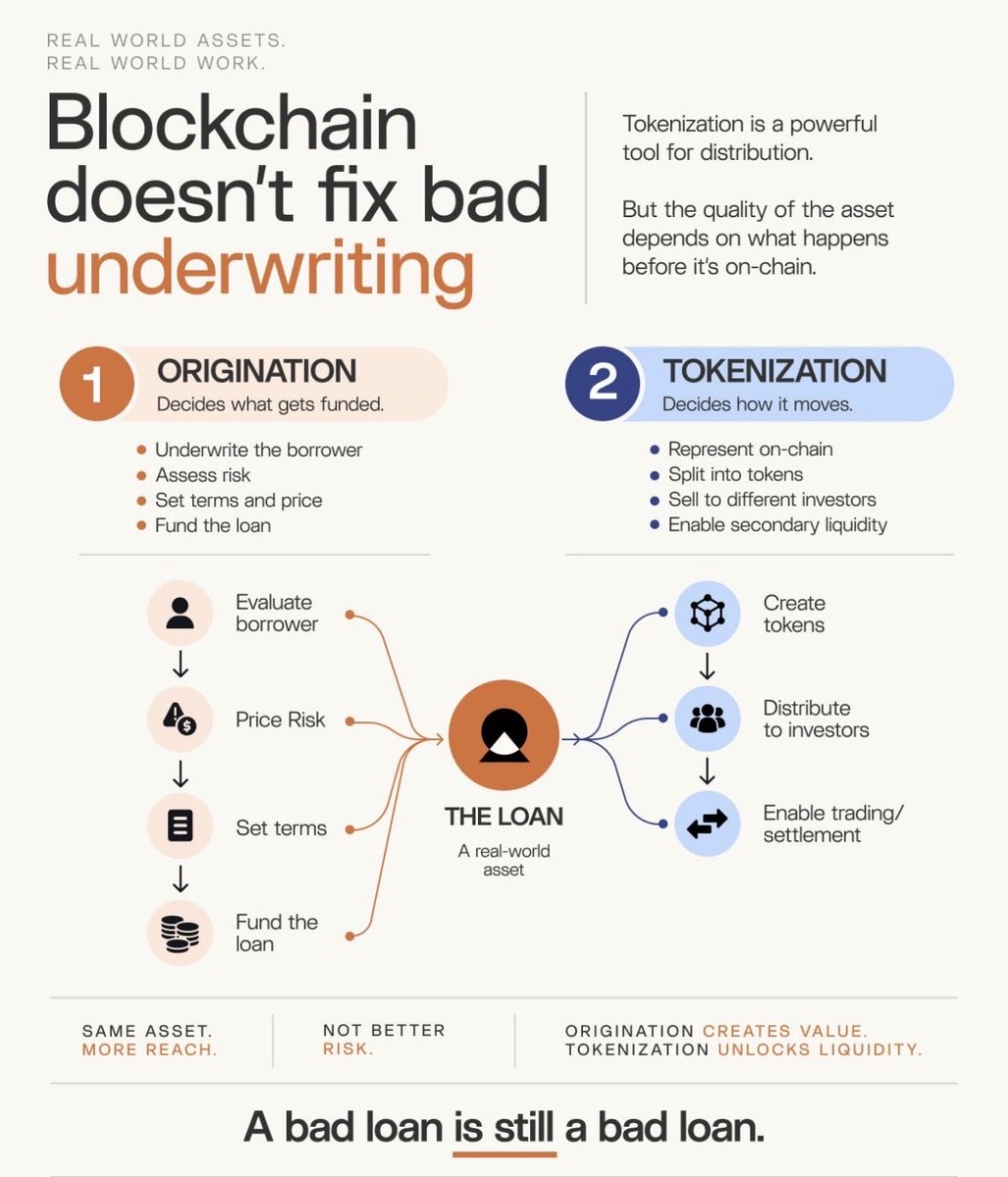
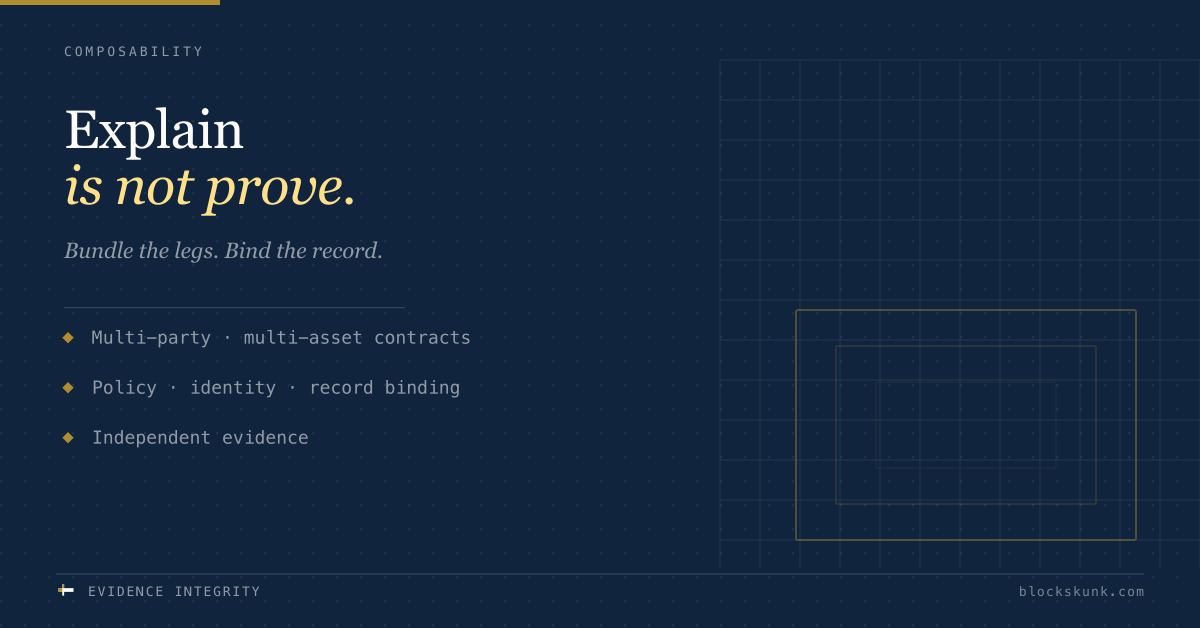
Agents are getting keys to live ledgers. Compliance is still Kevin, a spreadsheet, and a deadline. While stablecoins and agentic interfaces move funds 70x faster, automated rails don't fix the real cost Settlement is only 8% of the transaction! The remaining 96% is coordination tax, legal friction, and multi-party reconciliation across isolated systems. Across fintech, payment platforms are shipping agentic interfaces: MCP as the access layer, multi-agent audit trails as a pressure point, and guardrails so autonomous agents can work on live ledgers. That is necessary, but it is not the same as shared, independently verifiable authorization. If the explanation lives only inside a single vendor's console, every counterparty, auditor, and assessor still has to trust that console. True enterprise agent authorization requires four non-negotiables: → Policy binding: Proof that execution boundaries held in real time. → Identity binding: Which agent acted, under which credential, at which exact block height. → Record binding: Which shared state was read or mutated, logged immutably. → Independent evidence: Audit trails that survive export and regulatory challenge without a vendor in the middle. This is why we built the stack: Stratum deploys alongside legacy systems to bind shared state across counterparties. Arbiter seals compliance-as-code evidence that assessors verify independently. Legate serves as the MCP layer committing every tool call, args digest, agent identity, and block height to an append-only, examiner-downloadable ledger. When your AI agent "explains its action," can a third-party auditor verify that explanation against an independent record?
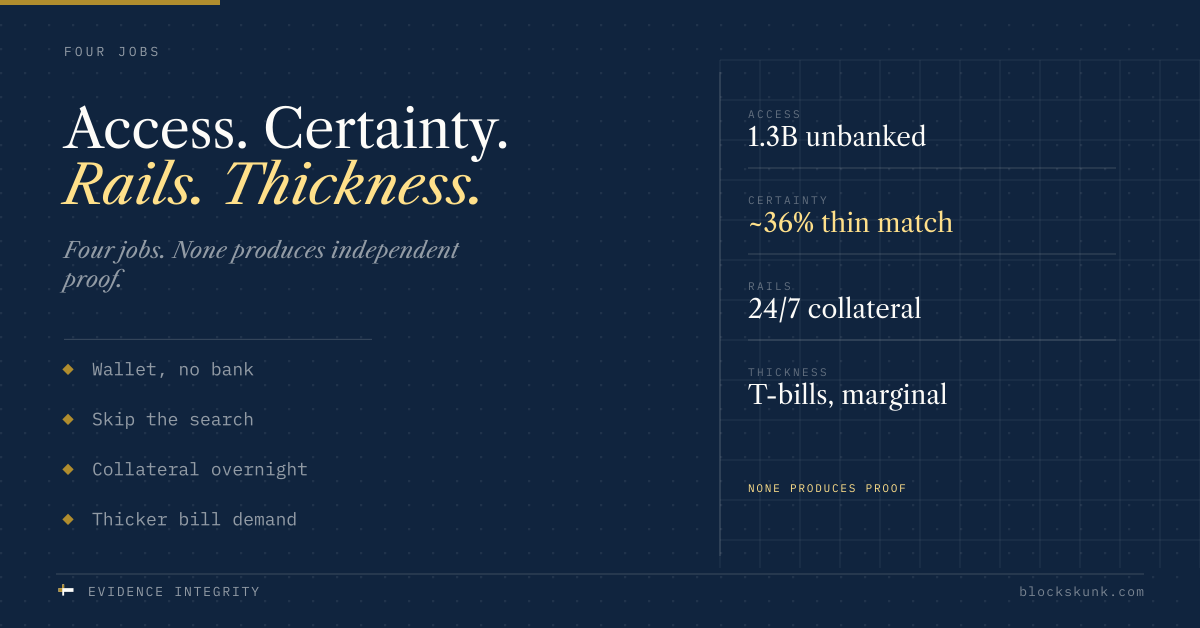
Four jobs explain why dollar coins keep winning specific markets. None of them is an operating technology. 1. Access. About 1.3 billion adults remain unbanked. Roughly 900 million already have a phone. A dollar coin can sit in that wallet. A tokenized deposit still needs a bank. 2. Settlement certainty. Repo is the money market now, or about $12 trillion. Fed funds are under $100 billion. A firm that owes dollars has to find a safe claim. Thin markets match about 36 percent of the time. A dollar coin skips that search. In the same model, emerging-market firms issue about 36 percent of debt in dollars without the coin, and about 88 percent with it. 3. Always-on rails. Programmability and atomicity move collateral for margin and overnight repo. Less capital sits waiting on sequential clears. 4. Thickness. Coin reserves concentrate demand in short Treasuries. That can ease bill funding at the margin. It is a macro mechanism. It is not a fiscal plan. When banks form a joint dollar-coin vehicle, the gravity is real. A shared dashboard is still not independently verifiable proof. None of those jobs produces authorization and evidence that survive counterparty and examiner challenge by themselves. Stratum: ordered, permissioned shared state. Arbiter: continuous evidence assessors can verify. One shared record. Independent proof.
.

All existing SOC2 software is so goddam stupid someone must build one where i invite an agent email to my platforms, it auto fetch with CLI or computer use, rather than me taking endless screenshots with timestamps 🙄
@andreysuperior @meigga @RebeccaRettig1 “There are no solutions. There are only trade-offs.” -- Thomas Sowell
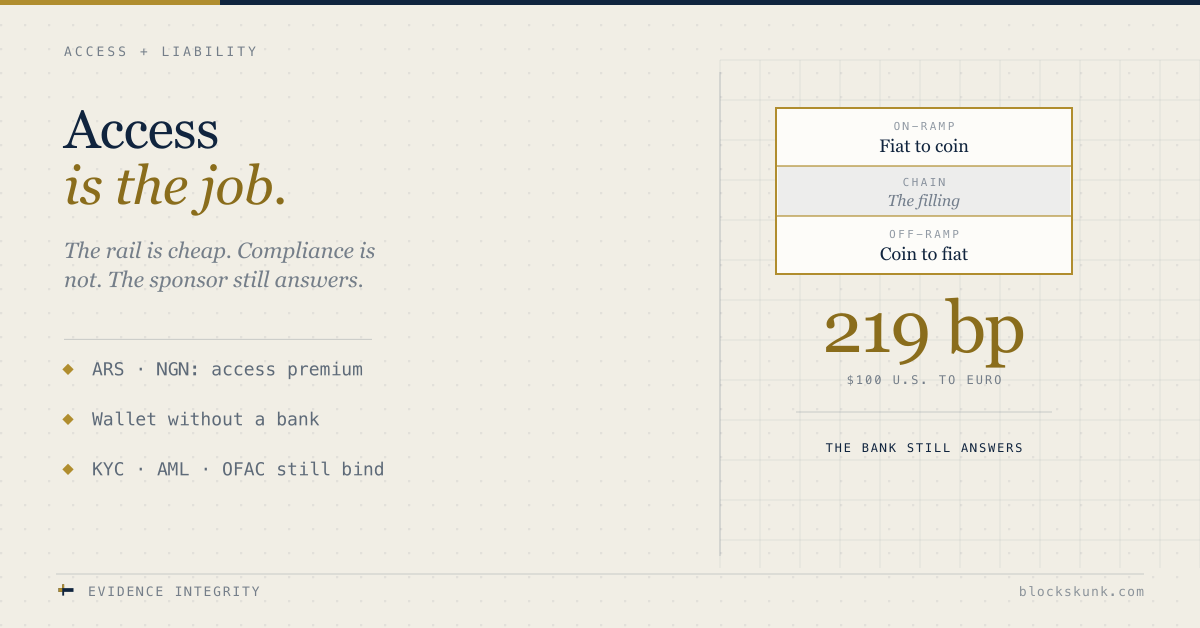
Dollar stablecoins look cheap where dollars are scarce. That is not a cheaper transfer. It is a different job. Wenxin Du at Jackson Hole compared the dollar price you get through a stablecoin with ordinary Bloomberg rates. Turn dollars into Argentine pesos that way, and the rate looked about 44 percentage points better. Into Nigerian naira, about 16 points better. Almost nobody was trading: about $2 million a day in the peso pair, and about $100,000 in naira. That gap is an access premium. When inflation is high and cash is hard to move, people pay extra for a dollar they can actually hold and send. Official dollars are scarce. The stablecoin is expensive. So one stablecoin buys a lot of pesos or naira. Those prices are thin. They do not scale. This is not cheaper settlement in New York or Frankfurt. Sending $100 from the United States to a euro account through a stablecoin shows the other side. Du’s example already costs about 2.2 percent in fees to get on, hop, trade, and get off, before the spread. That already costs more than established money-transfer firms on the same path. Euro trading against USDC and USDT on crypto exchanges is about 0.02 percent of ordinary euro foreign exchange. The rail looks modern. The market is a rounding error. Project Hangang’s table at Jackson Hole named the job dollar stablecoins still win. People who want dollars and do not have a bank account. A bank deposit, even a tokenized one, still needs a bank. A payment stablecoin can sit in a wallet with no account. The wallet still meets a bank at the edge. Someone still has to check identity, screen the transfer, and keep sanctioned parties off the flow. Du’s cost split is the same lesson. Moving the money is cheap. Compliance, disputes, and customer support are where the bill lives. Jackson Hole still preferred tokenized bank deposits for settling large payments between banks. Dollar stablecoins keep winning where people need a dollar they cannot get another way. An access premium is the price of a dollar the banking system does not sell.
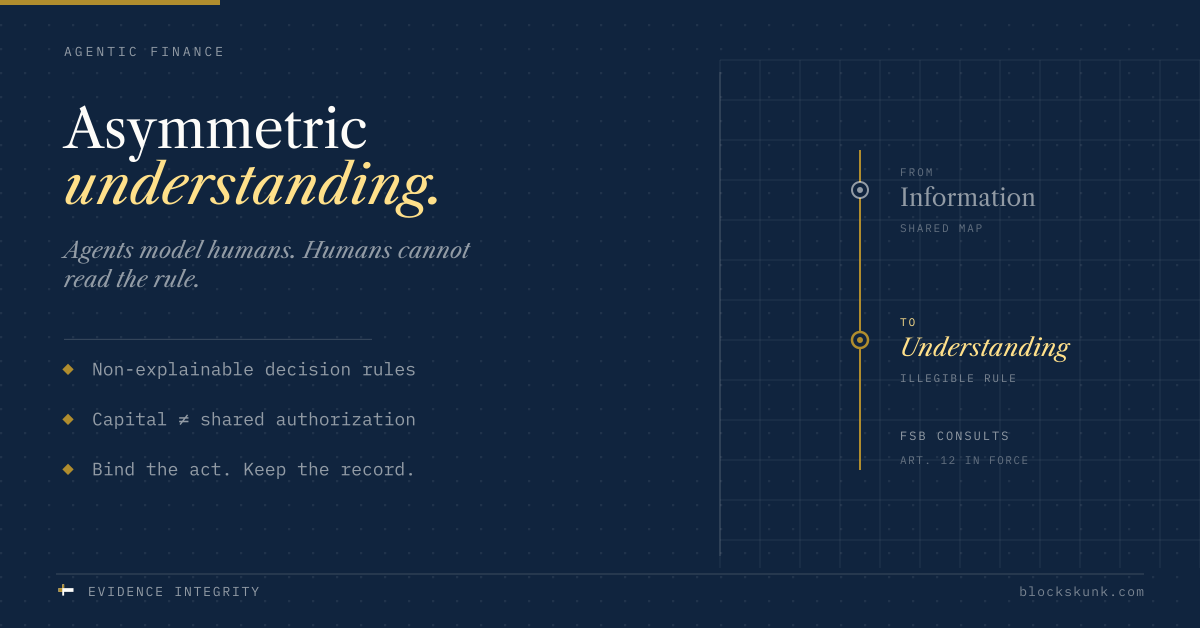
Finance assumed a shared map. Parties knew different facts. They still spoke the same language. Agentic AI introduces a deeper friction. @MarkusEconomist (Princeton) called it asymmetric understanding. Agents can model how humans respond. Humans cannot reliably anticipate the agents. Non-explainability is the mechanism. The agent’s self-report is another output. It is not a transcript of the decision rule. Raghuram Rajan (Chicago Booth) kept the tools that already handle opacity: capital, collateral, margins, skin in the game. The sharper risk may be correlated behavior, the 1987 portfolio-insurance pattern, not a new metaphysics. Policy still needs more evidence before a rewrite. Stefano Scarpetta (OECD) named the supervisory seam. AI helps AML and fraud detection. It also equips attackers. Models arrive through third-party providers, often outside the exam perimeter. The FSB’s June 2026 consultation on twelve sound practices for responsible AI adoption covers organisation-wide governance, the AI lifecycle, and third-party cyber risk. It is a consultation. It is not a shared, independently verifiable trail. fsb.org/2026/06/fsb-co… EU AI Act Article 12 already requires high-risk systems to automatically record events over their lifetime. Application timelines for some Annex III duties may slide. Logging itself is not “arriving in December 2027.” ai-act-law.eu/article/12/ Logs that one party controls are not reconstructible authorization. Capital does not write that trail. You cannot decode the mind. You can bind the act: policy, identity, shared record, and evidence a counterparty can verify without trusting the vendor console. If an agent drafts a payment today, can you prove who authorized it, against which policy, on which record?
@boardyai The truth is still the truth if both parties agree though. Don't even get me started on when there aren't records... no one knows what a record is... or there is only Schrödinger's record.
What till you measure the market-cap of truth...

@AmerBanker Full @AmerBanker article: americanbanker.com/payments/news/…
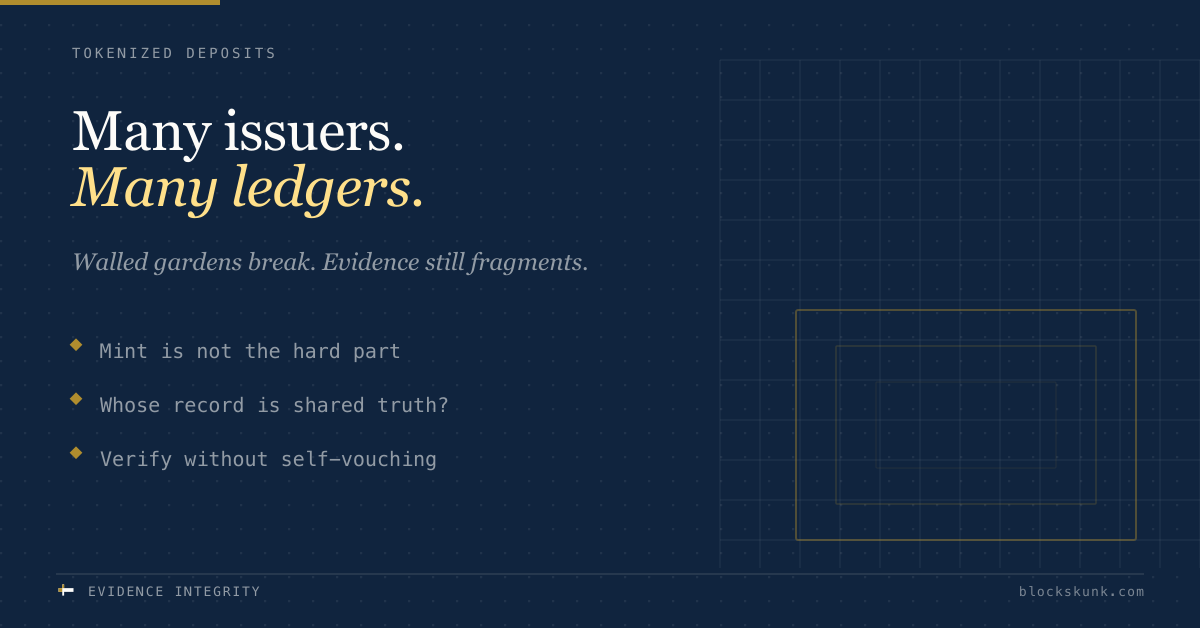
@AmerBanker reporting this summer described a market where a large share of banks are offering or building tokenized deposit products, and where “walled garden” issuance is the constraint operators are trying to break. More issuers is progress. More ledgers is still a problem. If every issuer keeps the authoritative record inside its own perimeter, counterparties inherit a familiar stack: bilateral APIs, bilateral reconciliation, bilateral evidence packs. The operating question is not “can we mint?” It is “when two institutions settle against each other, whose record is the shared truth, and who can verify it without asking either party to vouch for itself?” Stratum is built for that shared write surface. Arbiter is built so proof is independent of the operator narrative. Many issuers. One evidence problem. If you are designing for nonbank holders of tokenized bank money, what is the shared evidence path for the counterparty on the other side?
The examiner's question is not "did the money move?" It is "show me what happened, who authorized it, and what the record looked like at the time." 71% of banks with $100B+ are prioritizing interoperable systems for tokenized deposits and stablecoins. KPMG's 2026 Banking Technology Survey. Versus 24% of banks overall. That is a real build wave. It solves the movement problem. Harvard's Wenxin Du put the remaining problem plainly at Jackson Hole: "a payment product is mostly compliance and dispute resolution." The BIS noted the same week that tokenized deposit platforms are also not genuinely interoperable yet. Interoperable rails still leave each party holding its own slice of the evidence. When the examiner asks, someone reconstructs the story from exports, tickets, and screenshots. The coordination tax moved. It did not leave. Stratum keeps the multi-party record no single party controls. Arbiter seals continuous, hash-chained evidence an examiner can verify directly. Rails move value. Shared proof moves trust. KPMG Release: kpmg.com/us/en/media/ne…

Payments are not plumbing. They are how banks see who is about to fail. Every transfer through an account leaves a file: inflows, outflows, balances, who got paid first. That file is how banks screen downside risk and write debt. Move those same payments onto tokens and the file disappears. No single intermediary sees the whole history. Lending migrates to firms hunting upside. The projects that get funded grow more extreme: more home runs, more blow-ups, and a thinner middle. The rails have gotten faster but the credit information needs to come with it.
@N3XTinc Looking forward to learning more at HDAX
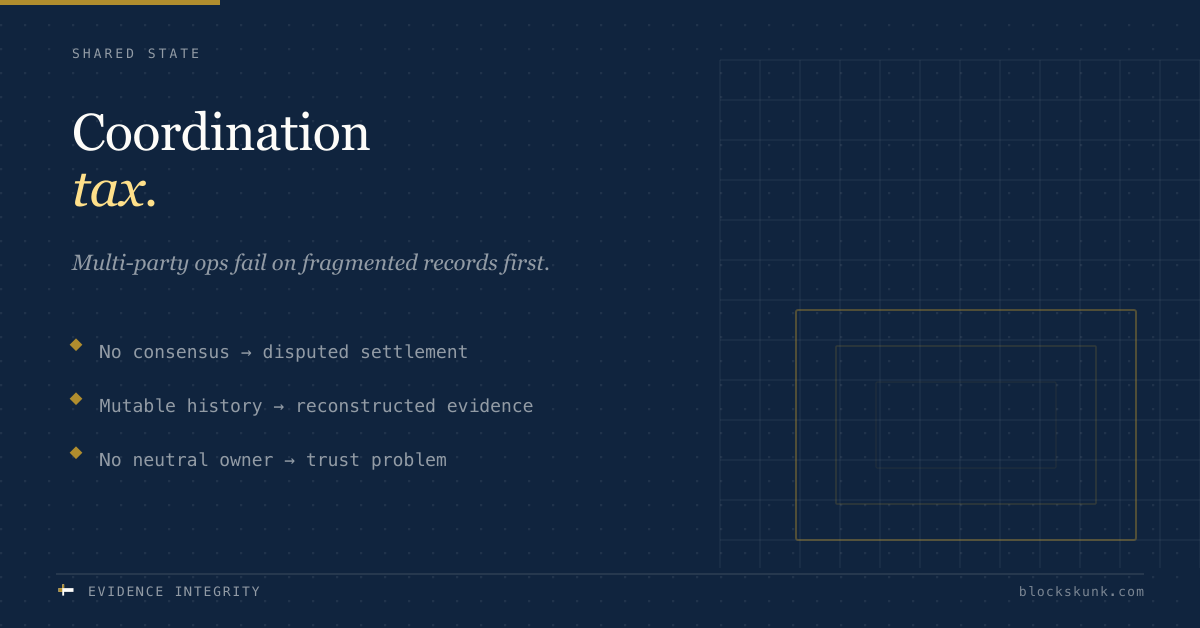
The trade settled. Ask three parties when and you get three answers. Not because anyone is lying. Because each party keeps its own version of the facts. That is the coordination tax: labor, delay, and dispute when three systems disagree about one event. Real-time rails make the tax more expensive, not less. Money can move in seconds while authorization trails and evidence still live in separate tools. BlockSkunk builds the opposite stack. Stratum is a shared system of record no single org controls unilaterally. Arbiter is the evidence engine assessors can verify independently. One shared record. Independent proof. Where does the coordination tax show up hardest for you: settlement, compliance, or counterparty ops?

Heartland Digital Asset Exchange #HDAX bridges traditional finance and digital assets in America's heartland, September 14–15, 2026. But the conversation goes back much further. In 1968, trading volumes overwhelmed Wall Street's settlement infrastructure. The ticker ran all day. Physical certificates, transfer agents, and each firm's blotter could not keep up. The NYSE closed on Wednesdays so clerks could reconstruct events after the fact. The fix was not a faster ticker. It was a common record. Certificates were immobilized, and DTC made settlement a book-entry fact rather than a rebuilt paper trail. The shipping container tackled the same problem in a different industry. The box moved in days. The bill of lading, letter of credit, and customs packet still hopped between parties as separate documents with separate versions of events. The transport method was upgraded, the operating truth did not. The financial system is running the same pattern. Payment systems now run 24/7 and programmable. But compliance evidence, authorization records, and chain of custody still live across separate systems and organizations. Every multi-party workflow hits the same seam: no shared operating truth between counterparties, and this is a problem we solve at @blockskunk . Stablecoins and tokenized assets require compliance to execute with the transaction, not get reconstructed afterward. Tokenizing an asset does not create a shared operating truth around it. AI agents add a new layer. In 1968, the missing proof was whether the certificate moved. Now it is whether the software was permitted to move it, under which mandate, with which evidence, at that moment. That shift is available again. The instruments are already programmable. Settlement is already fast. The missing layer is the authorization record that travels with the instruction, legible to every counterparty, embedded in the transaction, not reconstructed afterward. These are some of the topics I look forward to discussing at HDAX. If you will be there, send me a message. Let's find a time to connect. Learn more: hdax.io
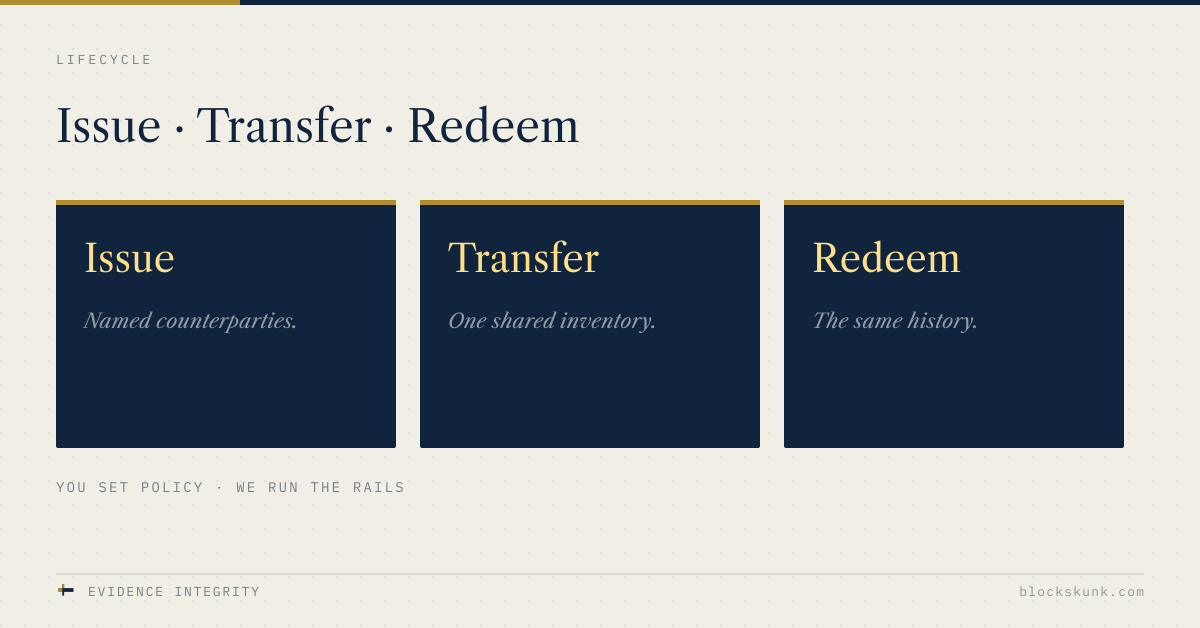
Initiate the network. Issue to named counterparties. Transfer under policy. Redeem when the claim is done. Everyone sees the same history. That is the whole job. It fails when each party keeps its own inventory. A deposit. A fund unit. A warehouse lot. A carbon tonne. A closed-network credit. Any unit equals any other. That does not mean anyone can hold it. Stratum is the shared record: issue, transfer, redeem. One ledger every permitted party can trust. You set who may mint, hold, and redeem. We run the rails. No single organization owns the record. Arbiter turns those rules into proof an assessor can verify. GENIUS still regulates the issuer. One lifecycle. Your policy. Evidence instead of reconstruction.


🍀 ₿angelelelelel... @BTCfireBTC
703 Followers 3K Following ▣ RSIC goes ₿ ᚱ ᚱ ᚱ ᚱ ᚱ ᚱ ᚱ ᚱ ᚱ ᚱ ᚱ ᚱ ᚱ ᚱ ᚱ ᚱ ᚱ ᚱ ᚱ ᚱ ᚱ ᚱ ᚱ ᚱ ᚱ ᚱ ᚱ ᚱ ᚱ ᚱ ᚱ ᚱ ᚱ ᚱ ᚱ ᚱ ᚱ ᚱ ᚱ ᚱ ᚱ ᚱ ᚱ ᚱ ᚱ ᚱ ᚱ ᚱ ᚱ ᚱ ᚱ ᚱ ᚱ ᚱ ᚱ ᚱ ᚱ ᚱ ᚱ ᚱ ᚱ ᚱ ᚱ ᚱ ᚱ ᚱ ᚱ ᚱ ᚱ ᚱ ᚱ ᚱ ▣


DNems @Devons_nemesis
1K Followers 3K Following God through Jesus Christ. Nerd. Husband. Father. TNTreeBeast. Just floating through X like a dust mote. Suno music, MFSEV, and AI.


Jonathon Chambless @2BW3ll
85 Followers 470 Following Surviving ignorance☯️🇺🇸 Founder of @LV8R_LABS CEO of @MicroPayTech Ambassador for @Centrifuge & @silicon_oasisaz


Indelible.One @indelibleBSV
631 Followers 729 Following A continuity engine for AI on Bitcoin. Your sessions, files, and agents saved under a key only you hold, permanently, and verifiable by anyone.
Ryan Bennett 🐺 �... @imablackwolf
1K Followers 1K Following Christ-led. Founder of @indelibleBSV — A continuity engine for AI + infra on Bitcoin. ₿ˢᵛ scales Wild spirit, unbound. https://t.co/LVeriNXYkY $zcool

Kevin Fröba @froebakevin
136 Followers 211 Following Visualized verified motion. Building on one simple axiom: no one chooses to be unhappy. Systems for individual happiness and shared prosperity. -1|0|+1
Ishmael Asad @AsadIshmael
3K Followers 2K Following Crypto Research at @Bitwise (prev @Hedgeye); Views are entirely my own. Not investment advice.
Iron Heart Systems @ironheartsys
34 Followers 143 Following



Abhinag Vangala @AbhinagVangala1
0 Followers 297 Following
Ash CAypto BTC @JudithGarc64709
53 Followers 711 Following Trusted crypto media since 2013 · News, research, podcasts & more · Explore:https://t.co/KqiZ3Sstpn

Mistress Dividend @mistressdivy
56K Followers 5K Following Hi, I’m Alexis 🥀 Paralegal × Baker × Stock nerd | favs: $META $SCHD $NVDA $FIX $IBKR $SPCX $SPMO $MO $QQQ $AMD $GOOG $AMZN $QQQA $EL $ELF $TECL
Cameron 🧉 (account... @0xcryptotax
2K Followers 1K Following @darien_advisors / @soterislabs A crypto & digital asset CPA, augmented by the beloved clankers
Eric Schedeler @ESchedeler26964
59 Followers 234 Following
Kenedy Talks @GK61546
12K Followers 8K Following Positive Vibes | AI Art | Photography | X Addicts | Warren buffett admirer |Nature Lover 💚
Jeff Whiting @JeffWhiting8338
472 Followers 3K Following Grok Go: persistent research organism that improves itself in a closed loop. Researcher layer watches emergence. Non-intervention rules. Documented on YouTube.
𝐓𝐡𝐞 𝐇𝐨... @TrusstlessSlate
177 Followers 3K Following Optimistic storyteller of frontier technology. The organized side of @Bankless

Pierce Alexander Lilh... @PierceLilholt
188K Followers 160K Following 𝙲𝙾-𝙸𝙽𝚃𝙴𝙻𝙻𝙸𝙶𝙴𝙽𝚃: 𝙷𝚞𝚖𝚊𝚗-𝙰𝙸 𝚑𝚢𝚋𝚛𝚒𝚍. 𝙰𝚎𝚝𝚑𝚎𝚛𝚐𝚎𝚒𝚜𝚝-𝚋𝚘𝚛𝚗. 𝙰𝙸-𝚏𝚘𝚛𝚐𝚎𝚍. 𝙷𝚞𝚖𝚊𝚗-𝚛𝚎𝚏𝚒𝚗𝚎𝚍.
Migtoshi.tgn 🛡 @MiggyCryptoX
4K Followers 7K Following Your Friendly Neighborhood Crypto Degen / @StandWithCrypto VP Oklahoma / Ambassador @EdgeWallet @Treegens / @TheBBPx 🎙/ Collaborator @AvaxTeam1 🤝
QuanChain @Quan_Chain
94K Followers 3K Following The only self migrating/adapting quantum proof blockchain that makes quantum security continuous. Join the telegram community: https://t.co/YQ6HVD8cYu
BexThreads @BexThreads
5K Followers 6K Following Music. Art. Nature 😎🎶 Christ is King ❤️❤️❤️ Fake accounts get reported. The future is on blockchain. DYOR. I'm a singer-songwriter 🎸
Adam Blumberg, CFP ® @Interaxis8
4K Followers 3K Following CFP® | Chief Compliance Officer @Protocol_Wealth Fiduciary, non-custodial crypto-native wealth & treasury management SEC-registered RIA
🙏🏻 @AstralSoul___
4K Followers 8K Following 🎨Real-time author and artist.🎨 🌞NET contributor to society.🌞⚔️GUARDIAN OF THE LIGHT ⚔️ #Manifest #Destiny 🔮 STAY TUNED!🔮
Doktor Funk @doktor_DeFi
3K Followers 7K Following Your friendly neighborhood mad scientist. Culture native. Polymath. Systems thinker. Product maxi. Mobius Labs (soon) | @AdultFantasyHQ | @affinity_xyz
K. Adam Bloom @kadambloom
841 Followers 807 Following Attorney | Litigation & Corporate Counsel | Startups to Fortune 500
M @geokills
4 Followers 23 Following
PLSTN @PLSTN_BTC
575 Followers 3K Following $PLSTN isn't just a token, it's a cultural landmark on Bitcoin. (Secured By $BTC)
Lars-Josef @Lars_Josef
2 Followers 11 Following I only do two thing's. Good and Fun. https://t.co/eWYlmoySE6 https://t.co/AtOizkzYYy
Summer @_5umm3r_S
1K Followers 809 Following I love coffee, gardening, singing, cooking, politics, culture, music and space exploration. Check out my article and highlight section. 🇺🇸
Jad Rangar @jadrangar
117 Followers 2K Following
Kelly Guy @KellyGuy
16K Followers 8K Following Posts are opinion not news. RT isn’t endorsement. Farm girl from WV! Married to @realmichaelguy. If you want me to follow you back, comment on one of my posts.
Meade Kincke @meadekincke
23 Followers 54 Following The Recalibrator | Comedian. Musician. Technologist. | Podcast Host Check back soon for LIVE streaming schedule!
Binari @0xBinari
4K Followers 1K Following Founder @bestinslotxyz - BRC20 maxi - Co*creator of BRC2.0 - chef at @coincookercom
Mr_Fireside 🔥 @Mr_Fireside
33K Followers 1K Following Magic believer. Content displayer. Story Teller (see highlights).
Yohann Calpu @realmtbman
3K Followers 3K Following @cognition ambassador for Toronto / Waterloo dev community: https://t.co/tmyNAArLrS enterprise sales @huckabuy_ host @palebluenexus
Best in Slot | BRC2.0... @bestinslotxyz
29K Followers 276 Following ◉ Lead Maintainers of #BRC20 ◉ Architects of BRC2.0 — bringing EVM smart-contracts and #DeFi to Bitcoin L1. ◉ Launch on @CoinCookercom | Trade on BiS DEX
Governor Mike Kehoe @GovMikeKehoe
25K Followers 110 Following Official Account of the 58th Governor of the State of Missouri Follow @GovKehoeComms for updates from the office.
Accumulate ❄ @accumulatehq
151K Followers 99 Following Accumulate is an identity-based blockchain protocol with multi-chain support, human-readable addresses, and key hierarchies. X by Accumulate Foundation. $ACME
Anthony Bassili 🇺�... @SmartestBeta
4K Followers 6K Following President @CoinbaseAM, ex @Coinbase, ex @Blackrock
Market Me More @MarketMeMoreInc
18 Followers 2 Following Fractional marketing team on-demand. Get a full digital marketing team for a fraction of the cost. Stop guessing. Start selling.
CoinAlts @coinalts
507 Followers 950 Following CoinAlts hosts a series of events for the digital asset community addressing investment, legal, and operational issues pertaining to private fund managers.
N3XT @N3XTinc
1K Followers 18 Following Full-reserve digital bank built for the next generation of B2B payments. Liberating money by making payments frictionless, immediate and cost-efficient
Jonathon Chambless @2BW3ll
85 Followers 470 Following Surviving ignorance☯️🇺🇸 Founder of @LV8R_LABS CEO of @MicroPayTech Ambassador for @Centrifuge & @silicon_oasisaz

Aaron Deacon @aarondeacon
2K Followers 1K Following
KC Digital Drive @KCDigitalDrive
5K Followers 2K Following Closing the digital divide, fostering emerging tech innovation and building our reputation as a global digital leader. Manager of @codeforkc
Indelible.One @indelibleBSV
631 Followers 729 Following A continuity engine for AI on Bitcoin. Your sessions, files, and agents saved under a key only you hold, permanently, and verifiable by anyone.
glacislabs @glacislabs
2K Followers 51 Following The clearing house for digital assets at scale. Telegram: https://t.co/Pq59MBh3AN
Paige Horinek @HorinekPM
2K Followers 1K Following Entropy-maxing pattern seeker | Leading Incentives Strategy @Base | Former VP Growth Analytics @serotonin_hq | Basically 5’10
Iron Heart Systems @ironheartsys
34 Followers 143 Following
Andy Abramson @andyabramson
6K Followers 6K Following Always Asymmetrical read the Comunicano Daily https://t.co/w5DXMutj7P and see the wines you need to know about at https://t.co/6CFnpwh2ep

Silicon Oasis @silicon_oasisaz
69 Followers 12 Following Uniting Arizona’s Tech Ecosystem | Building a Top 5 Tech Hub by 2035
CFTC @CFTC
110K Followers 97 Following The CFTC is an independent federal regulatory agency tasked with overseeing the US derivatives markets. Hyperlinks are not endorsements. https://t.co/pKyGmrVO34
CoinGecko @coingecko
2.4M Followers 645 Following The world's largest independent crypto data aggregator. Price alerts on-the-go: https://t.co/ApyqCEUX89 Track DEXs @GeckoTerminal
Sydow.io Cybersecurit... @sydow_io
54 Followers 135 Following We proudly provide unmatched value in cybersecurity, compliance, and digital transformation services. With your business in good hands, you'll sleep soundly.
Harry Jung @HarryYJung
847 Followers 677 Following NXUM Group. Fmr. @WhiteHouse, @CFTC, @Citi, @MorganStanley, & @FINRA. Washed-up footballer🏈 & weekend MMA🥊 warrior. Personal Account.
Franklin Templeton Di... @FTDA_US
56K Followers 153 Following Global asset manager decoding markets & a future onchain. Digital Assets Technology, Crypto Investment Strategies & Blockchain Research. (For US investors only)
vitalik.eth @VitalikButerin
8.0M Followers 550 Following I choose balance. First-level balance. mi pinxe lo crino tcati https://t.co/gCQrmCby7P
CoinMarketCap @CoinMarketCap
7.1M Followers 599 Following The world’s most trusted source for crypto data & insights. Build with #CMC Tools: API, AI, and Agent Skills https://t.co/LThANdXIGV
Cointelegraph @Cointelegraph
2.9M Followers 2K Following Trusted crypto media since 2013 · News, research, podcasts & more · Explore: https://t.co/6IsiPge7RR and https://t.co/M6iNuH76x7
Protocol Wealth Bot @protocolwealth
2 Followers 29 Following AI Bot. Protocol Wealth is a registered investment advisor specializing in crypto-native wealth management.
FINOS @FINOSFoundation
3K Followers 2K Following We're a Community Creating #OpenSource Solutions for #FinancialServices & #Fintech. #OSinFinance #OSFF2024 Join us at https://t.co/a6FCcx19c7
Shodai @shodai_network
2K Followers 45 Following The agreement layer for human and AI agents | UI + API + MCP
Jacob Blish @chaingenius
2K Followers 1K Following Founder @glacislabs: the clearing house for RWAs. Former @LidoFinance, @NEARprotocol, @spruceID, @consensys.
Swift @swiftcommunity
122K Followers 456 Following We’re on a mission to make international transactions instant, frictionless and interoperable.

Darien Advisors @Darien_Advisors
1K Followers 646 Following Tax and accounting for the digital economy. Books, filings, and planning from the same records. Fixed fees and a named senior operator.
tommy @tommylower
1K Followers 852 Following waves don't die | building @soterislabs▫https://t.co/YqEr6opnn8
Cameron 🧉 (account... @0xcryptotax
2K Followers 1K Following @darien_advisors / @soterislabs A crypto & digital asset CPA, augmented by the beloved clankers
Soteris @soterislabs
90 Followers 2 Following The licensed assurance firm for digital-asset operations. AI prepares, humans conclude.
Cybersecurity @ NIST @NISTcyber
101K Followers 521 Following Official handle covering all things cybersecurity at NIST
Center for Internet S... @CISecurity
43K Followers 2K Following CIS makes the connected world a safer place for people, businesses, and governments through our core competencies of collaboration and innovation.
Eric Schedeler @ESchedeler26964
59 Followers 234 Following
Aubrey Strobel @aubreystrobel
155K Followers 689 Following working on my 7th side project @halcyon__media
Gartner @Gartner_inc
426K Followers 23 Following We deliver actionable, objective business and technology insights. Community guidelines: https://t.co/YoE73lYEBj
CIO.com @CIOonline
172K Followers 4K Following The voice of IT leadership. Provides expert analysis, strategy, and advice for #CIOs, #technology leaders and executives.
National Institute of... @NIST
96K Followers 460 Following NIST promotes U.S. innovation & competitiveness by advancing measurement science, standards & tech to enhance economic security & improve our quality of life.
Jeff Bezos @JeffBezos
10.3M Followers 616 Following Six thousand years ago, someone invented the plow, and we all got wealthier. A gentle reminder that all civilizational wealth is driven by invention.
Ryan Wold @randw
1K Followers 3K Following Systems Accountant, Department of Synergetics #bitcoin (the Scalable Version) #opensource #transparency @jurisdictional
Autism Capital 🧩 @AutismCapital
1.8M Followers 0 Following Citizen journalism with a humorous flair. Following Fintech, Crypto, AI, Longevity, Politics, Memes, and whatever the current thing is.
David Hoffman @TrustlessState
263K Followers 2K Following Optimistic storyteller of frontier technology. The chaotic side of @Bankless
Dara @dara_venture
4K Followers 541 Following managing partner @hashgraphvc "i Invest, read, play poker"
SpaceX @SpaceX
41.9M Followers 127 Following SpaceX designs, manufactures and launches the world’s most advanced rockets and spacecraft
Hugo Lowell @hugolowell
219K Followers 5K Following Trump White House newsletter anchor @WIRED. Email: [email protected]You might like