Hello Interview @_hellointerview
Where top software engineers prepare for interviews hellointerview.com/twitter Joined May 2023-
Tweets643
-
Followers3K
-
Following2
-
Likes52
Separate jobs with very different runtimes. A quick report shouldn't spend hours behind a huge export. Separate queues let you allocate workers and tune each workload independently. More on backpressure and async workers:
Scale workers with the backlog. Queue depth tells you how much work is waiting. Add capacity as it grows, while checking that downstream services can handle the extra concurrency.
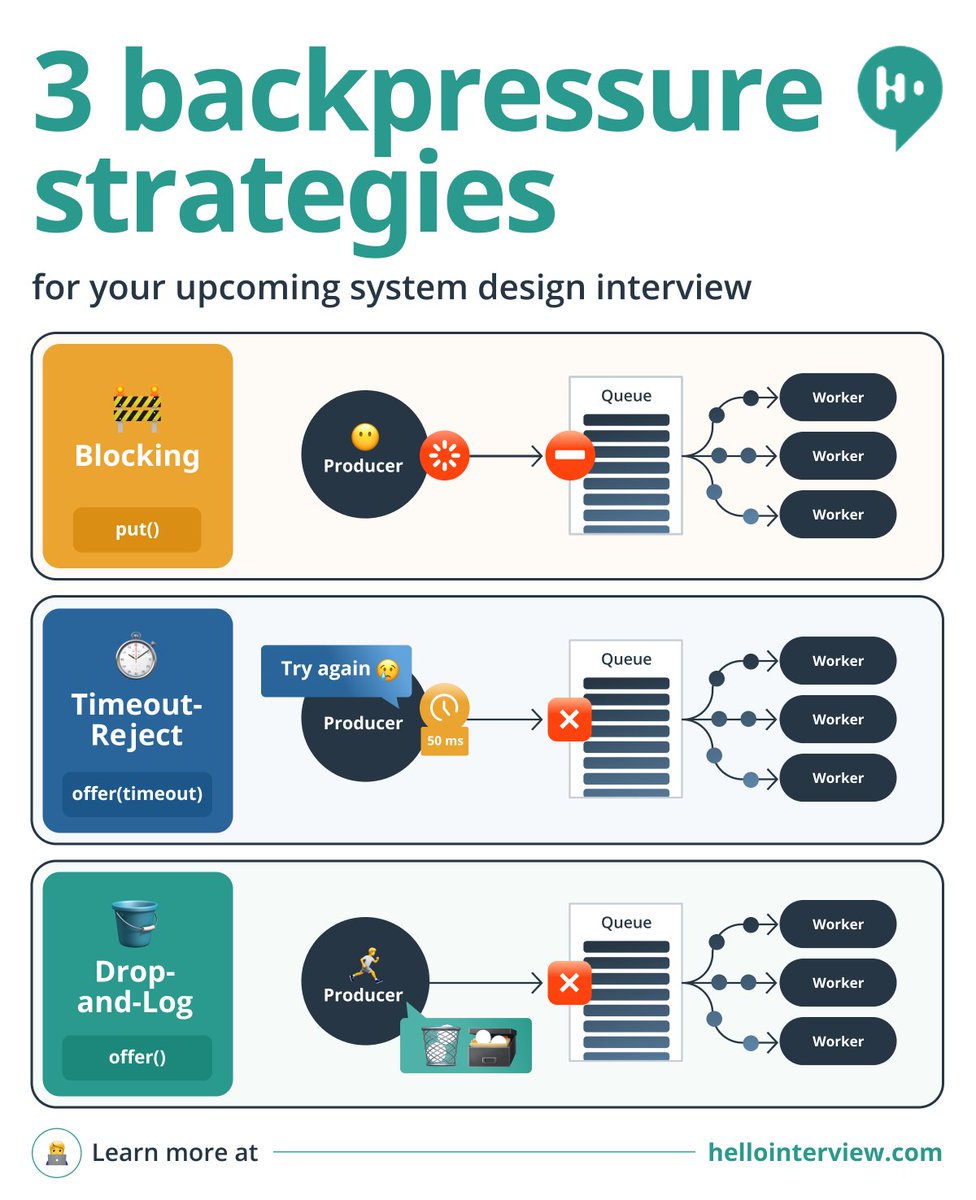
A queue won't save you if jobs arrive faster than workers can finish them. It just turns overload into a longer wait. Three ways to keep that under control.
We break posts like these down ourselves too: 𝑖𝑛-𝑡ℎ𝑒-𝑤𝑖𝑙𝑑&𝑢𝑡𝑚source=twitter&utm𝑚𝑒𝑑𝑖𝑢𝑚=𝑠𝑜𝑐𝑖𝑎𝑙&𝑢𝑡𝑚campaign=in-the-wild
Stripe Blog. Payments and fraud detection at a scale where being wrong costs money directly. stripe.com/blog/engineeri…
The best system design material is written by the people running the systems. Five worth reading, starting with Netflix on chaos engineering and streaming to 230 million people. netflixtechblog.com

What to expect in the format: youtube.com/watch?v=ssoYRv…
Which changes what is being scored. Not whether you can produce the function, but whether you can direct the tool, catch it when it is wrong, and own the result.
Meta has a coding round where you keep the AI. It is trying to hold two things at once: the practical reality that you will use a model at work, and the need to evaluate the person behind the keyboard.
When you meet someone, ask what you should know that isn't obvious and who else you should talk to. You'll learn things the onboarding doc misses. More on building context, relationships and momentum in a new role:
Take on a small, useful change you can finish well. Learn the code, get it reviewed and follow it through to production. Your teammates get evidence that you can deliver, and you learn how work actually gets done there.
You got the job. Now how do you become someone the team trusts with important work? Start smaller than your title might suggest.

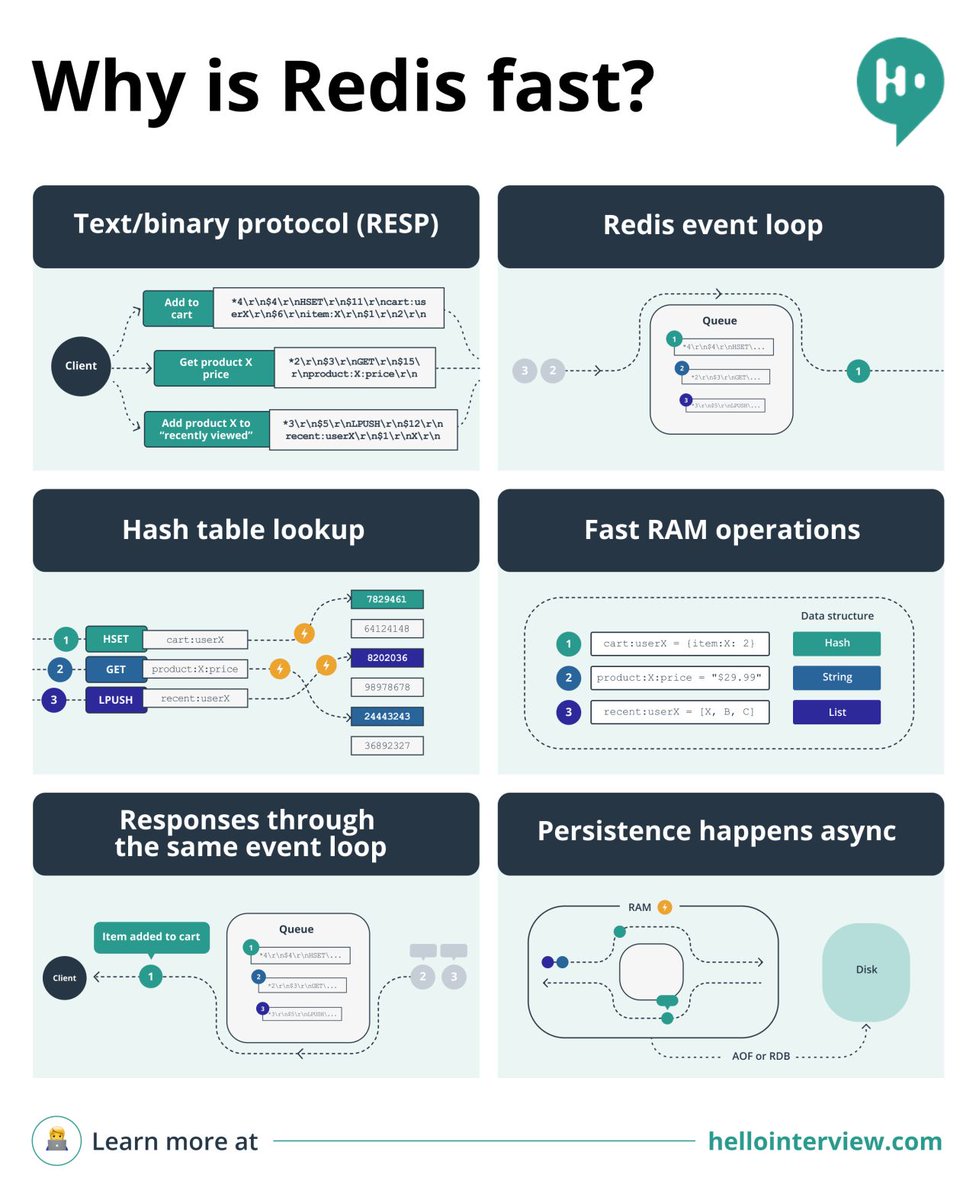
Persistence stays off the critical path. AOF appends sequentially with configurable fsync, RDB snapshots run in a child process. The tradeoff is you can lose data, and Redis makes that trade to stay fast.
Data lives entirely in RAM and keys route through a hash table, so most lookups are O(1) on average. No random disk I/O in the hot path.
Redis is single-threaded on purpose. One core loop processing commands means no locks, no context-switch thrash, no coordinating threads over shared data. Want more CPU? Run more instances in a cluster.
Full Post Search breakdown, built from scratch:
This one shows up in infrastructure-flavoured interviews specifically, where the interviewer wants to see how you reason about indexing rather than which product you would buy.
Design post search, and the interviewer tells you Elasticsearch is off the table. Now you have to build the inverted index yourself, which is the whole point of the question.



Melvin @REDMEL_
7 Followers 713 Following

ean @eanndut
29 Followers 335 Following
Amey Patil @AmeyPatil_9
16 Followers 612 Following CS @BITSPilaniGoa | Man Utd and Scuderia Ferrari ❤️
Raashid @raashid_anwar
3 Followers 218 Following
saumya tyagi @saumya_tyagi6
32 Followers 172 Following
Ashish Srivastava @ashsrivast1
0 Followers 8 Following

Samuel Jacob @sammycoolster
142 Followers 4K Following Senior Principal SW EE, DEBUG Ninja, Assembly Code Nut. OS Internals Crazed Software Mechanic.
Shourya Gautam @shouryagautam__
0 Followers 207 Following
Ankush @Ankush51457509
10 Followers 566 Following

Willliam Veliz @WiliVeliz
9 Followers 415 Following
Sam @RocksSal
0 Followers 563 Following
Atef Sawaed @AtefwSawaed
3 Followers 713 Following
Carmelito @mosrez1999
17 Followers 592 Following todos los cerebros del mundo ahaganzzmjzjslznxnxndvshakKM sjjsjsmsmskzjsjssjisks sijssjdjdu
Pratik Sonawane @pratik_6102
22 Followers 1K Following
Vishesh Jindal @VisheshJindal17
18 Followers 160 Following


Vaibhav Matere @vaibhav_matere
3K Followers 3K Following FullStack Dev, Curious - diversified interests random tweets around tech, jobs, books, travel, memes, some of my observations & learnings
Chinmay Bhushan @bhushanchinmay
11 Followers 221 Following
Chandra vai @Vaiyapuri17
2 Followers 58 Following
Nirmal Krishnan @nirmalrk1729
6 Followers 2K Following
Phx @Phxh6tg
1 Followers 281 Following
Moin Bagban @moin_bagban
21 Followers 178 Following
Hemant Adhikaari @HAdhikaar82
5 Followers 199 Following
Sinisa Dakovic @dakovic011
15 Followers 392 Following
Payas @payasvaishnav
315 Followers 512 Following prev intern @visa & jio • systems, ai, performance, cp
Vishank Sharma @SharmaVishank
1 Followers 96 Following Developer @SAP | Interested in AI, Tech, Books & more | A Generalist
Gaurav @Tweets_GS9356
52 Followers 139 Following Engineering - Amazon | Building software by day, dreams by night 💻 | Builder by Passion | Mentoring devs | Football fanatic | Movie buff | Meme connoisseur
Prince Kamariya @PrinceKamariya
56 Followers 831 Following Software Engineer @MeditabSoftware Hiring ? I’m up | DMs open
isaacschraderhank @isaacschraderr
0 Followers 514 Following
karan patel @kpatel1121993
11 Followers 200 Following
Farouq @pharouq_ay
25 Followers 163 Following
india bombay boy @indiabombayboy
21 Followers 4K Following


Trust the process | s... @aldox927
1K Followers 7K Following 9-5 is how you survive, I ain’t trying to survive I’m trying to live it to the limit and love it a lot.
SDE @SDE2078095
1 Followers 88 Following

abiramcodes @abiram_ng
16 Followers 266 Following He/Him | Looking for Remote Roles | Open source contributor | Front end developer | Angular | React
Prasanna @Iam_Prasanna_M
51 Followers 797 Following Dreamer | Fighter | All tweets are personal. RTs are not endorsements.
Yashwanth @yash1th_tweets
134 Followers 8K Following E quindi uscimmo a riveder le stelle. alum @mahindrauni
hrishikesh @Hrishikeshjosh9
11 Followers 606 Following
Ankur Sharma @sharmankur004
19 Followers 600 Following
Hiren @hiren_shah7
92 Followers 228 Following Staff Software Engineer/Architect | stock investing | numbers and data. Mostly reTweets

Kevin Alemán @kaleman15
192 Followers 653 Following Backend web developer. Trying to learn something new every day!

Stefan Mai @iamnafets
1K Followers 914 Following Older than all dogs. Creating: Hello Interview. Sold 2 startups, failed 1, ready for more. Previously ML eng leader FB, AMZN.You might like