SpaceComputer @SpaceComputerIO
The secure space internet infrastructure company 🛰️ Orbital confidential computing and security services spacecomputer.io https in orbit Joined May 2024-
Tweets1K
-
Followers4K
-
Following92
-
Likes2K

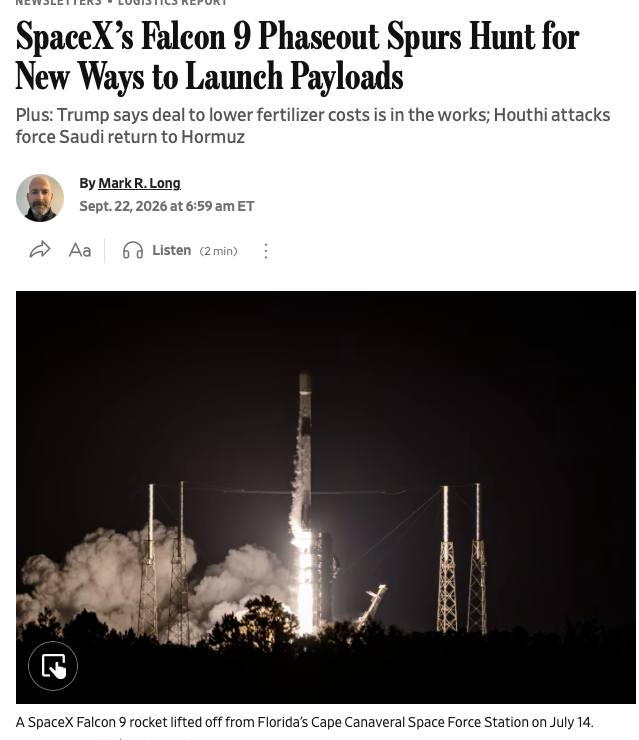
It's no longer a secret that Falcon 9 missions are deprioritized as SpaceX shifts more and more focus and resources to Starship There's a lot of industry wide concerns about it, but, are they justifies? Short term: absolutely, everyone is already feeling the crunch on launch availability Long term: this will lead to 1. Competition on launch, more resources will be allocated to get alternative providers into production 2. Long term this will be remembered as the traumatizing period we needed to make sure accessibility to space isn't neglected. SHOCK THERAPY for the space sector
Post Quantum Cryptography (PQC) is critical infrastructure for space technologies. And this is a much deeper conversation than just preparing for the inevitability of quantum computers breaking classic cryptographic encryption. We need to build adaptable, software-enabled post-quantum migration solutions for spacecrafts that work with data in any capacity. At SpaceComputer, PQC readiness and migration is a top priority amongst our cybersecurity solutions. Subscribe & watch the full video on YouTube: youtu.be/oa4zc0JiwH0
EDCON has always been one of my fav gathering for the Ethereum community Stoked to support 2026 conference in Kuala Lumpur 🫡💛💚

EDCON has always been built by and for the Ethereum community. This year, we’re taking it a step further to ground EDCON2026 even deeper in our host region. Introducing the EDCON2026 Community Committee👇 Three local leaders bridging the global Ethereum ecosystem with APAC’s

Read about KMS & PQC: blog.spacecomputer.io/post-quantum-m…
Post-quantum migration is fundamentally a key management problem. You can’t upgrade key security if you can’t find the keys. A key management service (KMS) centralizes key generation, storage, access control, rotation, and audit, so keys live in one hardened place, like a trusted execution environment (TEE). That's security you need today. Post quantum cryptography (PQC) is security for the future where quantum computers will eventually break public key encryption. These threats are relevant today. Harvest now, decrypt later attacks collect encrypted data today to break it once quantum machines are strong enough. So why do you need both? When every key lives in a KMS and you swap in quantum-resistant algorithms, every key inherits the upgrade. The KMS becomes your layer of cryptographic agility. A KMS also automates the mechanics of generating new keys, re-encrypting data, and key rotation and retirement across your stack. It also absorbs the friction of PQC's larger keys and signatures so your applications stay fast. With quantum computing still on the horizon, and KMS options available from every cloud provider, why is SpaceComputer building a post-quantum agile platform? One simple reason: a satellite launched today must be ready for the next 5-10 years. You can't add hardware in orbit (for obvious reasons), so crypto-agility must be built in before launch. Our KMS will anchor keys in attested TEEs, non-exportable by design: they can be used but never extracted. We're starting with hardened infrastructure on Earth, eventually moving to keys born in orbit inside a satellite-based TEE, with post-quantum readiness currently in development. So we ask you: how are your security keys managed today? And if you could test a KMS built for orbit: would you? Drop a 🙋 below if you'd want early access.

The space industry is at the precipice of an exponential transition 1. Nearish term: from 10-20k satellites in orbit to ~100k 2. Longer term, prepare for >10m satellites Security infrastructure requires first principles thinking across the stack and the opportunities are huge!
There's 15,000 satellites in orbit today, with projections for over 100,000 by 2030. As part of the new generation of companies racing to build compute satellites, we ask one question: how are companies handling their cybersecurity? Many platforms are marketed as 'secure' and
There's 15,000 satellites in orbit today, with projections for over 100,000 by 2030. As part of the new generation of companies racing to build compute satellites, we ask one question: how are companies handling their cybersecurity? Many platforms are marketed as 'secure' and 'sovereign' yet take no visible steps towards cybersecurity measures. And cybersecurity is becoming such critical infrastructure in space it's at a 5 billion dollar market gap in 2025. This coincides with cyber incidents surging upwards of 118% in 2025, with little critical infrastructure built to encrypt, secure, and protect everything from ground stations to GEO spacecraft. We're building to fill that gap, and solve the security problem in space infrastructure. Here's a comprehensive breakdown of the state of the industry, and what we need to do next with cybersecurity for space infrastructure: blog.spacecomputer.io/the-5-billion-…
If your satellite isn't secure at launch, it can be compromised with as little as a software-defined radio and a few software bugs. "So we have to consider the life cycle and the lifetime of the designs of the respective choices, the respective spacecrafts and make sure that there are solutions for that." That's our mission at at SpaceComputer: building secure satellite computing systems for the long term, starting at the hardware and software level. Catch the full deep dive with on YouTube: youtu.be/mip1p4zy3Ks
@Lithos_eth very interesting way to look at it! 🤔
Every spacecraft and ground station in the data chain needs security and end-to-end verifiability. One of the best use cases for this is satellite imaging. Our approach to this is to use cryptographically verify what image came from which satellite. This high-security guarantees help prove the image wasn't tampered with, which is useful for providers and data users alike. Let us know in the comments what other use cases verifiability in orbit could be used for? 🤔
Watch the full episode of the Space Show here: youtube.com/watch?v=Lrim_L…
Are space data centers are dumb, or does SpaceX's IPO filing make them inevitable? This is the most polarizing debate in orbital computing: cooling vs. power. We cover both arguments at their strongest points, and the R&D pipeline that will end the argument by 2027. Read it here: blog.spacecomputer.io/orbital-data-c…
Commercial activity led roughly 78% of the $626B space economy in 2025 Governments are now the minority customer! Every satellite business needs several other space businesses to get it from idea to orbit everyone is racing to build a piece of the space acceleration era, but all these layers aren't yet interoperating the same way infrastructure does on Earth. I've compiled my recent 3 piece into a deep dive on 50+ companies, from ground stations on Earth to asteroid miners, and what's happening in each layer: blog.spacecomputer.io/layers-of-the-…
For some applications, the most secure place to run a computer is where nobody can reach it. For others physical inaccessibility is the biggest limitation. We spend a lot of time thinking about these kinds of tradeoffs that come with building compute systems in orbit. On Earth, compute is abundant and trust is the hard part. Roughly 55% of data center security incidents come from the inside. In orbit - nobody can access the satellite, and therefore the physical attack surface is ≈0. In orbit, that same isolation means no repairs, radiation-constrained chips, and a power budget where one satellite roughly equals one GPU today. So which one do you build on? It depends on what applications you're building for and the level of in-depth security you need. If physical possession of the hardware is part of your threat model, orbit offers guarantees Earth can't match. If you need fast, large-scale compute, and your threat model is handled by conventional controls, Earth wins on practicality. (For now). So where do you sit on the tradeoffs of physical isolation and capabilities on Earth versus on orbit? Let us know in the comments 👇


Want to know what it will take to secure the space internet? Had such a fun time with at the T-Minus Space-Cyber Briefing with Maria Varmazis! It was a bit of challenging to fit everything into 15 mins though. Tune into how we're approaching secure stack in space at @SpaceComputerIO 👇 youtu.be/eDhsmBr-_GA?si…
Open, verifiable Space Infrastructure. When you realize that current space infra is in it's infancy and lacks verifiability, interoperability and security that seem obvious today in terrestrial networks - then you realize @SpaceComputerIO's mission.
At SpaceComputer, we look at our open infrastructure the way the internet once looked at Linux. Linux infrastructure is open, auditable, and vendor-neutral. That openness is why it’s the foundation of the internet: hyperscalers, competitors, and governments could all standardize
👀🛰️
Which trust decisions across the Earth-to-orbit path can actually be verified and which risks still sit outside that evidence? The more we looked at it with @zkpedrongmi and the rest of the team, the more the same pattern kept showing up: space systems need a better model for
Ready for the full talk? Subscribe to the Frontier Podcast on YouTube: youtu.be/mip1p4zy3Ks?si…
At SpaceComputer, we look at our open infrastructure the way the internet once looked at Linux. Linux infrastructure is open, auditable, and vendor-neutral. That openness is why it’s the foundation of the internet: hyperscalers, competitors, and governments could all standardize on it, because trusting Linux never meant trusting a vendor. We're doing the same for the space internet. Our infrastructure design, Space Fabric, is built on open verification. We publish our tech stack and system design, and work with hardware partners like Tropic Square also take an open source approach. We incorporate Raspberry Pis into our infrastructure due to their exceptional interoperability across diverse applications. Linux was one of the biggest companies to build backbone level verifiable infrastructure into what it is today. The space internet needs the same foundation, and we're building it. Explore the solutions we offer now: spacecomputer.io/solutions/?utm…

yonash_liberman @LibermanYonash
5 Followers 207 Following
Mariana @maricoim
2K Followers 3K Following growth geek in audits @pashovAuditGrp. prev @requestNetwork, @0xCoinshift | @devreluni Cohort 2| @Kernel0x B4 | Industrial & Mngemnt Engineer. Views'r my own.

Donlad Rook @DonladRook
1K Followers 670 Following 🖍🧠 Elon and Nikki or whoever ruined this app and killed retweets

Alexandr Yablochnikov... @AYablochnikov
396 Followers 2K Following
Angelo Olivera @redondos
121 Followers 1K Following
DocCrypte @Doccrypte
48 Followers 1K Following

Evan 🔜 CASTLEDAO �... @0xevan
922 Followers 3K Following Head of Growth @DLP_Group | (Prev. @OKX, @vibevibefun & @Seedify


Dr. Danny Bruna @DrDannyBruna
11 Followers 384 Following Dr. Danny Bruna is a leading expert in cyber Wargaming, cybersecurity, and information technology. With a Doctorate in Information Technology/Cyber Security, he


NordicPatient @NordicPatient
0 Followers 32 Following

saleel.eth @_saleel
1K Followers 342 Following Leading @ZKPassport at @AztecLabs_ - Prev: @ethereumfndn @PrivacyEthereum, @zkemail, @AnonAadhaar
D Wood @dwood32896
1 Followers 6K Following
0xdevas @0xdevas
209 Followers 1K Following 0xbe863b2a9cbef8462c5c23791ed21456d0df0563bc95396e25e75397e54732d3 #SUI @monad
Gary Wachtel @gary_offchain
409 Followers 477 Following @OffchainLabs General Counsel // all views are my own.
Marcin Bosk @OrBoskey
39 Followers 145 Following PhD candidate and researcher at @tum_cm @TU_Muenchen It's ok to fail if you learn from it!

Drownedのチャン�... @Ticocotico2
65 Followers 182 Following リヴァイアサンさまのテンパード アイコンは花屋 📷 Copyright (C) SQUARE ENIX CO., LTD. All Rights Reserved
Sandipan Kundu 🛠 @SandipanKundu42
3K Followers 3K Following Developer Relations & AI Engineer | Fine-tuning and Inference https://t.co/Xz1nPoloxY https://t.co/GkgQPJPxZ4
ywc⟠ @yashwant_eth
1K Followers 6K Following 0 → 1 → ∞ onchain since ’21. interested in technology. i use products

metaVrealtyco @metavrealtyco
145 Followers 3K Following
NANOG @nanog
8K Followers 211 Following North American Network Operators’ Group | Our networking engineering events shape tomorrow's’ Internet infrastructure. Join Us: 10/19-10/21 - Miami #WeAreNANOG
LJ @ljthebald
7K Followers 3K Following Web3 BD & Growth | 5 years in the trenches GTM, partnerships, launches & the occasional bad take
𝗛𝗮𝗿𝘃𝗲�... @crreach1
8K Followers 4K Following Co-founder & CEO @ChainReachCalls | Web3 ♦ Capital Markets ♦ Community | Helping founders sharpen their narrative, gain visibility & build traction.
kapp @richkapp_
2K Followers 1K Following i love building current project: product & strategy @everdraw_rpg
Binwilly @binwilly_
173 Followers 924 Following CTO @intuitivo_ai | Co-founder @cuidamimascota | Convirtiendo ideas en productos que escalan.
Milk Road Crypto @milkroaddaily
106K Followers 4K Following Helping millions of investors navigate the crypto markets. Track our 5 top-tier analysts portfolios inside Milk Road PRO.
Levent Peker @pekerleo
37 Followers 224 Following Satellites, systems, spectrum & the intelligence behind the launches.


Betoshi_Pt 🇵🇹 �... @Betoshi_Pt
5K Followers 5K Following Web3 Educator & Analyst Análises Fundamental Honestas de Projetos e DeFi Termos Técnicos Cripto com Humor e Profissionalismo Founder & Mod & Content Creator
OpenDe.AI|中国龍... @ZHCsAI
5K Followers 5K Following https://t.co/UWjbFYzDTf|Open Decentralized AI https://t.co/uvmqGOvqqX |Zero Human Companies
Baltic container @Balticcontainer
362 Followers 2K Following Our company ,,Konto garantas'' sells #containers in Baltic coutries and beyond.If you have offers as a supplier contact me. Looking forward for collaboration.
Alexander Platinum �... @DaiKimBlue868
114 Followers 893 Following Encrypted ☂️ Master !!! OG of ETH @ArcResearch102
Ⓜ️anuel Polo @mrmx
2K Followers 6K Following 2 fix or not 2 fix,that's the expression. #Bitcoin ❤️ soft dev circa 80s,🎹4 ever & life ∞.@Wuabit @Wualabs @OnWuard @QTSurfer @WuaLeds 🤖@LibroBlockchain 📖
WEB3 MATRIX @WEB3_MATRIX
814 Followers 7K Following Building the bridge between Web3 projects and thriving communities. 🌐 AMAs • Community Growth • Partnerships • Web3 Marketing
Andrey McQueen 🐂�... @AndreyMcQueen
4K Followers 6K Following Supporter @Polkadot @kusamanetwork , PBA-X @AcademyPolkadot Wave #1
Caspian @Ca5p1an
60 Followers 691 Following 𝙸𝚗 𝚒𝚝 𝚏𝚘𝚛 𝚝𝚑𝚎 𝚌𝚞𝚕𝚝𝚞𝚛𝚎, 𝚗𝚘𝚝 𝚏𝚘𝚛 𝚝𝚑𝚎 𝚝𝚎𝚌𝚑... 𝙲𝚘𝚗𝚝𝚛𝚊𝚛𝚒𝚊𝚗. 𝙻𝚊𝚛𝚙. ∞ ⟠

| MinhDucc | Shark @SharkDucc
2K Followers 2K Following ✧ Content Creator | Web3 & Blockchain | NFT ✧ Sketch artist ✍️ | Learning, contributing, evolving 👑Contributor XYZ @axisrobotics

Tropic Square 🌴�... @tropicsquare
4K Followers 121 Following Transparent and auditable secure elements. Don’t wait — start building with TROPIC01 DevKits now! https://t.co/FbtYAoGRHw
Spacemanic @spacemanictech
1K Followers 883 Following We produce new-generation high-end nano-satelitte buses for your payload and components for your nanosats. Call us for datasheets, prices and collaborations.
Utocif @utocif
39 Followers 258 Following cryptographer working on TSS/MPC/PQC @spacecomputer, prev @vultisig / @thorchain

Pedro @zkpedrongmi
3K Followers 1K Following DevRel & Technical BD Lead @SpaceComputerIO. Prev @aztecnetwork, @0xPolygon. I talk about space, zero-knowledge and decentralization. Opinions are my own.

Ameen Soleimani @ameensol
47K Followers 12K Following coordination arms dealer @unchainiran @0xbowio https://t.co/mH2RCmSK73 @letsgethai @reflexerfinance @molochdao
Amber Group @ambergroup_io
45K Followers 35 Following https://t.co/kK7sDgejA8 / https://t.co/lv7AAjjaKh / https://t.co/hhMNDr2TR6
Regan Bozman @reganbozman
17K Followers 2K Following investing in open markets @lattice_fund @gocryptopeaks past lives @dovemetrics @CoinList @AngelList
Zurab Kazhiloti | Bit... @kazhiloti
3K Followers 819 Following Bought first BTC in 2013. Founder at https://t.co/nn7Cid85UY from 2017.

EO @EO_Network
39K Followers 292 Following EO Network: The Data Layer for RWA's and Institutional DeFi

Tom Mitchelhill @ideacasino
7K Followers 1K Following internet coin enjoyoor | head of growth @synthetix | host @ngmi_xyz | serfmaxxing @frmrsmrkt | petrol checkooor
Vaelyn @Cyph3rVae
484 Followers 778 Following backing buidlers at @PlutosCap w @FryCookVC || @ETHPanda_org @wiepteam @winprivacy @Eth_Auckland @babesnetx🤓 Ex-litigation. Cypherpunk. Views are my own.
The Tallest Tara @tarasjeans
490 Followers 488 Following AI, crypto & space tech marketing | ideas are intangible without execution | Algae enthusiast | @savebaddies | @shefiorg S14 scholar | @SpaceComputerIO
Marta Adamczyk @madamczyk0
586 Followers 744 Following ops & events @SpaceComputerIO 📡🛰 @shefiorg Season16 💫 contributing @EthereumSydney @ETHWarsaw @WomenInPolkadot @Durian2069
Encode Club @encodeclub
44K Followers 9 Following Learn, build and advance your career in AI & Web3. The Encode Hub our new London builder space https://t.co/PnEpwlHZK0
thumbpark @eomjipark
3K Followers 1K Following Community, Ecosystem & Growth | Web3 x AI | Prev. Head of Research & Operations at @encodeclub | Guest Scientist at I8 @TU_Muenchen
Nina Rong @nina_rong
43K Followers 2K Following Executive Director of Growth @BNBChain | prev: Head of Partnerships @Arbitrum Foundation and @OffchainLabs | All words are Rong and NFA
Lukas ⟠🔺 @FryCookVC
355 Followers 1K Following ⟠ I have zero knowledge of crypto ⟠ FryCook turned HeadChef at @PlutosCap ⟠ channeling network spirits ⟠ pesca-pescatarian
Rand @randhindi
41K Followers 7K Following Founder (@zama), deeptech investor (https://t.co/3Bm60gidap) & competitive biohacker



Kyle O'Brien @analog_kyle
2K Followers 2K Following building confidential onchain finance @zama funding freaks & geeks @unit_ventures documenting the singularity @JoinStateChange

praneeth_s 🦇🔊 @bees_neeth
2K Followers 2K Following Investing @etherealvc. Did venture investing ⟠ @Consensys and bits and bytes @microsoft 🦇🔊
AppleNvidia ∞ KIN @AppleNvidia
1K Followers 8K Following Founder @AppleNvidiaAlfa 💎 Alpha is Darkness let me Shine the Light ⚡️ I track Smart Money 🧠🧠@Wise3Ventures @UnidentifiedDAO @leftcurvedao @WarsFNF


Andy Chen @andyisnotandy
642 Followers 3K Following ventures & investments @GSR_io, prev @Superscrypt
Eason Chai @easonchaiii
929 Followers 519 Following Betting on the future @foresightnow | Prediction Market Fanatic

swillinger @swillinger
962 Followers 2K Following GP @thebbfund Running @stanfordSBA fmr @cbventures @blockstream @google
Kun Peng @elkun_peng
2K Followers 183 Following 🇨🇳🇦🇷🇺🇸 with a touch of 🇮🇹. Also speak: 🇧🇷🇫🇷 | Founder of SBA & BASS & ETHSF & ETHNYC @StanfordSBA | Partner @thebbfund | @Stanford MS
Blockchain Builders F... @theBBFund
2K Followers 296 Following Blockchain Builders Fund supports and invests in the best blockchain founders and teams from the Stanford Blockchain community

Bodhi Ventures @bodhi_ventures
3K Followers 52 Following Investing, building and disrupting alongside the tech mavericks of the world | Partners @hjmomtazi @kaiynne

Mike Zajko @MikeZajko
5K Followers 1K Following Backing Founders @lattice_fund ⛷ @gocryptopeaks since 2020 Previously @coinlist & @facebook


vikiival @vikiival
1K Followers 2K Following Experimental AI & Crypto Research ⚗️ prev: co-founder of @KodaDot 🖼 Crafting the world, one pixel at a time.

rain & coffee @rainandcoffee
11K Followers 2K Following research partner @Maven11Capital writings @ https://t.co/KbQfPAyrJs

Wise3 Ventures @Wise3Ventures
2K Followers 56 Following We support, encourage and fund bold Web3 founders. Here to leave our mark on the ecosystem.
You might like