SnoreLessNow @SnoreLessNow
Sleep education from the team behind SnoreLessNow. Daily insights on snoring: why it happens, what helps, and how to sleep (and breathe) better 💙 🇺🇸 SnoreLessNow.com Ellicott City, Maryland Joined February 2023-
Tweets198
-
Followers12
-
Following3
-
Likes39
Two oral appliances for #snoring and sleep apnea can look similar from the outside but work on completely different principles. Knowing the distinction matters if you are weighing options with your dentist 🦷 A standard mandibular advancement device, or MAD, uses upper and lower components to gently move the lower jaw forward during sleep. That forward position also brings the tongue with it, which helps keep the upper airway open. The Full Breath Solution takes a different design route. It is a single arch appliance with a posterior tongue restrainer that limits backward and upward tongue movement directly, without relying on mandibular advancement. Both aim to support airflow during sleep. The right one depends on your anatomy, your diagnosis, and which mechanism your dentist or sleep professional thinks fits your case. Neither should be self prescribed, especially if obstructive sleep apnea is involved 😴 Read the full breakdown: snorelessnow.com/blogs/the-good… 👉 #OralAppliance #SleepApnea

If you have been quietly wondering why your morning breath is especially rough on nights you snored a lot, there is a specific chain reaction behind it. Worth knowing because once you see it, breaking it gets easier 💧 You snore with your mouth open. Your mouth dries out. Saliva, which is your mouth’s natural rinse, runs low. Without enough of it, bacteria on the tongue multiply and produce the volatile sulfur compounds behind the smell. By morning, you have the dry, funky taste that no amount of brushing the night before quite prevents. Three small habits break the chain. Encourage nose breathing with a nasal dilator or by addressing nasal congestion so your mouth has less reason to fall open overnight. Keep water on the nightstand to sip if you wake up dry. And tackle the #snoring itself, since fixing the source saves your mouth from drying out in the first place 😴 Read the full breakdown: snorelessnow.com/blogs/the-good… 👉 #OralHealth #SleepHealth

If you have been shopping for a "quiet mouth guard" to deal with both #snoring and teeth grinding, here is the honest answer most product pages skip. These are two different sleep problems that happen to share a part of the body 🌙 The signs of grinding are specific. Waking with a sore jaw or tight facial muscles. Tooth sensitivity. Worn or flattened tooth surfaces. Chipped teeth. Headaches around the temples. A partner hearing grinding sounds during sleep. The signs of snoring that calls for more than a comfort device are different. Loud nightly noise. Gasping or breathing pauses. Daytime fatigue despite full nights in bed. Each warrants its own evaluation, which is why the honest answer is often two conversations rather than one product. A dentist can assess the grinding and recommend an appropriate guard. A doctor can evaluate the snoring. Starting there protects both your teeth and your #sleep 🩺 Read the full breakdown: snorelessnow.com/blogs/the-good… 👉

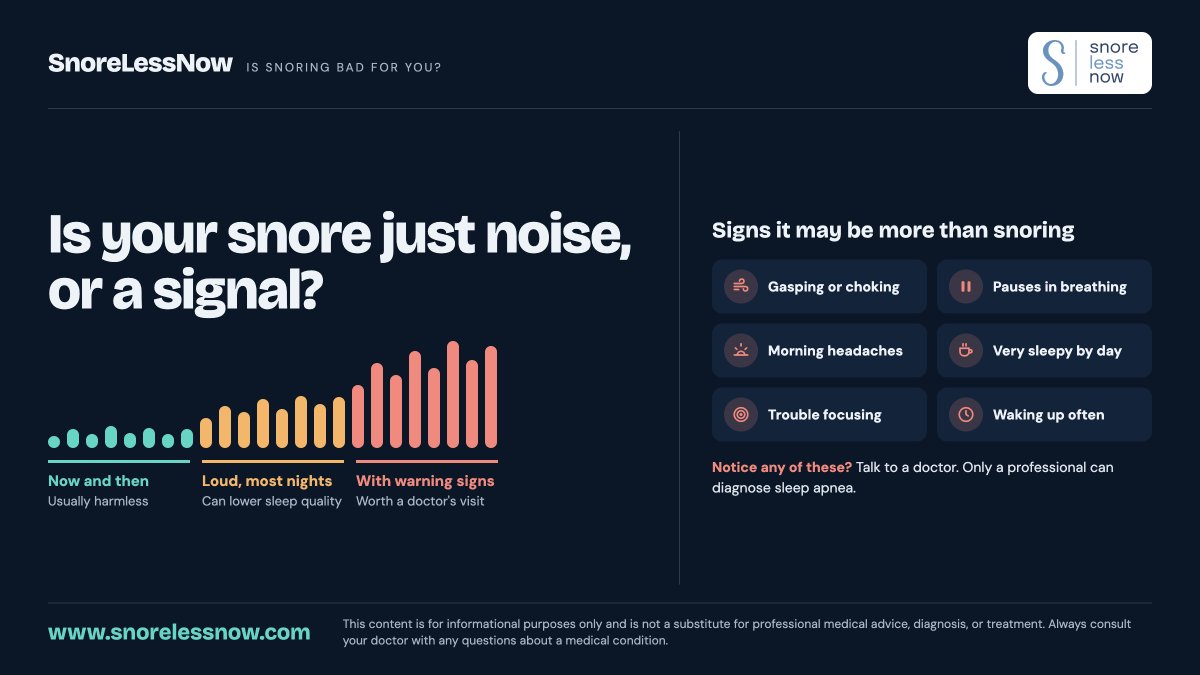
Snoring is one of those things that gets treated like a punchline until you are the one lying awake listening to it, or the one waking yourself up mid snore. The honest answer about whether it is bad for you depends on where it sits on a three tier ladder 🕵🏻♂️ Occasional and mild is the first tier. A late night, a few drinks, a bad cold. It comes and goes, does not disrupt your own sleep, and your partner is not reporting anything unusual. Usually harmless. Loud and nightly is the second tier. The airway is more consistently obstructed, which fragments your sleep even if you do not fully wake. Daytime fatigue, trouble focusing, and never quite feeling rested can quietly follow. The third tier is loud #snoring paired with gasping, choking, pauses in breathing, morning headaches, or heavy daytime sleepiness. That combination is worth a doctor's visit rather than waiting it out. Only a professional can diagnose #SleepApnea. No device or habit change is a substitute for that conversation when the warning signs show up 🩺 Read the full breakdown: snorelessnow.com/blogs/the-good… 👉
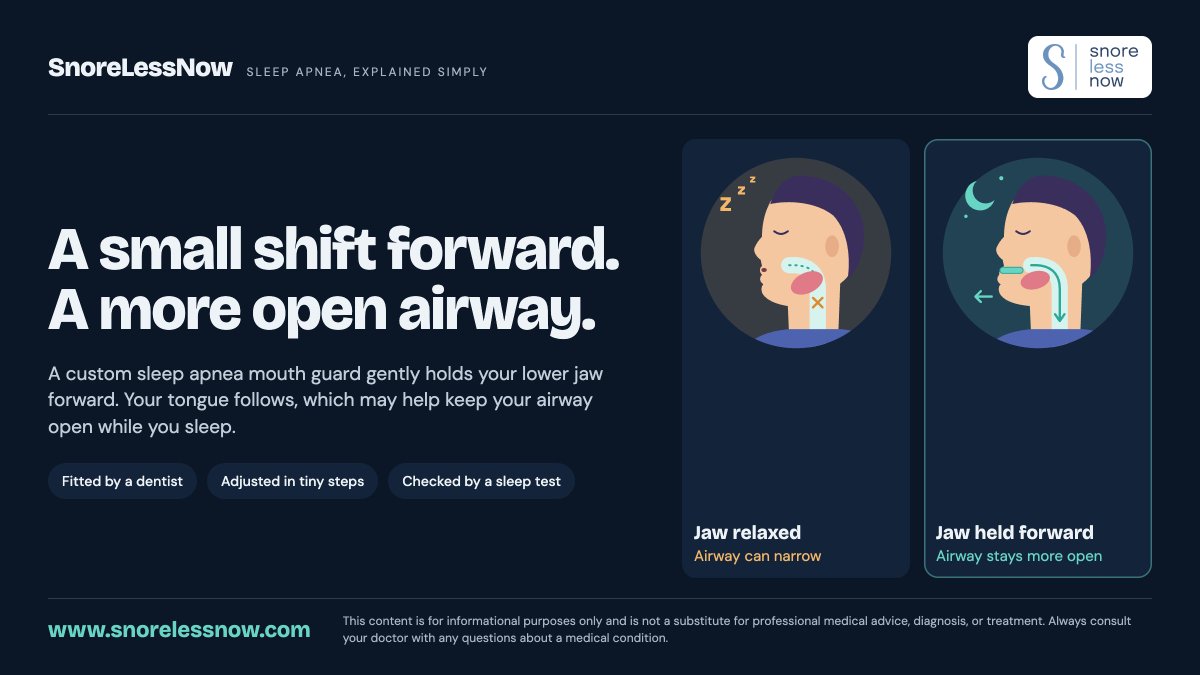
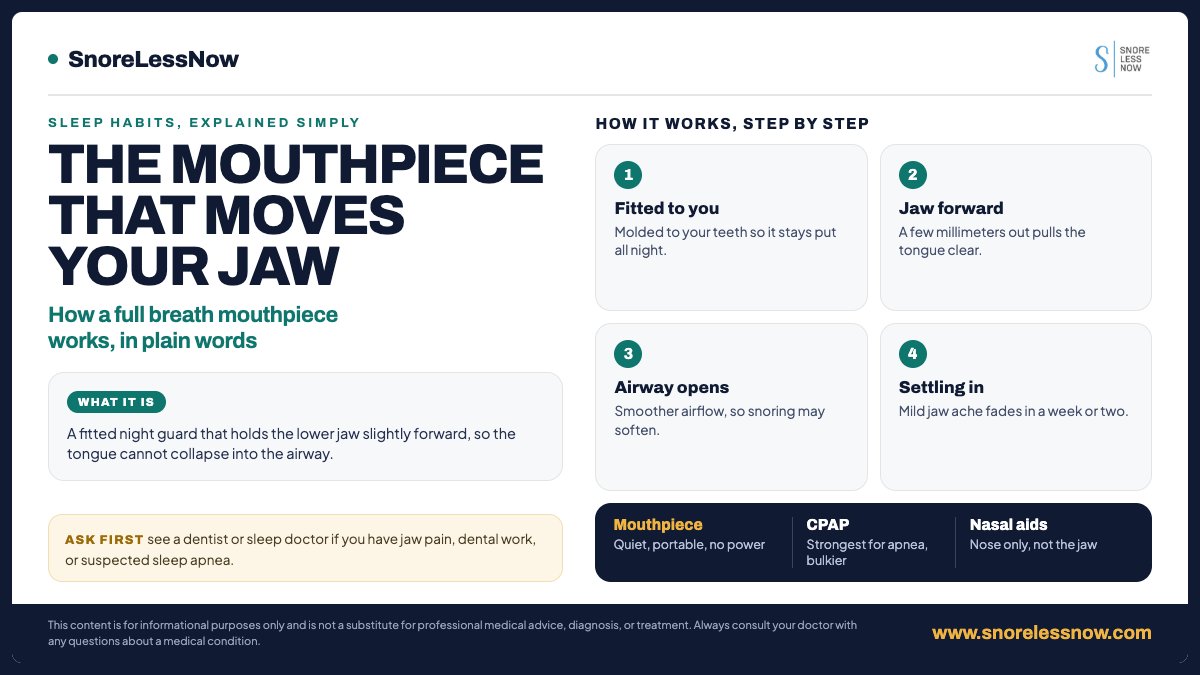
A custom sleep apnea mouth guard works on a surprisingly small physical principle. The lower jaw is held slightly forward during sleep. The tongue follows. The upper airway stays more open than it would otherwise 🌒 Three things separate a prescribed custom appliance from an over the counter mouthpiece. First, it is fitted by a qualified dentist to your individual dental and jaw anatomy. Second, it is titratable, meaning the mandibular position can be adjusted in tiny steps over several visits to find your therapeutic range. Third, its effectiveness is confirmed by a follow up sleep test, because reduced #snoring or better sleep alone does not prove sleep #apnea is adequately controlled. The American Academy of Sleep Medicine recommends oral appliance therapy for adults with obstructive sleep apnea who cannot tolerate #CPAP or prefer an alternative. It is a clinical pathway with real oversight, not a product to self prescribe. If you have diagnosed or suspected sleep apnea, start with a sleep physician and dentist 🩺 Read the full breakdown: snorelessnow.com/blogs/the-good… 👉
If autumn always feels like your sleep quietly slips, you are not imagining it. Shorter days, drier heated indoor air, and the clocks changing all nudge sleep off course. The way through is smaller than most guides make it sound 🍂 Seven small adjustments that tend to help. Catch morning light early, since ten minutes outside anchors your body clock against the later sunrises. Keep one wake time, which is steadier than chasing an early night. Add moisture to the air, because heating dries the nose and throat. Keep the bedroom cool overnight by turning the heating down. Wash bedding weekly, since dust mites build up once the windows shut for the season. Move the clocks gently for daylight saving, fifteen minutes at a time over several days. And watch the cosy habits: evening wine, heavy comfort food, and late naps all make snoring louder and sleep lighter. Pick two or three and hold them rather than trying all seven at once. That is how #autumn sleep actually gets steadier. 🌒 Read the full breakdown: snorelessnow.com/blogs/the-good… 👉

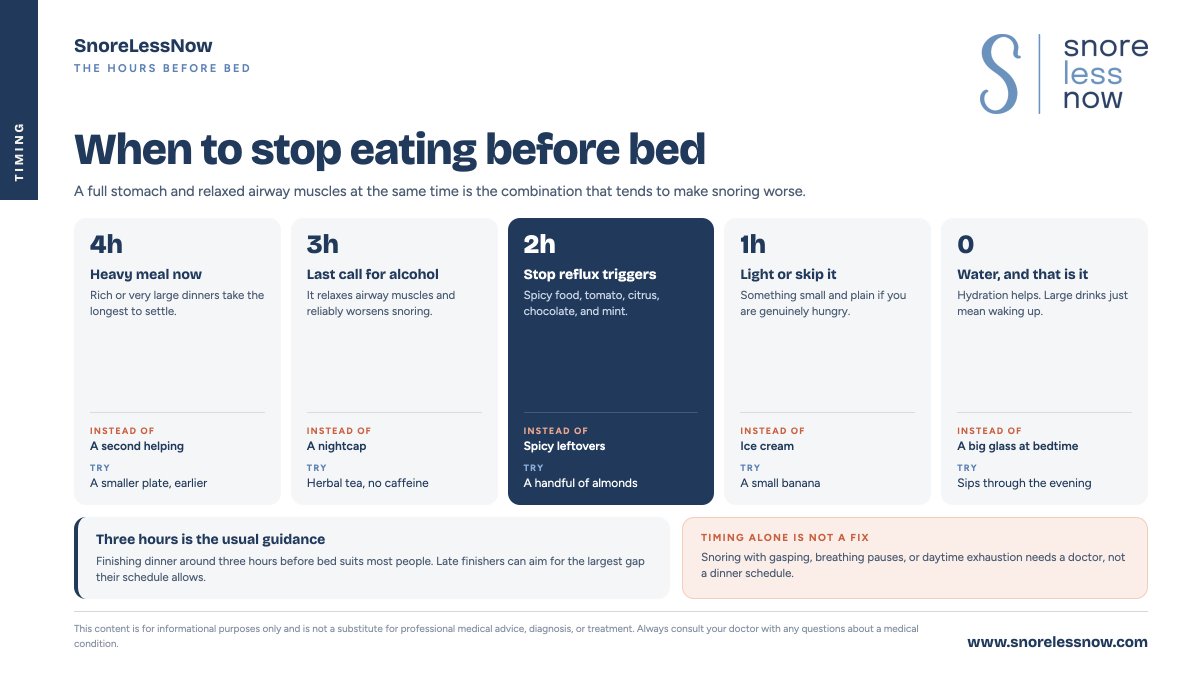
If you snore, the hours before bed matter more than most people realize. Here is a countdown that tends to reduce noise at night ⏳ Four hours out. Eat the heaviest meal of the day. Rich or large dinners take the longest to settle, so give them time. Three hours out. Last call for alcohol. It reliably relaxes airway muscles and worsens snoring more than any other single factor. Two hours out. Stop reflux triggers. Spicy food, tomato, citrus, chocolate, and mint can irritate the throat overnight. One hour out. Light or skip it. A small plain snack if you are genuinely hungry, not ice cream. Bedtime. Water only, and small sips through the evening rather than a big glass at the last minute. Three hours is the usual guidance. Late finishers can aim for whatever gap their schedule allows. Timing alone is not a fix. #Snoring with gasping, breathing pauses, or persistent daytime exhaustion needs a doctor, not a dinner schedule 🍽️ Read the full breakdown: snorelessnow.com/blogs/the-good… 👉
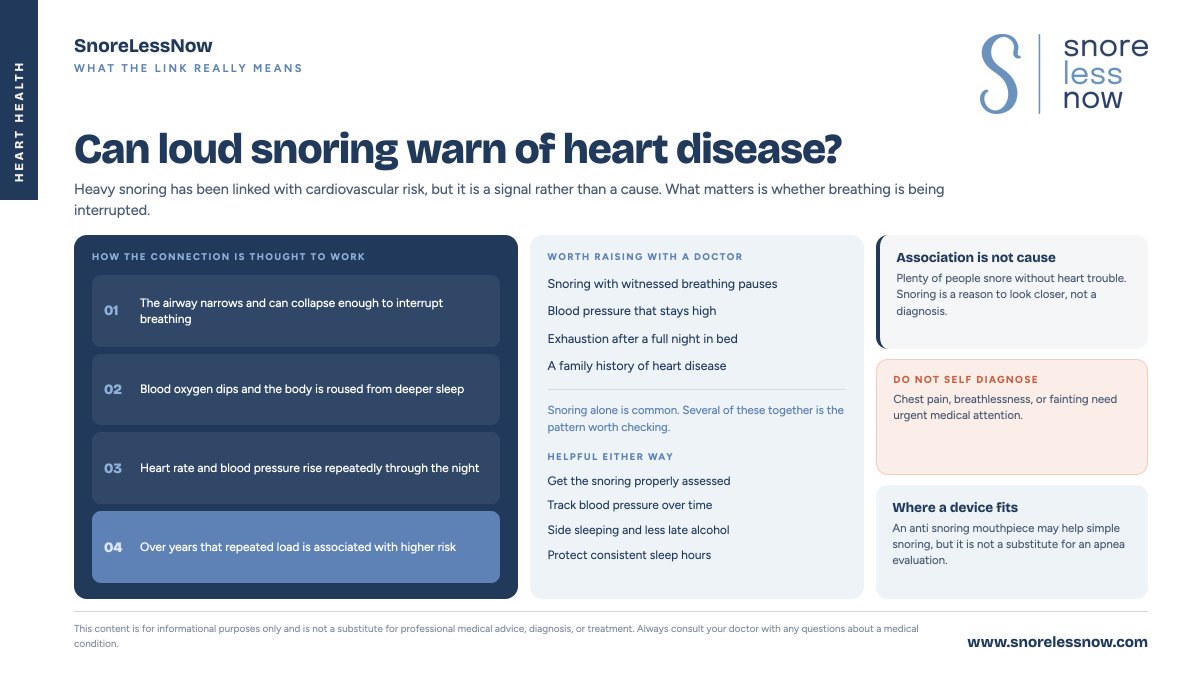
Heavy snoring has been linked with cardiovascular risk in years of research. But the link is a signal, not a cause. What actually matters is whether breathing is being interrupted through the night ❤️ The mechanism looks like this. When the airway narrows enough to briefly collapse, blood oxygen dips. The body rouses from deeper sleep to restart breathing. Heart rate and blood pressure rise repeatedly. Over years, that repeated load is associated with higher cardiovascular risk. Simple #snoring without breathing interruptions does not involve the same pattern. The signs worth raising with a doctor are the combinations. Snoring with witnessed breathing pauses. Blood pressure that stays high. Exhaustion after a full night in bed. A family history of heart disease. Snoring alone is common. Several of these together, most weeks, is the pattern worth checking. And if you experience chest pain, breathlessness, or fainting, that is urgent medical attention, not a next appointment 🩺 Read the full breakdown: snorelessnow.com/blogs/the-good… 👉
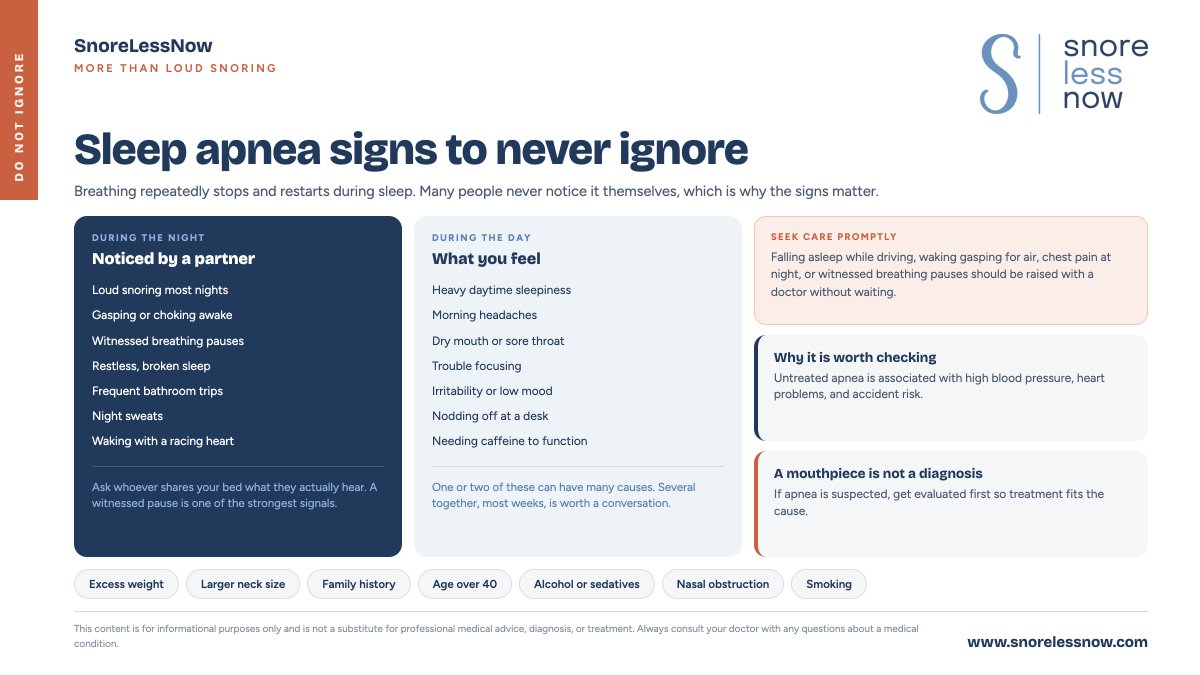
One of the strangest things about sleep #apnea is that the person who has it is usually the last to know. Breathing repeatedly stops and restarts through the night, but you never remember it. The brain wakes just long enough to reopen the airway, then you drift back down. The signs almost always come from someone else 💤 That is why witnessed pauses in breathing are one of the strongest signals. Loud, habitual snoring most nights. Gasping or choking awake. Restless sleep with frequent bathroom trips and night sweats. Then during the day: heavy sleepiness that does not lift with more hours in bed, morning headaches, trouble focusing, low mood, needing caffeine just to function. One or two of these can have other explanations. Several together, most weeks, is worth a conversation with a doctor. Falling asleep while driving, waking gasping for air, chest pain at night, or a witnessed breathing pause should be raised without waiting. A sleep study can be done at home now, not just in a lab. Read the full breakdown: snorelessnow.com/blogs/the-good… 👉
If you have tried nasal strips and given up on them, chances are the problem was not the strips. It was where you put them 👃 Placement is genuinely everything with nasal strips. The flexible bands inside each strip try to straighten after they are stuck down, and that outward pull is what widens the nasal passages. Set the strip on the bony bridge of your nose and there is nothing for it to lift. Set it too low over the nostrils and it slips. The sweet spot is just above the nostrils, where the bone gives way to softer tissue. That is the part of the nose that actually narrows during sleep. Five quick steps for a fair test: wash and dry the nose so oils do not weaken the adhesive, find the soft spot just above the nostrils, center the strip and press outward from the middle first, check for a gentle lift once applied, and remove it in the morning with warm water rather than ripping. And if adhesive irritates your skin, a reusable non adhesive dilator is worth considering 🌒 Read the full breakdown: snorelessnow.com/blogs/the-good… 👉

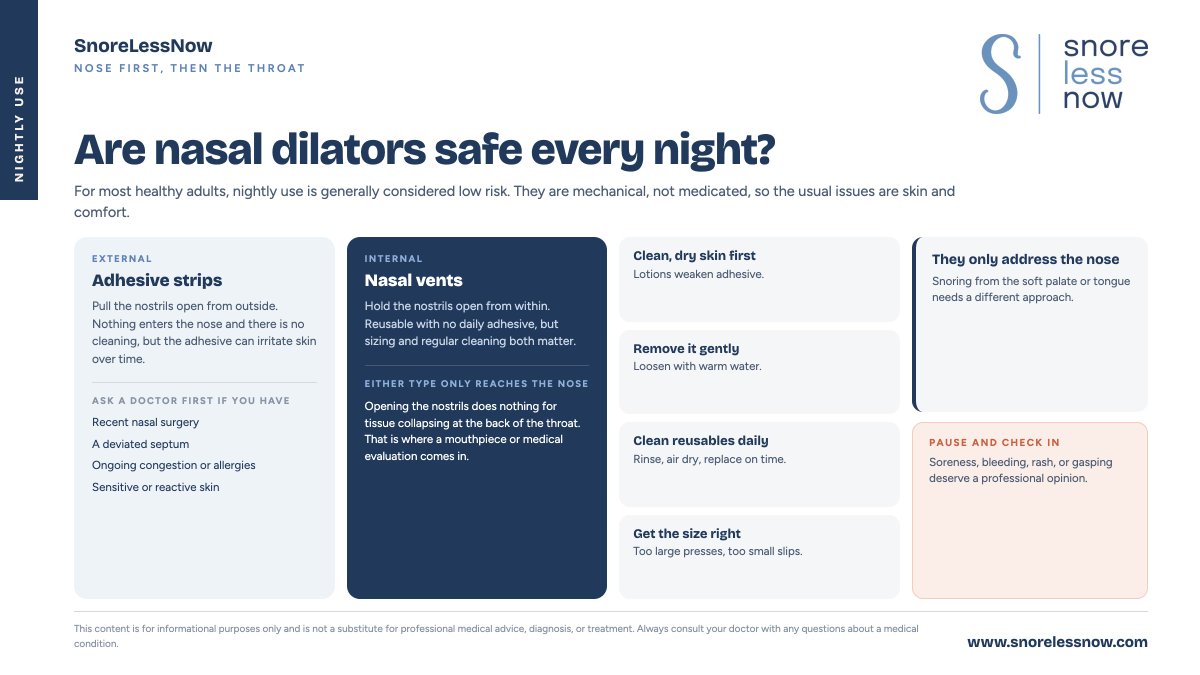
For most healthy adults, nasal dilators are generally low risk for nightly use. The catches, when they show up, are almost always about how they get used rather than the dilators themselves. Four things to get right 🌒 One, choose the correct size. Too large presses, too small slips. Two, keep the skin dry and lotion free if you use adhesive strips, since lotions weaken the adhesive over time. Three, remove them gently, and loosen with warm water rather than pulling if the adhesive is stubborn. Four, clean reusable dilators daily with mild soap and warm water, air dry them, and replace on time. Ask a doctor first if you have had recent nasal surgery, a known deviated septum, ongoing congestion or allergies, or sensitive skin. And if you notice soreness, bleeding, a rash, or gasping while using them, pause and get a professional opinion. Small habits, big difference in comfort 💙 Read the full breakdown: snorelessnow.com/blogs/the-good… 👉
An honest answer from a brand that sells anti snore pillows: they are effective for the right person, not a universal fix. Here is where they actually fit 🌒 A pillow changes the angle of your head and neck, which can help if your #snoring is worse on your back or if poor alignment is compressing your airway. It works best when sleep position is a real contributor. What a pillow cannot do is change jaw position during sleep, prevent tissue collapse in the throat, or address nasal blockage or anatomy. Those need different tools. Compared to the other options, pillows sit as supporting players. Nasal strips act on the nose, not the throat. Mouthpieces address jaw and tongue position directly. #CPAP is the strongest option, but prescribed and reserved for diagnosed sleep apnea. Lifestyle changes (weight, alcohol, sleep timing) shape everything else. Match the tool to the cause and pillows usually earn a spot in the mix, not the center of it 🩺 Read the full breakdown: snorelessnow.com/blogs/the-good… 👉

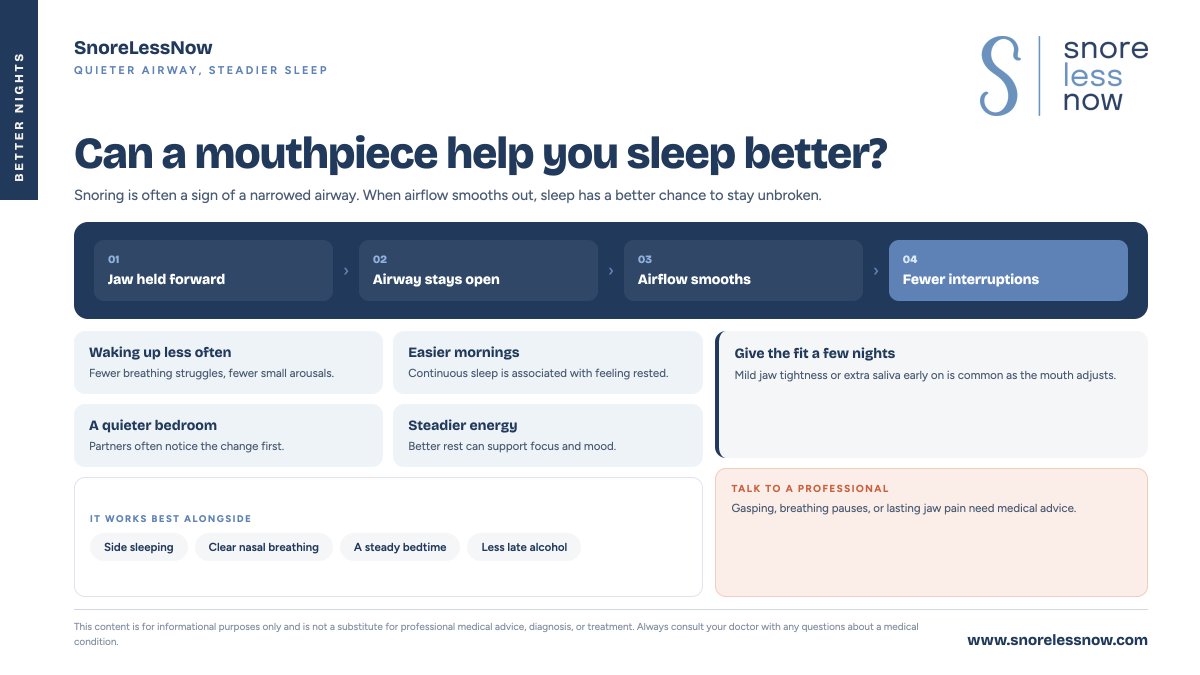
One of the quieter truths about snoring is that the person #snoring is often the last to know how much sleep it is quietly costing them. The disruption is not always dramatic enough to wake you up, but it fragments the rest that should have made the hours count 🌒 When a mouthpiece works, the improvement rarely feels dramatic in one moment. It feels quieter. You wake up less often through the night. Mornings feel a little easier. Your partner stops reacting to noise. Energy through the day steadies out. The bedroom gets calmer for both of you. Not a knockout effect. Just fewer interruptions doing their work every night. The mechanism is simple. The jaw is held slightly forward, the airway stays more open, airflow smooths, and the small breathing struggles that trigger micro arousals happen less often. It works alongside side sleeping, clear nasal breathing, a steady bedtime, and less late alcohol. If snoring comes with gasping or breathing pauses, that is a doctor conversation 🩺 Read the full breakdown: snorelessnow.com/blogs/the-good… 👉
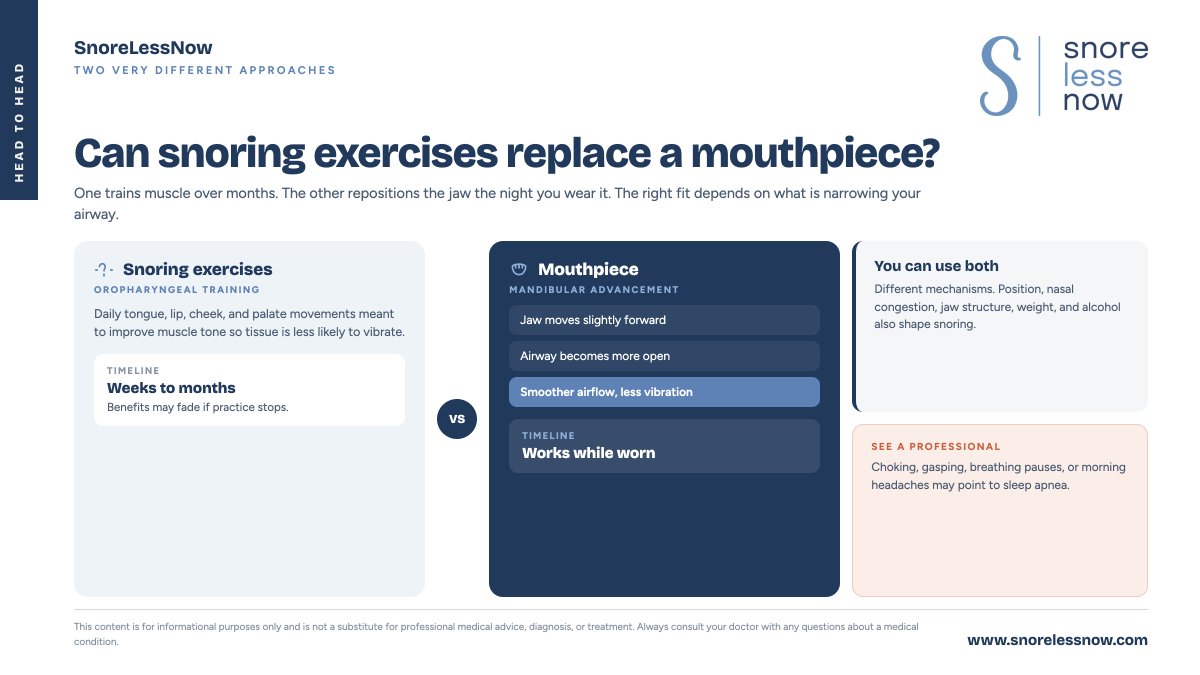
The question of whether to try #snoring exercises or a mouthpiece is often framed as a choice between them. The more honest answer is that they work on completely different parts of the same problem. Which is why some people use both 🌙 Snoring exercises strengthen the muscles that support the airway. Daily practice, weeks to months of consistency, and the benefits depend on keeping the routine going. Think of it as training for the tissues that vibrate at night. A mouthpiece does not touch muscle tone at all. It repositions the lower jaw forward while you sleep so the airway is physically wider through the night. Immediate mechanical support rather than gradual conditioning. The right fit depends on what is narrowing your airway. Muscle relaxation and gradual weakening of tissue tone respond well to exercises. Jaw position responds to a mouthpiece. Position, nasal congestion, weight, and alcohol also shape snoring, so combining approaches often does more than either alone 🌒 Read the full breakdown: snorelessnow.com/blogs/the-good… 👉
Ever noticed that a stressful week seems to make your snoring worse? You are not imagining it. Stress does not directly cause #snoring, but it quietly amplifies almost everything that does 🌒 The chain looks like this. Stress keeps you tense, so shallow breathing and a clenched jaw follow you to bed. Sleep gets lighter, which usually means more mouth breathing and a drier airway. Snoring gets louder, because tissue vibrates more when the throat is tired and dry. And then poor sleep feeds the #stress back, so tomorrow starts short on rest, and the loop restarts. Three quieter contributors to watch for on hard days. Jaw clenching shifts the airway. A nightcap relaxes the throat further. And late nights leave the muscles going slack once you finally crash into deeper sleep. Breaking one link tends to loosen the whole pattern. Slow breathing in bed. Screens off an hour early. Same bedtime, even after a hard day 🕯️ Read the full breakdown: snorelessnow.com/blogs/the-good… 👉

If a snoring mouthpiece is next on your list, the first question to answer is not which brand. It is which type. There are two main categories, and the right one for you depends on your teeth as much as your #snoring 🦷 Jaw advancers hold the lower jaw slightly forward to open the airway. They are the most common choice, often adjustable, and generally the strongest option for people with healthy teeth and a jaw that can tolerate the forward hold. Expect a mild jaw ache for the first week. Tongue holders skip the jaw entirely and use gentle suction to keep the tongue tip forward. They are the safer pick for people with dentures, extensive dental work, or existing jaw discomfort. They do need a clear nose to work, though. After the type, four things to check. Fit (custom molding lasts longer than boil and bite). Adjustability (so you can dial the jaw back if it feels sore). Airflow opening (essential for mouth breathers). Care (rinse daily, replace within a year) 🌒 Read the full breakdown: snorelessnow.com/blogs/the-good… 👉

Most snoring products fall into two buckets: chemicals and mechanics. A mandibular advancement mouthpiece sits firmly in the mechanical bucket, and that distinction matters more than most people realize 🦷 Sleep aids, sprays, and lozenges all work chemically. They rely on the substance doing something to your body, and the results tend to be inconsistent or short lived. A mouthpiece works differently. It is molded to your teeth, holds your lower jaw a few millimeters forward through the night, and physically keeps the tongue from sliding backward into the airway. No active ingredient. Just physics. The result: a wider airway behind the tongue, smoother airflow, less tissue vibration. It is a good fit for people who snore most nights, whose #snoring gets worse on their back, and who breathe well through their nose. Expect a mild jaw ache for the first week or two while your body adapts. Ask a dentist or sleep doctor first if you have jaw pain, dental work, or suspected #SleepApnea 🩺 Read the full breakdown at snorelessnow.com/blogs/the-good… 👉
One of the quiet myths about snoring is that some people are just "loud sleepers" and others are not. The reality is more useful, and more hopeful, than that. Some of it is anatomy. A lot of it is habit 🌒 The anatomy side is what you were born with. A slightly narrower airway. A larger tongue. A longer soft palate. A jaw that sits a little further back. These structural things do not always cause problems, but they raise the odds that the soft tissue will vibrate when your muscles relax at night. Family history, age, and neck size all sit in this column too. The habit side is where most of the leverage actually lives. Alcohol before bed relaxes throat muscles further. Sleeping flat on your back lets gravity work against you. Smoking irritates the airway. A blocked nose forces mouth breathing. Change any of these and the anatomy you were born with has less to work with. It rarely has to be all or nothing 🌙 Read the full breakdown at snorelessnow.com/blogs/the-good… 👉

Two of the most common oral #snoring devices sound similar but work differently, and knowing which one addresses your cause is more useful than picking the more familiar name 🔍 A mandibular advancement device holds the lower jaw slightly forward, which repositions the tongue as a downstream effect. A tongue retention device skips the jaw entirely and uses gentle suction on the tongue tip to hold it forward directly. Both aim to keep the airway more open during sleep. The mechanism is what differs. The TRD tends to be a better fit for people who cannot comfortably wear a jaw device (dentures, TMJ issues, sensitive teeth) but breathe clearly through the nose. It travels easily and requires no straps or power. Expect a few nights of extra drool while you adjust, and keep it clean daily. It is not built for severe sleep apnea, which is a doctor conversation regardless of which device sits in the drawer 🌒 Read the full breakdown at snorelessnow.com/blogs/the-good…👉

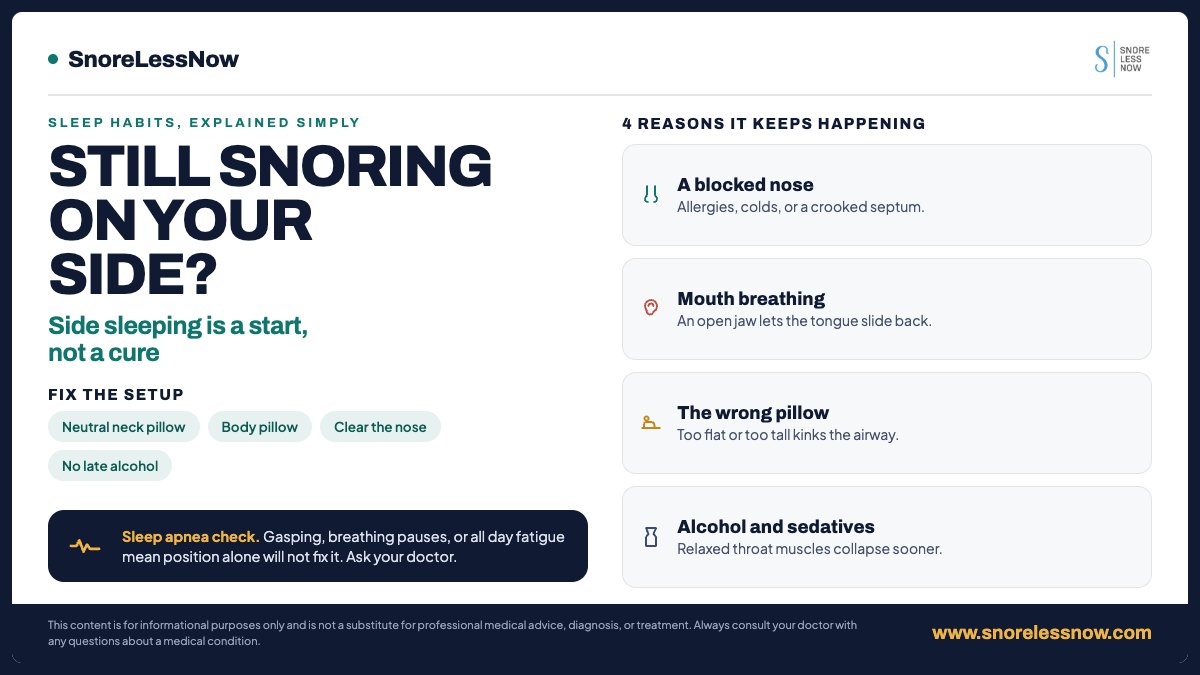
Snoring on your side comes down to four common culprits, and knowing which one is yours is more useful than trying every fix at once 🔍 A blocked nose, from allergies, a cold, or a crooked septum, pushes you toward mouth breathing that keeps the airway noisy. Mouth breathing itself can happen even without congestion, an open jaw at night lets the tongue slide back and vibrate. The wrong pillow, either too flat or too tall, kinks the neck at an angle that undoes the airflow gain of side sleeping. And alcohol or sedatives close to bedtime relax the throat muscles enough that even the right position cannot compensate. Side sleeping is a genuine first step. But if it is not solving the noise on its own, the fix is usually addressing the piece that is still narrowing the airway rather than sleeping harder on your side 🌒 Read the full breakdown at snorelessnow.com/blogs/the-good… 👉



Retro Uploads @retrouploads
165 Followers 2K Following Pictures and commentary on cool retro stuff. instagram:retrouploads

Adobe Slice @adobeslice
4 Followers 112 Following Elevate your brand's identity & make a lasting impression with our exceptional packaging design! Contact us at https://t.co/FNpRWWyEEj today.
Sleep Review @SleepReview
15K Followers 3K Following Sleep medicine news for clinicians and consumers. Covering Sleep Apnea, Insomnia, Restless Legs Syndrome, Narcolepsy, Etc. https://t.co/o7oLA9OgBX
Elle Neu @elle_neu
1K Followers 5K Following
Oleh Pylyp 🇺🇦 @OlehPylyp
1K Followers 2K Following Driving Innovation & Strategic Partnerships for CHC | Supporting Solutions for 52M+ Patients 🏥
Klondike @megistrate
787 Followers 6K Following
techy english teacher... @techmidschteach
22K Followers 9K Following 7th grade English teacher in VA🌊Title I school 🌈💜 I teach each student like they are my own child #clearthelist wishlist 📌 Venmo @techymary261
Avrilsgranny @avrilsgranny
2K Followers 2K Following I love sweeps and my #cats and #dogs #50sandFabulous.
Shout Radio @YourShoutRadio
713 Followers 1K Following ✨ Music To Sing Along To 🔊 Listen at https://t.co/l74BM4ZMLh and on your smart speaker
The Mindfulness Medit... @TrainingMindful
657K Followers 44K Following Charles A Francis: Mindfulness teacher. Speaker. Author “#Mindfulness #Meditation Made Simple: Your Guide to Finding True #InnerPeace” #inspirationalquotes #joy
Headspace @Headspace
287K Followers 1K Following Love your mind Providing mental health resources and tools for everyday life Need help? Send us a message @HeadspaceHelp
Men's Health Mag @MensHealthMag
4.3M Followers 1K Following Men's Health magazine is your ultimate guide to fitness, health, weight loss, nutrition, sex, style and guy wisdom.Trends for United States
You might like