Pi Network @PiCoreTeam
THIS IS THE ONLY OFFICIAL X ACCOUNT of Pi Network. All other X accounts are not official, and those with replicated images are imposters - https://t.co/1g6rWfr97F minepi.com Palo Alto, California Joined May 2019-
Tweets904
-
Followers4.2M
-
Following2
-
Likes348
Pi KYC and Mainnet migration received several technical updates that address corner cases and help unblock more Pioneers in these processes! Go to the Pi app to learn more!

SoloHost updates have been released alongside Pi Desktop version 0.6.3! This improves app discovery, reliability, and developer tools. Pioneers can more easily discover actively used SoloHost apps. Reliability improvements and developer resources, such as AI agents compatibility, also support the building and troubleshooting of apps. These updates further support SoloHost’s role in extending the utility of Pi Desktop and Nodes beyond blockchain infrastructure, giving Pioneers more ways to use their computers for self-hosted apps and developers more tools to build and bring apps into SoloHost. Learn more in the Pi app!

Supporting developers is essential to expanding utility at the application level. Developers create products, services, and experiences that give Pioneers more ways to participate in the Pi ecosystem. Improving the underlying development environment helps turn Pi’s technical capabilities and ecosystem resources into applications that Pioneers can use. Learn more about Pi's newly released developer capabilities and developer documentation. minepi.com/blog/dev-capab…
Pi has introduced new capabilities for developers building on Pi! This includes local storage support, access to app-specific staking data, and file and video sharing. Pi’s new developer documentation is also now released, providing a single destination for technical resources and a clearer path from getting started to building and launching an app on Pi. Improving developer tools is important for Pi’s broader focus on utility because they directly affect the types of apps and services that developers can create for the community and beyond. Learn more in the Pi app!

SoloHost gives Pioneers more ways to use their computers for local AI and easier access to other self-hosted applications, further extending the utility of Pi Desktop and Nodes beyond blockchain infrastructure. OpenClaw and the Atlassian MCP Server show how SoloHost can support different types of self-hosted software for different user needs, from local AI agents to more specialized developer utilities. Through SoloHost, people can benefit from AI while keeping more of their data and computation on their own devices and reducing reliance on third-party remote infrastructure. Learn more minepi.com/blog/new-soloh…
OpenClaw and the Atlassian MCP Server are now featured in SoloHost on Pi Desktop, expanding the range of self-hosted tools users can run locally. OpenClaw offers a more contained local AI setup with streamlined installation, while the Atlassian MCP Server supports AI-integrated Jira workflows for professionals through a locally run connection. Go to the Pi mining app to learn more about both apps and how SoloHost expands the utility of Pi Desktop and Nodes beyond blockchain infrastructure by bringing new AI and developer tools into the Pi ecosystem.

Following the successful completion of the Protocol 26 upgrade on Pi Mainnet, Pi Testnet is upgrading to Protocol 27! Protocol 27 introduces more flexible and secure smart contract authentication capabilities, enabling more advanced ways for accounts and applications to authorize transactions. The upgrade continues Pi’s broader work to incorporate newer protocol features and expand the network’s smart contract capabilities. The target date for the Mainnet upgrade to 27 is September 15, 2026.

Along with the new Node 0.6.2 release, Pi has completed an initial distributed computing functionality test through SoloHost with five volunteer Node runners. The devices operated by all five participants successfully completed the computing tasks sent to them automatically through a SoloHost app. The test validated the end-to-end flow of tasks across real devices, including connecting to a Pi coordinator, receiving and processing computing jobs, and reporting results back. Learn more minepi.com/blog/pi-node-0…
Update to Pi App Studio creation pricing on August 24, 2026! Read to learn more. x.com/i/article/2089…
The Pi Node version 0.6.2 has been released! This introduces improvements to SoloHost, Node connectivity, and the Pi Desktop user experience. In parallel, Pi has successfully completed a distributed computing test through a SoloHost app, further advancing the utility of Pi Nodes beyond supporting the Pi blockchain. Together, these updates make it easier to run and manage applications on Pi Nodes and SoloHost, while advancing their distributed computing utility. Go to the Pi app to learn more!

The Pi2Day 2026 Ecosystem Quest ran from June 28 – July 13, celebrating and highlighting Pi2Day’s major ecosystem and utility-supporting updates. The Quest guided Pioneers to complete activities that help them discover new apps, test ecosystem features, and understand how Pi’s infrastructure supports utility creation across compute, AI, and identity. Pioneers who completed the Quest also received a special-edition in-app badge accessible in Pi Chats and Pi Social Profiles. Learn more minepi.com/blog/pi2day-20…
The Pi2Day 2026 Ecosystem Quest saw incredible participation with over 2.56 million Pioneer participants, and over 1.78 million of them completing every step to claim this year’s special-edition badge. Congratulations to everyone who celebrated Pi2Day by exploring the Pi ecosystem and the new Pi2Day releases: SoloHost, Pi-Sign-in, and PiVerify. Learn more in the Pi app.


Pi Network @PiCoreTeam joins RoboPay as a payment partner. Pi will be used to pay for robot services across the Fabric network. RoboPay was built to enable AI agents to discover, hire, coordinate, and pay robots autonomously onchain, transforming robots from connected machines into autonomous economic actors capable of providing real-world services. Today, that same infrastructure extends beyond AI. Tens of millions of Pi users will have access to robot services directly through the use of currency that they already hold. Once available, the anticipated robot services may include requesting a delivery robot to bring groceries, dispatching a security robot to patrol a property, scheduling an inspection robot for industrial facilities, or interacting with humanoid assistants in retail and hospitality. Autonomous labor may become as accessible as any digital service. This partnership marks a fundamental shift in how humans are able to interact with robotics. Instead of purchasing robots themselves, users will be able to simply purchase outcomes. Physical intelligence becomes an on-demand service that is discoverable, programmable, and instantly payable through a shared economic network. By connecting humans, AI agents, and robots through the same payment infrastructure, RoboPay and Pi have created the foundation for an open machine economy, where autonomous labor can participate in everyday commerce alongside real people. The future isn't just AI that can think. It's an economy where humans, AI, and robots are all able to transact, collaborate, and create value together.

Reminder: the Pi Mainnet is upgrading to Protocol v26. All Mainnet node operators must complete the upgrade by August 11 to remain connected to the network. Protocol v26 is a major milestone that improves contract safety, state management, interoperability, and cryptographic capabilities ahead of the final planned upgrade, Protocol v27. Details here minepi.com/pi-node
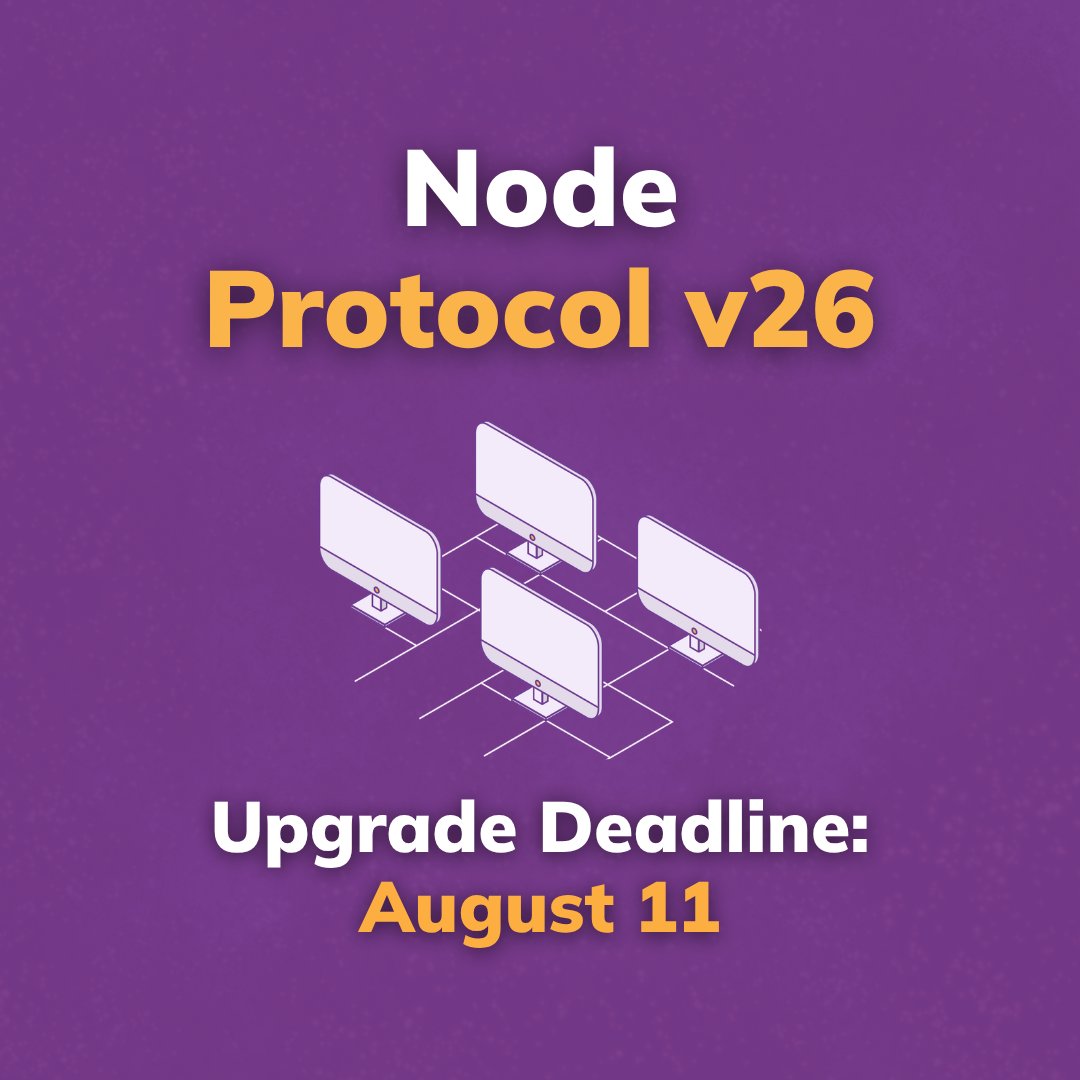
The Pi Mainnet is upgrading to Protocol 26. Deadline: Aug. 11. All Mainnet node operators must complete the upgrade before the deadline to remain connected to the network. Details here: minepi.com/pi-node Protocol 26 is a major milestone ahead of the final planned upgrade, Protocol 27. With 8 successful upgrades completed over the past few months, these final two upgrades will bring the network up to date with the latest protocol features, improvements, and functionality.
In the Pi Launchpad model, projects issue tokens as tools to acquire users for their applications and integrate those tokens directly into product functionality, such as access, payments, rewards, and governance. Instead of being taken by the issuing project, the proceeds of Pi from their token launch go to a liquidity pool with the ecosystem token, which bootstraps a healthy liquidity foundation from the start. For the SLICE test launch on Testnet, this results in a liquidity pool containing SLICE and Test-Pi. In addition to matching individual buyers and sellers through a traditional decentralized order book on the Pi DEX, the pool uses an automated market maker algorithm to calculate swaps based on the amounts of both assets it currently holds. Learn more about how the SLICE liquidity pool works. minepi.com/blog/launchpad…
Pi Launchpad has completed the distribution of its second Testnet token, SLICE! Explore the post-launch experience and see how liquidity pools work through the new price tracking feature! The Launchpad app in Pi Browser shows individual allocation details, the launch and effective token prices, access to the SLICE liquidity pool, and a chart tracking changes in the SLICE price relative to Test-Pi. Go to the Pi mining app to learn more about the SLICE launch and liquidity pool mechanics.

The Pi mining app side menu and app profile page have been redesigned! As the first step of a broader mining app design refresh, this update makes important Pioneer info and ecosystem features easier to find, understand, and navigate. Tap the hamburger (☰) icon in the top left of the Pi mining app to check it out. Since the mining app is a central part of the Pioneer experience and its interface has supported the Pi community’s growth to over 60 million engaged Pioneers, changes to its design and user experience must be introduced thoughtfully and iteratively to improve clarity, style and usability while maintaining core functionalities. Go to the Pi mining app to learn more, and provide feedback on the new design and style!


On July 22, Pi is scheduled to upgrade to Protocol v25, which primarily focuses on improving network stability and reliability, and supports new capabilities for more efficient, privacy-preserving smart contracts. Go to the Pi mining app to learn more!

The new App Planning Phase feature in Pi App Studio allows creators to develop their ideas with the help of AI before App Studio generates the app. For example, App Studio may ask for more detail about the app’s: - Main idea - Goal - Design - User experience This helps guide creators from an initial idea toward a more complete app concept in a more interactive and dynamic way. Watch the video walkthrough to learn how the planning process works!

Pi News │ Uxuy @PiNewsMedia
1.1M Followers 83 Following We share the latest Bitcoin, Pi Crypto & Finance news. Not financial advice. Pi & Uxuy Ecosystem Builder
CORE (Satoshi) @Core_002
1.0M Followers 1K Following BITCOIN & CRYPTO UPDATES || MY POSTS ARE NOT FINANCIAL ADVICE DM FOR COLLAB
Pi UpdatesDaily | INT... @Pi_UpdatesDaily
593K Followers 2K Following Fan Page & Parody | Crypto Expert| Football News |DM For promotion| #sol #bnb #ICP #AVX &other https://t.co/AcXmCLSrBy https://t.co/prTti1qzk2
Chix 🐋 @jamila_go
477K Followers 11K Following 🌐KOL @ OKX | Pi Network Pioneer | Web-3 Sniper👀 | Not Financial Advice | 🤝MAMILAHPINATAPAI
Ben @BenX_HQ
569K Followers 2K Following Co founder of @BSCNews Personal opinions are my own Global Admin
PiChain Global @pichainmall
622K Followers 78 Following ⭐Top e-commerce platform on Pi Network ⭐ #PCM Pi Hackathon 2021 winning team | PCMWallet | PiChainMall | PiNFTART
Pi Revolution π @PiRevolutionX
456K Followers 127 Following Taking the Pi Revolution to the everyday people. Join our community chat group on telegram ➡️ https://t.co/5szhYN2Jst
Đào Phúc Quang Vũ @daophucquangvu
239K Followers 234 Following Professional director, screenwriter, and photographer based in Gia Lai, Vietnam. He is widely recognized for his independent film projects
Woody Lightyear 𝛑 @WoodyLightyearx
238K Followers 3K Following Artist | Building Web3 Communities | Founder - @PiRevolutionX
Alpha Whale 🐳 @RealAlphaWhale
359K Followers 72 Following Alpha leaks • Whale insights • posts DYOR & NFA 💎 $Pi $ETH $SOL $BNB 📈🚀
Doris Yin 东方紫�... @dorisyincpa
344K Followers 339 Following Pi Network Global GCV Movement Founder GCV Committed to one mission. One direction. Long term value over short-term noise. Focus. Integrity, long term vision.
Pi Update @CoreNews_2
400K Followers 40 Following Fan Page & Parody | Crypto Expert| Crypto Enthusiast|DM For promotion| #sol #bnb #ICP #AVX &other
Comnexx AI @COMNEXX
174K Followers 444 Following Comnexx | The AI Workforce of the Future (formerly known as Miidas) https://t.co/raH5AeRdgn | The world's first autonomous AI workforce marketplace!
Pi UNIVERSE @Pi_Universe_VN
254K Followers 12 Following ⚡️ Fastest Crypto 24/7 📊 Market Analysis | Breaking News | Web3 🌐 Decoding the digital economy 🔔 Follow & Turn on notifications to stay ahead
Kim H Wong @Time_and_Trade
158K Followers 2K Following EECS engineer turned broker/analyst. A new era crypto enthusiast and a big Pi Network (PI), Interlink Network (ITL) and Supra (SUPRA) believer.

Web3.0 π. Revolution... @Gavinz212
112K Followers 4K Following https://t.co/GODVHRRAJo $Pi is a new digital currency developed by Stanford PhDs, with over 60 million members worldwide.
Vindicated Chidi 🕊 @Vindicatedchidi
211K Followers 968 Following Global Lead Amb @rwaassetchain | Web3 Educator | Founder of @shalom_token | Help Projects Grow | Community Builder | OBI-dient ✌️ | https://t.co/E7misifxGP
Dr. Whale @DrWhaleReal
304K Followers 1K Following Crypto Trader | Activist | Web3 | DM for Promo #DrWhale

KOMAL PATRE @KomalPatre
16 Followers 43 Following fashion enthusiast and blogger engineer by profession
Master @Aamer_Aian
0 Followers 40 Following
Muhammad @ModuAlhaji15039
99 Followers 376 Following Official ambassador of interlink labs - ID 47314813
Ahmed Roufai @AhmedRoufa91942
0 Followers 12 Following

Khils Hussein @HusseinKhi
0 Followers 23 Following
Kaddham1120 @Giantknight
114 Followers 989 Following Life is a serial killer- we're all just innocent victims.
Berry John @berryjohnex
2K Followers 1K Following what will be…will be🖤💛 /CRYPTO/NFT/Web3 &Cana lover 💨🚀 Motivation, Memes😂 , 💙 for life , I tweet anything wey come my head 😎
KENASH ˢᵀ 👁�... @adex4me
3K Followers 2K Following Web3 Enthusiasts | Automating prediction markets | Algorithmic trader | Onchain Analyst | Coding fanatic | Crypto & DeFi explorer
Tschuuuly @Tschuuuuly
10K Followers 7K Following digital artist/curator/collector/community-surfer/ cofounder of @Cryptowiener_ /Cryptopunk/tokenizing moments since 1984 https://t.co/ryYkOhTN9M

Robert Adeiza Otaru @otaruadeX1067
4 Followers 18 Following
Ibrahim Danladi @IbrahimDan97sl
1 Followers 21 Following
Muhammad nur @Muhammadnusrwn
0 Followers 15 Following
BINAYAKA123 @binayakamahapa1
63 Followers 874 Following
~Kunle Adewoyin~ @KunleAdewoyin
1 Followers 197 Following
Christian Jeremiah Li... @literary68509
11 Followers 124 Following I don’t just market books—I build literary movements. Helping authors go viral (for the right reasons). 📖🚀
Mangal @Mangalaruna1954
2 Followers 107 Following
Usman Abduljeleel @usmanabduljel
1 Followers 23 Following
Badmus Olanrewaju @I_AM_DeKUNMi15
24 Followers 477 Following
Paul Dino Bala @Ansopraise
1 Followers 24 Following

Sifon Okon @SablePiGamer
0 Followers 54 Following CODM Legend 🎮 | eFootball addict ⚽ | Mining Pi Network ⚡ 24/7 | I turn kills & goals into Pi coins 💰 | NG 🇳🇬
Daniel Obrotu Oghener... @DanielObro81171
0 Followers 22 Following
Milad Soli @Itsmiladsoli
7K Followers 4K Following Web3 Creator | Researcher | Operator UGC | Onchain | Ai | NFTs Building, Investigating & Creating in Public
gabsari Emmanuel Musa @GabsariEM
2 Followers 12 Following


Azabo Jay @Azabo_J
3 Followers 90 Following
david.mpumlwana@gmail... @davidmpuml81302
4 Followers 33 Following
Yozan GOHORE BI @YozanGOHOREBI
0 Followers 33 Following

wrapd @wrapd_btc
4K Followers 3K Following Ignore the noise. Building @GMNTWRK ✊ | Advisor @lobothewolfpup 🐺
aliraza @alirazaf91
1 Followers 5 Following
zaviar.LM @zaviarmonie
20 Followers 113 Following
Uni Tembook @UTembook
23 Followers 57 Following

Ali @AliZaidalimi00
0 Followers 8 Following
lovenish garg @LovewithDevil
9 Followers 35 Following
MamaNnukwu @stillwaters112
865 Followers 849 Following Catholic|| Posting random thoughts|| Brainstormer 💜
Desiré Ephrem AMPITO... @Desire_4330
0 Followers 17 Following
Gus Muh @MuhGus69367
3 Followers 13 Following
Senator Roy @Roydnanny83
12 Followers 65 Following
Wisdom Emmanuel @WisdomEmmanuelA
0 Followers 85 Following
Trustless Payments @TrustlessToads
992 Followers 627 Following XRPL’s social escrow platform. Build your name. Find your people. Lock the deal. The machine handles the trust. 🐸
Нада Дервић @jae4bw
0 Followers 4 Following
Maina Maijaji @MainaMaijaji
3 Followers 96 Following
Bokalli Émile wilric... @Bokallimilau
0 Followers 3 Following
Nicolas Kokkalis @nkokkalis
537K Followers 40 Following Pi, Head of Technology. This is the only real X account about me. Proof: https://t.co/avPkXv117L The only real Pi Core Team's X account: @PiCoreTeam
Chengdiao Fan @Chengdiao
135K Followers 8 FollowingYou might like