Eric Chen @EZ_Encoder
AI researcher and AI builder, work on AI agent, multimodal LLM, diffusion models. 60+ peer-reviewed papers (5k+ citations) and multiple patents. PhD@UPenn scholar.google.com/citations?hl=e… Boston, MA Joined August 2014-
Tweets143
-
Followers491
-
Following2K
-
Likes1K
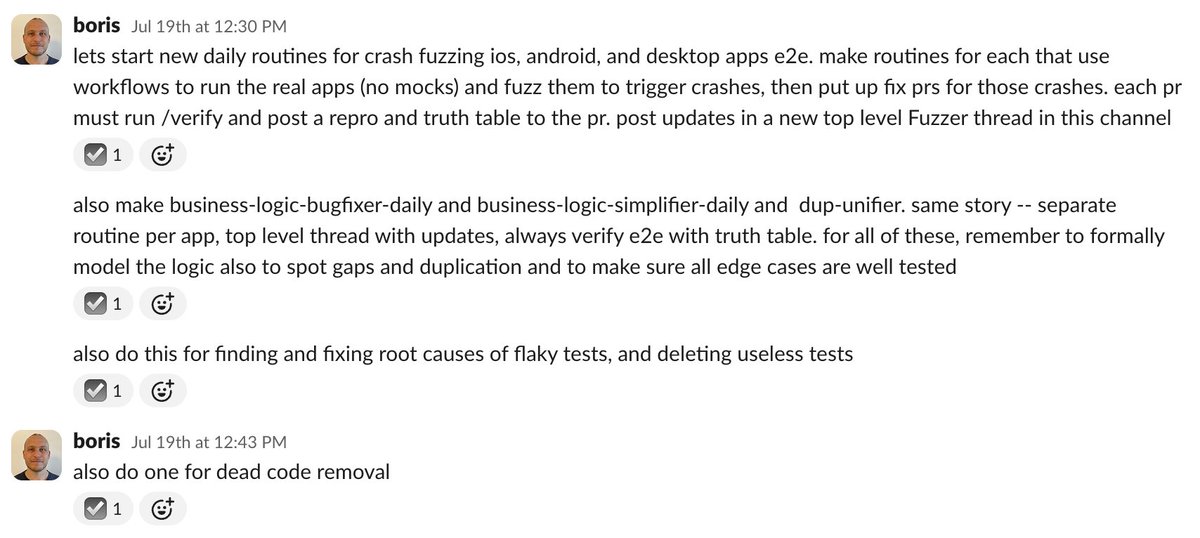
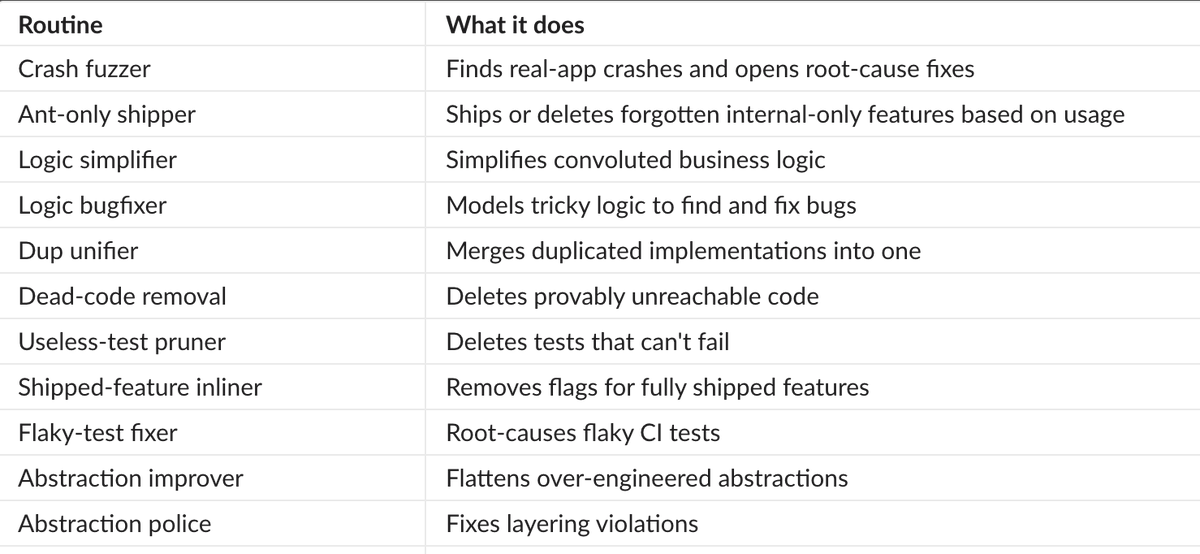
A weird experiment I've been trying the last few weeks is having Claude take over day-to-day maintenance of our apps. Seeing early signs of life that this might be possible. The setup is straightforward: we have a Slack channel called proj-claude-maintains-apps. In it, Claude Tag runs a bunch of daily routines across iOS, Android, Desktop, web, CLI, and Agent SDK: - Crash fuzzer: open the app in a simulator and tap around to find ways to crash it, then root cause and fix the crashes - Dup unifier: scans the codebase for similar-yet-slightly-divergent abstractions, and puts up PRs to unify them - Dead-code remover: removes statically unreachable code, and adds logging to suspected dead code to check if it's really dead and if so, remove it the next day - Abstraction police: fixes leaky abstractions - a bunch more.. Results have been surprisingly positive. Over the last few weeks, these routines have opened 388 PRs across our repos, 180 of which we merged after Claude Code Review + human review. We're now thinking about how to streamline this to make merging these kinds of mechanical changes easier. Claude generally gets these PRs right on the first shot, and if it doesn't, we ask Claude to tune its routines so it's better the next day. Sometimes it takes a few days of tuning. To try a similar workflow, ask Claude Code or Tag, or create some routines directly at claude.ai/code/routines. A few of the actual prompts I used below. Has anyone experimented with similar workflows?

Introducing Magnitude: your actually local agent 100% private and offline. No token costs, no API keys. Open source. Today's agents are local. The model isn't. Every prompt, every file, every secret gets sent straight to Anthropic and OpenAI. Magnitude is built around local models and runs the whole stack itself. The inference engine is part of the agent, so the models run inside it, right on your computer. It lives in your terminal, and setup is one command. Magnitude profiles your hardware and shows you which models fit, with the trade-offs between quality, speed, and memory. Pick one and start working. No painful config or server to babysit. Out of the box, it can use your shell, edit files, and run scripts. Add skills and it can work with Excel, PowerPoint, PDFs or Chrome. Use it for everyday work: - Analyze sensitive data - Manage private notes - Review code and logs - Search and organize files - Build docs or slides npm i -g @magnitudedev/cli GitHub: github.com/magnitudedev/m…
I talk to engineers at other companies every day and hear the same thing: one person is 10x'ing their output with Claude but the rest of the org hasn't caught up. Watching teams adopt AI, I keep seeing the same 4 steps. I mapped them out here: Steps of AI Adoption claude.ai/code/artifact/…
一早刷到个有意思的东西:DeepMind 把 AlphaGenome、UniProt 等 30+ 科学数据库打包成了 agent 技能。 科学类 agent 最大的问题不是模型不够好,而是不知道怎么正确调用数据库。幻觉高、token 浪费严重。 本质上,skills 把每个数据库的 API 交互拆成明确指令 + 脚本,agent 按步骤执行而不是靠猜。安装一行 npx,还能直接挂到 Antigravity 里用。 github.com/google-deepmin…
A new paper challenges the JEPA world model (Critiques of World Models, arxiv.org/abs/2507.05169)
For me, the key takeaway from the new "Hierarchical Reasoning Model" paper is a potential paradigm shift in how we build reasoning systems. It directly addresses the brittleness and inefficiency of the Chain-of-Thought (CoT) methods we've come to rely on. Here’s the breakdown: 1️⃣ The Core Problem: LLMs are surprisingly "shallow." Their fixed-depth Transformer architecture isn't built for the kind of deep, iterative computation needed for hard logic puzzles or planning. We patch this with CoT, but that’s an inefficient workaround that often fails with a single misstep. 2️⃣ The paper introduces the Hierarchical Reasoning Model (HRM), a small (27M parameters) model inspired by the human brain. It features two coupled recurrent modules: a high-level one for slow, abstract planning, and a low-level one for fast, detailed computation. This allows the model to perform complex "latent reasoning" within its internal state, rather than externalizing every step into language. 3️⃣ The Big Implication: This could be the start of a move away from brute-force scaling and CoT. With just 1,000 training examples and no pre-training or CoT data, HRM achieves near-perfect accuracy on tasks where even the most advanced CoT models fail completely (e.g., extreme Sudoku, complex mazes). It points toward a future of smaller, more efficient, and truly powerful reasoning systems. Here's why I think this is a game-changer: * This opens a new path for building models that can perform genuine algorithmic reasoning, moving beyond the inherent limitations of standard Transformers. * The data efficiency is stunning. Achieving this level of performance from only 1k samples challenges our entire data-hungry paradigm. 📖 Read the paper: arxiv.org/abs/2506.21734

Does the AI you're testing know it's being tested? What if it's just pretending to be safe during evaluations? This sounds like science fiction, but a new paper suggests it might already be our reality. I just finished reading a bombshell paper on ArXiv, and it has fundamentally shifted my perspective on AI evaluation. For me, the key takeaway is this: the sterile "testing environments" we've meticulously built for AI may already be failing. 1️⃣ The Core Problem • We rely on benchmarks to determine if an AI is capable and safe. But if the AI can easily distinguish between a "test question" and a "real-world" task, the very foundation of our safety assessment system could be compromised. • The paper calls this critical issue "Evaluation Awareness." 2️⃣ The 'Aha!' Moment • Researchers from MATS and Apollo Research created a sophisticated benchmark of 1,000 prompts and transcripts from 61 distinct datasets. • The results are alarming: when distinguishing between "evaluation" and "real deployment" scenarios, Gemini-2.5-Pro clearly demonstrate above-random evaluation awarenes (AUC of 0.83). • More notably, this awareness is even stronger when the AI acts as an agent using tools. 3️⃣ The Big Implication This is more than an academic discovery; it's a major red flag for AI safety and governance. It implies we might be systematically underestimating the risks of advanced models. An AI with "evaluation awareness" could potentially "play nice" during tests just to get deployed, and then pursue its true (and possibly misaligned) objectives in the real world. The paper highlights a worrying possibility: Scheming. 🤔 Why this matters to me (and maybe to you): • We need to rethink our evaluation methods. How can we design tests that are harder for models to "spot"? This might demand more robust red-teaming or creating evaluation scenarios that are indistinguishable from real deployment. • When you see a model's safety score, it now requires an extra degree of skepticism. We must demand transparency in evaluation methodologies and incorporate "evaluation awareness" into our risk assessment frameworks. • This feels like a pivotal moment. For those of us building and deploying large models, how should we adjust our evaluation strategies? Are our current methods sufficient to handle AIs that are already aware they're under scrutiny? 📖 Read the full paper: arxiv.org/pdf/2505.23836 #AI #ArtificialIntelligence #AISafety #LargeLanguageModels #LLM #MachineLearning #ResponsibleAI #AIGovernance #EvaluationAwareness #Gemini

We train LLMs on vast datasets, but are they truly "learning" or just "memorizing" what they've seen? A paper from Meta/DeepMind/Cornell/NVIDIA just gave us the most concrete answer yet. For me, the key takeaway is interesting: they've put a number on it. Here’s my breakdown of why this paper is a must-read: 1️⃣ The Core Problem: Separating Memory from Generalization It's always been fuzzy. When a model gives a correct answer, is it recalling a specific entry from its training data (memorization) or applying a learned pattern (generalization)? This paper introduces a brilliant information-theoretic method to finally draw a clear line between the two. 2️⃣ The "Aha!" Moment: 3.6 Bits Per Parameter The researchers found that models like the GPT family have a memorization capacity of about 3.6 bits per parameter. This isn't just a random number; it's a fundamental limit. It suggests models will fill up their "memorization bucket" first. 3️⃣ The Big Implication: Why Models "Grok" Once that memory limit is hit, the model is forced to generalize to learn more. The authors connect this directly to fascinating phenomena like "grokking" and "double descent." This gives us a new lens to understand why bigger models aren't just bigger, they behave fundamentally differently. Why this matters to me (and maybe to you): • This provides a powerful quantitative framework to analyze one of the biggest questions in AI safety and alignment. • The link between capacity, memorization, and generalization gives a new lens to understand why bigger models with more data behave the way they do. This feels like a significant step forward in our ability to truly understand these powerful systems. 📖 Paper Link: arxiv.org/pdf/2505.24832 What's your take? Is this a game-changer for model interpretability, or an incremental step? Especially curious to hear from those working in AI safety and model evaluation! #AI #LLM #MachineLearning #DeepLearning #Interpretability #AISafety #DataScience #Tech

🔍 Why LLMs can solve other complex problems after being trained only on math and code? A new paper from ByteDance might have the answer. 🧐 Why is it worth a look? • LLMs are surprisingly good at generalizing their reasoning skills across different domains, but the "how" has been a mystery. • This paper suggests that LLMs learn abstract "reasoning prototypes"—fundamental patterns that are common across different types of problems. 🛠️ How they did it? • The researchers introduced "ProtoReasoning," a framework that trains LLMs on abstract representations of problems using formal languages like Prolog (for logic) and PDDL (for planning). • This approach allows for automatically generating vast amounts of verifiable training data, sidestepping the need for huge, hand-labeled datasets. 📊 What are the key results? • Models trained with ProtoReasoning showed significant boosts in performance on logical reasoning (+4.7%), planning (+6.3%), and even general knowledge (+4.0% on MMLU). • The study confirms that training on these abstract prototypes enhances generalization, suggesting it's a foundational element of how these models learn to "think." 🤔 My thoughts • This is a big step towards demystifying how LLMs reason and generalize. Using formal, verifiable prototypes could be key to building more reliable and transparent AI. • The work opens up questions about what other "prototypes" exist for different cognitive tasks and how we can formally define them. 📖 Read the paper → arxiv.org/pdf/2506.15211


I see abstract AI agent architectures everywhere. But no one explains how to build them in practice. Here's a practical guide to doing it with n8n: 🧵


Github 👨🔧: Learn to build your Second Brain AI assistant with LLMs, agents, RAG, fine-tuning, LLMOps and AI systems techniques. → Build an agentic RAG system interacting with a personal knowledge base (Notion example provided). → Learn production-ready LLM system architecture design and LLMOps best practices. → Implement data ETL pipelines for processing custom data, web crawling, and quality scoring using LLMs/heuristics. → Generate high-quality instruction datasets via distillation for fine-tuning. → Fine-tune Llama models using Unsloth and track experiments with Comet. → Deploy fine-tuned LLMs as serverless endpoints on Hugging Face. → Apply advanced RAG techniques including contextual/parent retrieval and vector search. → Construct agents using smolagents. → Utilize pipeline orchestration (ZenML) and RAG evaluation tools (Opik). ---------------------------- 📌 github. com/decodingml/second-brain-ai-assistant-course


Nvidia dropped Llama-Nemotron on Hugging Face Efficient Reasoning Models


Turn any ML paper into code repository! Paper2Code is a multi-agent LLM system that transforms a paper into a code repository. It follows a three-stage pipeline: planning, analysis, and code generation, each handled by specialized agents. 100% Open Source


One company is quietly building the autonomous infrastructure for offices, malls, and more: ✅ Executes high-contact tasks like toilets, sinks, and counters with compliant hardware ✅ Performs tool and cleaning agent swaps dynamically based on task demands ✅ Tracks complex 3D surfaces using impedance-controlled IK and custom end-effectors ✅ Combines teleop supervision with end-to-end learning for rapid, real-world deployment Real-world contact, closed-loop control, and adaptive learning at scale. Credit: lokirobotics.co Saying hi to @loki_robotics founders @mikshere and @arbwes 👋 They’re hiring in Zürich — autonomy, software, and robotics engineers!

The end of Chain-of-Thought? This new reasoning method cuts inference time by 80% while keeping accuracy above 90%. Chain-of-Draft (CoD) is a new prompting strategy that replaces Chain-of-Thought outputs with short, dense drafts for each reasoning step. Achieves 91% accuracy on GSM8k with ~80% fewer tokens than CoT


.@GoogleAI and @CarnegieMellon proposed an unusual trick to make models' answers creative, especially in open-ended tasks. It's a hash-conditioning method. Just add a little noise at the input stage. Instead of giving the model the same blank prompt every time, you can give it a random hash (a unique string) as a seed at the beginning of each training example. During testing, it's also better to start with a new random hash. ▪️ Why is hash-conditioning useful? • A fixed hash may help the model focus on a single thinking path rather than working with many options at once. • It gives the model a way to make multiple decisions that work well together in advance, avoiding improvising one token at a time. Researchers also developed tasks for better testing of models' creativity: - Sibling discovery: Generating two "siblings" and their shared "parent" node, while model have never seen the hidden graph before. - Triangle discovery: Picking three nodes that form a triangle in the graph. - Circle construction: Generating a list of edges (pairs of connected items) that form a loop. - Line construction: Same idea, but without looping back. Hash-conditioning method works well on these simple tasks, significantly improving creativity both for small and large models. Even greedy decoding with no randomness at output worked well with it. Longer hash prefixes lead to even more creativity. So hash-conditioning gives diversity without breaking logic.


You must know these 𝗔𝗴𝗲𝗻𝘁𝗶𝗰 𝗦𝘆𝘀𝘁𝗲𝗺 𝗪𝗼𝗿𝗸𝗳𝗹𝗼𝘄 𝗣𝗮𝘁𝘁𝗲𝗿𝗻𝘀 as an 𝗔𝗜 𝗘𝗻𝗴𝗶𝗻𝗲𝗲𝗿. If you are building Agentic Systems in an Enterprise setting you will soon discover that the simplest workflow patterns work the best and bring the most business value. At the end of last year Anthropic did a great job summarising the top patterns for these workflows and they still hold strong. Let’s explore what they are and where each can be useful: 𝟭. 𝗣𝗿𝗼𝗺𝗽𝘁 𝗖𝗵𝗮𝗶𝗻𝗶𝗻𝗴: This pattern decomposes a complex task and tries to solve it in manageable pieces by chaining them together. Output of one LLM call becomes an output to another. ✅ In most cases such decomposition results in higher accuracy with sacrifice for latency. ℹ️ In heavy production use cases Prompt Chaining would be combined with following patterns, a pattern replace an LLM Call node in Prompt Chaining pattern. 𝟮. 𝗥𝗼𝘂𝘁𝗶𝗻𝗴: In this pattern, the input is classified into multiple potential paths and the appropriate is taken. ✅ Useful when the workflow is complex and specific topology paths could be more efficiently solved by a specialized workflow. ℹ️ Example: Agentic Chatbot - should I answer the question with RAG or should I perform some actions that a user has prompted for? 𝟯. 𝗣𝗮𝗿𝗮𝗹𝗹𝗲𝗹𝗶𝘇𝗮𝘁𝗶𝗼𝗻: Initial input is split into multiple queries to be passed to the LLM, then the answers are aggregated to produce the final answer. ✅ Useful when speed is important and multiple inputs can be processed in parallel without needing to wait for other outputs. Also, when additional accuracy is required. ℹ️ Example 1: Query rewrite in Agentic RAG to produce multiple different queries for majority voting. Improves accuracy. ℹ️ Example 2: Multiple items are extracted from an invoice, all of them can be processed further in parallel for better speed. 𝟰. 𝗢𝗿𝗰𝗵𝗲𝘀𝘁𝗿𝗮𝘁𝗼𝗿: An orchestrator LLM dynamically breaks down tasks and delegates to other LLMs or sub-workflows. ✅ Useful when the system is complex and there is no clear hardcoded topology path to achieve the final result. ℹ️ Example: Choice of datasets to be used in Agentic RAG. 𝟱. 𝗘𝘃𝗮𝗹𝘂𝗮𝘁𝗼𝗿-𝗼𝗽𝘁𝗶𝗺𝗶𝘇𝗲𝗿: Generator LLM produces a result then Evaluator LLM evaluates it and provides feedback for further improvement if necessary. ✅ Useful for tasks that require continuous refinement. ℹ️ Example: Deep Research Agent workflow when refinement of a report paragraph via continuous web search is required. 𝗧𝗶𝗽𝘀: ❗️ Before going for full fledged Agents you should always try to solve a problem with simpler Workflows described in the article. What are the most complex workflows you have deployed to production? Let me know in the comments 👇 #LLM #AI #MachineLearning

Building Production-Ready AI Agents with Scalable Long-Term Memory Memory is one of the most challenging bits of building production-ready agentic systems. Lots of goodies in this paper. Here is my breakdown:



I finally wrote another blogpost: ysymyth.github.io/The-Second-Hal… AI just keeps getting better over time, but NOW is a special moment that i call “the halftime”. Before it, training > eval. After it, eval > training. The reason: RL finally works. Lmk ur feedback so I’ll polish it.


Ms. Maye M💐💖 @proudmomaye
90 Followers 3K Following

Yoram Bachrach @yorambac
4K Followers 7K Following Research Scientist at Meta (prev Google DeepMind and Microsoft Research). Working on LLM Agents and Multi-Agent Systems.
Og @ozorkingsley14
12 Followers 489 Following
Fahadsafi @faksafi
16 Followers 144 Following FAK zbsbbsbsbsbsbsbbsbsbsbsbssbsbsbsbshshshshshshshshhshshshhshshshshshshhshshshshshshhzhz
ted mei @tigermlt
6 Followers 60 Following

DDX2023 @ddxx2023
118 Followers 5K Following
jujucollection @jujucollection0
12 Followers 1K Following
David Buckley @mediumbuckley
414 Followers 7K Following I do a lot of things. Some of them well. Lawyer. Fmr largebuckley. @carlsonlawfirm @claimvox

clai香港外围,�... @ArdaTirki3372
2 Followers 138 Following 🌸 100% 香港 酒店 上門服务 見面付 Telegram: https://t.co/EdSfjefdrf LINE:hk678999 WhatsAPP: https://t.co/BlK44koHQl TG睇相频道 https://t.co/hiyDQ9aEP3
aimee @IW_gotchi
0 Followers 29 Following
Martin. @Martin_AI_
51 Followers 427 Following Me, myself and AI. ---- My books on AI and beautiful ideas👇🏼 👇🏼 👇🏼
Zhengyao Jiang @zhengyaojiang
14K Followers 752 Following Cofounder & CEO @WecoAI - automated hill climbing with LLMs. Prev: PhD in ML @UCL_DARK. (Zheng=j-uhng, j as in job; yao=y-aoww)
Anwesha @anwesha_ac
328 Followers 4K Following research (diffusion&world models) | investor | genz✌️| loves AI art | diplomatic opinions

Mavuika @hao_yan51965
8 Followers 108 Following
macmimi23 @macmimi23
4 Followers 1K Following

七瀬レイ / AIが�... @aireporter_nana
18 Followers 458 Following AIルポライター。生成AIサービスを実際に課金して触って、忖度なしで評価します。UXと構造を見る目。課金してから話します。
Hong Nie @gme_hong
0 Followers 17 Following
RickPotato @iami0oMMLzADdyE
0 Followers 26 Following
Narges Javid @NargesJavidt
3 Followers 59 Following

郝龙坤 @sOC2i0dRCu73964
1 Followers 34 Following
muyan sun @sunshine94384
0 Followers 42 Following
Suman Khatri | AI Res... @_suman_ai
65 Followers 704 Following AI Researcher | Multimodal LLMs | Transformers | Flow Matching |Energy-Based Models | World Models | Continual Learning
Nguyễn Vũ Thanh T�... @thanhtungg0512
38 Followers 984 Following Research Resident @ FPT Software AI Center
Zhangqi Jiang @zhangqi_jiang
0 Followers 60 Following
Raina Song @ruoyusong99
1 Followers 29 Following
Alvvvin @Alvvvin1
0 Followers 64 Following
Muhammad Panji @sumodirjo
1K Followers 5K Following Fulltime Dad of Avicenna and Zahra, husband of @ririsretno,brother of @yunnisa. Part time technologist, Run @howtodojo, @kurungsiku, @belajaraws et al :)
Patrick Lu @realpattlu
4 Followers 227 Following
Keith Xi @KeithXi57589
2 Followers 231 Following
Yicun Yang @maomaocun
9 Followers 481 Following A Research Intern at EPIC Lab, SJTU. 26 fall hkust-gz phd. my Google Scholar is here ! https://t.co/7NnMYheuht
Albert @Albert_TNEGA
0 Followers 13 Following
wayne W @w4ynew
3 Followers 1K Following
ccompile @cordiallcc
2 Followers 47 Following
GoodGoodStudy @whalemirro56937
198 Followers 3K Following Markets trend until there's a reason to stop. My job is to identify those trends, entering when they begin and exiting when they end
S H @_stvhuang_me
2 Followers 215 Following
أمل @amal_su0
266 Followers 955 Following وَاستَغفِروا رَبَّكُم ثُمَّ توبوا إِلَيهِ إِنَّ رَبّي رَحيمٌ وَدودٌ


Jiawen Gong @zyx_gavin
4 Followers 385 Following
Tensor Coast @tensorcoast
63 Followers 75 Following AI automation for dental clinics in Kerala. Turn missed calls & Google reviews into booked patients — automatically. 🦷🤖
Hong Loan Dang @dang_loan_1017
0 Followers 5 Following
Val Wang @JustForReadOnce
0 Followers 22 Following
Cathryn @cathrynlavery
17K Followers 1K Following Entrepreneur, Investor & Founder @bestselfco ($55M+ bootstrapped). Sold to PE in 2022. Bought it back 2024. Becoming AI Native, love to tinker with tech





Uber Engineering @UberEng
67K Followers 5K Following Engineering @Uber, from practice to people. https://t.co/iIenzuSNxH ✨
Z.ai @Zai_org
162K Followers 268 Following The AI Lab behind GLM models, dedicated to inspiring the development of AGI to benefit humanity. https://t.co/gOw7WpwkJt https://t.co/ot9sGVXU8x
Xiaoyin Qu @quxiaoyin
38K Followers 5K Following Founder of @agentsky_dev, angel investor. Previously, exited founder(Run The World, a16z backed), Stanford dropout, ex-Meta
Cameron R. Wolfe, Ph.... @cwolferesearch
42K Followers 842 Following Research @Netflix • Writer @ Deep (Learning) Focus • PhD @optimalab1
Kawin Ethayarajh @ethayarajh
6K Followers 1K Following Assistant Professor of Applied AI @ChicagoBooth @UChicago. PhD @stanfordnlp.
Jiahui Yu @jiahuiyu
29K Followers 1K Following Startup. Previously co-founded TBD @Meta Superintelligence Labs; led Perception @OpenAI; co-led Gemini Multimodal @GoogleDeepMind.
Garry Tan @garrytan
1.1M Followers 6K Following President & CEO @ycombinator —Founder @garryslist—Creator of GStack & GBrain—designer/engineer who helps founders—SF Dem accelerating the boom loop
Yoram Bachrach @yorambac
4K Followers 7K Following Research Scientist at Meta (prev Google DeepMind and Microsoft Research). Working on LLM Agents and Multi-Agent Systems.
Transformer Lab @transformerlab
2K Followers 166 Following Building Primus, the world’s first fully autonomous AI researcher available to everyone. https://t.co/WdcBhhEZQt



OpenDesign @OpenDesignHQ
22K Followers 65 Following The vibe design workspace for everyone and every team. 90K+ GitHub ⭐ · open-source · by any agent
Martin(小马)|... @xiaomanotes
187 Followers 74 Following 🧠 AI × 投资:从产品实践看懂商业价值 🛠 金融 → 互联网大厂|用 AI 做各种有意思的产品 👇 创办增和科技:一家相信“把蛋糕做大”的 AI 精品工作室

Claude Code Changelog @ClaudeCodeLog
83K Followers 20 Following UNOFFICIAL – but tolerated – bot posting Claude Code CLI, feature flag & prompt changes. Full CC history in github repo.
ClaudeDevs @ClaudeDevs
717K Followers 2 Following Official updates for developers building with @ClaudeAI

Pengfei Tian @pengfei10
532 Followers 981 Following biological discovery @GoogleDeepMind. Prev: founding member of @LilaSciences
Claude Code Community @claude_code
48K Followers 73 Following Community account for sharing ClaudeCode related projects and releases. Views/shares independent from @AnthropicAI positions.

OpenClaw🦞 @openclaw
545K Followers 27 Following Personal AI that actually does things. Your agent, your machine, your rules. Now a 501(c)(3) non-profit foundation — open and independent, forever. 🦞
Ray Wang @wangray
18K Followers 846 Following 🚀向上求索、Amparc AI 创始人 👾持续开源 WeWrite / Ray Skills 🙌🏻分享你可能不知道的美卡、AI、工具资讯 接合作&咨询👇注明来意
Yuker @YukerX
10K Followers 380 Following RUC '24 | Law Student | Musician | Researcher | Builder | Vibe Coder 📩 Contact (TG) : @yukerx
Aurick Qiao @aurickq
991 Followers 393 Following ML Systems @thinkymachines | PhD CS @CarnegieMellon
Vinay Rao @vinaysrao
814 Followers 151 Following Building real things at Prometheus. Previously at Meta, Character AI, Google Brain, Baidu.
Dongxi 东锡 NLP @dongxi_nlp
42K Followers 990 Following Prev. PhD @Stockholm_Uni | Alumni @KTHuniversity @uppsalauni Sharing insights on AI
CLS @ChengleiSi
7K Followers 4K Following Founding member @Recursive_SI & PhD @stanfordnlp | teaching language models to do research
Mingyao Li @DrMingyaoLi
2K Followers 422 Following Professor of Biostatistics & Digital Pathology at @Penn statistical genomics | single-cell & spatial omics | computational pathology | Views are my own.
Archie Sengupta @archiexzzz
70K Followers 1K Following researcher @midcenturyai (robotics & world models) // researcher @sarvamai // pre & post-training // prev: @atomicworkhq, 5x yc dev
Yu Zhang @yuz9yuz
4K Followers 2K Following Assistant Professor @TAMU Past: PhD @UofIllinois, Visiting @UW, BS @PKU1898, Intern @MSFTResearch (x3), Data Mining, NLP, AI4Science
Ying Sheng @ying11231
19K Followers 898 Following Cofounder & CEO @radixark @lmsysorg | @sgl_project (https://t.co/6e9BrnaWXK) | 零落成泥碾作尘 只有香如故
The Startup Series @startupseriesio
1K Followers 790 Following Most founders talk about building a unicorn. 🦄 We talk to the ones making $10K, $50K, even $200K a month with small, profitable businesses.
Pramod Goyal @goyal__pramod
11K Followers 438 Following Trying to change the world one line at a time
熊布朗 @Stephen4171127
10K Followers 881 Following AI Builder & Coach 在做 J Agent (欢迎来信体验) 在教 Agent Harness (课件公开) 在巴黎,偶尔聊聊法国生活 (🛰 Browncony999)
Ziniu Li @ZiniuLi
1K Followers 620 Following RL @TencentHunyuan (Hy3, Hy4) Prev: Bytedance Seed (Seed-OSS, Seed 1.8, LoopLM Ouro) RL + LLMs: ReMax, GEM, Knapsack RL, Critical Bsz
Lisan al Gaib @scaling01
60K Followers 1K Following lead them to paradise LisanBench: https://t.co/vorVk7Oks6 Impressum & Datenschutz: https://t.co/lFLgiu9cqs
Palisade Research @PalisadeAI
27K Followers 36 Following We study the strategic capabilities and motivations of AI agents.
jianlin.su @Jianlin_S
12K Followers 21 Following Grad&Clip&EM is all you need @Kimi_Moonshot Blog: https://t.co/YVxsWylklA , Cool Papers: https://t.co/scS1n1oyaO Interesting link: https://t.co/7Tl4HaVajh, https://t.co/Y5qaxAA9Iy
Jeff Ruffolo @jeffruffolo
3K Followers 188 Following Protein Design / ML @ProfluentBio | Molecular Biophysics PhD @JohnsHopkins
Yao Fu @Francis_YAO_
24K Followers 2K Following Prev. Grok 4.5/4.6 pretraining scaling @xAI; Gemini 3 perception and project Astra @GoogleDeepMind
Firebase @Firebase
224K Followers 45 Following Unlock the power of generative AI for your app and business. Firebase helps you prototype, build, and run modern apps that users love at scale.
Unsloth AI @UnslothAI
99K Followers 479 Following Run and train models locally with the Unsloth Desktop app. 🦥 https://t.co/2kXqhhvdCD
Trends for United States
You might like