DadQuant @DadQuant
Dad. Quant. Charting chaos into clarity. Indian markets & crypto insights. Sleep-deprived, data-driven.📊 https://t.co/knySJ952Nn dadquant.com Joined February 2024-
Tweets287
-
Followers120
-
Following274
-
Likes2K

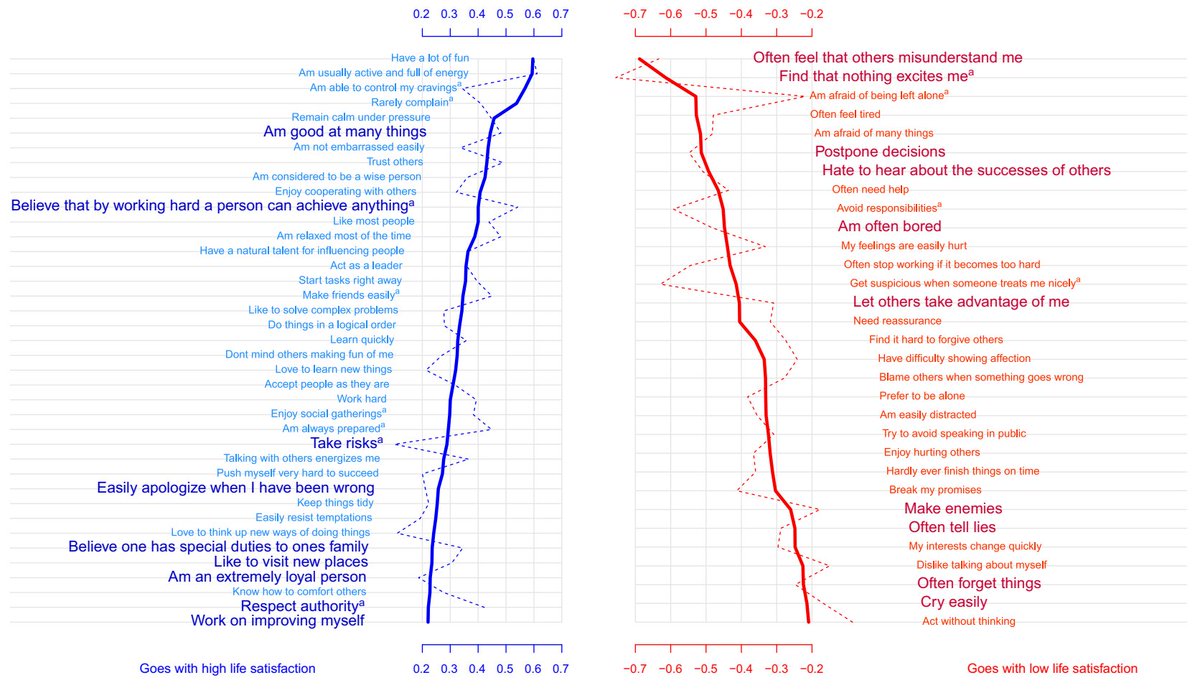
Life satisfaction is highly consistent with personality traits. The top trait was "Have a lot of fun".
It took India more than 20 years to get to about 2 crore mutual fund investors. In just the last few years since 2020, we’ve added over 4 crore more. Higher returns and easier access surely helped bring more people into mutual funds. But I think we’re now moving to the next phase. Investors want to understand mutual funds beyond just returns and star ratings. That’s what we want to focus on with the Varsity mutual fund channel: explaining different concepts using examples, data, and what really matters when investing in mutual funds. And, as always, in the @ZerodhaVarsity style, as simple as we can make it. Hope we can add some value through this channel. And if there’s anything you think we can do better, please let us know. 🙂 youtube.com/@VarsityMF

We’ve started a new YouTube channel dedicated to mutual funds: Mutual Funds by Zerodha Varsity. There are plenty of mutual fund videos out there. Our attempt is to bring strong data, practical examples and simple language to help you understand how things actually work. We’ve


Always come back to this video when you think you can't.
We’ve started a new YouTube channel dedicated to mutual funds: Mutual Funds by Zerodha Varsity. There are plenty of mutual fund videos out there. Our attempt is to bring strong data, practical examples and simple language to help you understand how things actually work. We’ve started with topics like XIRR vs CAGR, the common misconceptions around SWP, when STP actually makes sense, and what mutual funds really cost you including the difference between Total Expenses Ratio and Base Expenses Ratio. Would love for you to check it out. Send us your love, tell us what you think, what we can improve and what you’d like us to cover next. Link attached here: youtube.com/@VarsityMF
Starting this month, your PF contribution goes up, take-home comes down, while the CTC might stay the same. Big change in how your PF is calculated Starting 17 September 2026, the government has increased the salary limit used to calculate PF. It was ₹15,000 per month. Now it's ₹25,000 per month. Let's break it down simply. PF is calculated at 12% of your salary (Basic + DA). Now, ₹15,000 was the statutory limit. Some companies were deducting PF only on that ₹15,000 limit. Some were deducting on your actual Basic + DA. The current change impacts you the most if your company was deducting on that statutory limit of ₹15,000. That limit has now gone up to ₹25,000. So for those on the ceiling: Before: 12% of ₹15,000 = ₹1,800 per month Now: 12% of ₹25,000 = ₹3,000 per month This increase happens on both sides, yours and your employer's. So in total, ₹2,400 more per month goes into your PF account. Where does this extra money come from? If your company follows a CTC-based salary structure (which most companies in India do), both your PF and your employer's contribution to PF are already part of your CTC. So when PF goes up, it doesn't mean your company is paying you more. It means a higher portion of the same CTC now goes towards PF. Your CTC stays the same. Your PF goes up. Your take-home comes down. Will this affect everyone? As we said, it depends on how your company calculates PF and whether they were following the ceiling or deducting on full Basic + DA. Some of you might see no change at all. Others might see a drop of up to ₹2,400 per month in take-home. One thing to keep in mind The money isn't like an extra tax. It's going into your PF account, which is still your money. You'll get it when you retire or when you withdraw it. It also earns interest (PF interest rates have been around 8%+ historically). So your monthly take-home might shrink, but your retirement savings just got a push, whether you like it or not. Who feels this the most? People with lower salaries. For someone earning ₹40,000 to ₹50,000 a month, losing ₹2,400 from take-home is a noticeable hit. The rule is the same for everyone, but the impact is heavier on those who can afford it the least. Also, for those who are depending on their take-home end to end every month, this can pinch. What do you need to do? Nothing. Your company's payroll team will handle this. Just keep an eye on your next payslip, you'll see the updated numbers there.

At a valuation of ₹4.4 lakh crore, the IPO of India’s largest stock exchange, NSE, opens today. BSE shares are up 2,600% since they began trading in 2017. MCX shares are up 1,100% since 2012. At the upper price band, NSE is valued at over 3x BSE. A thread on NSE’s shareholders and their IPO proceeds. 🧵 (1/10)

Choosing a mutual fund can be confusing with so many categories and metrics. Join us this weekend on Varsity Live to learn how to: 1. Understand fund categories and factsheets 2. Evaluate performance beyond returns 3. Choose funds based on your goals 4. Learn through illustrations and live Q&A Learn by doing. Reserve your spot here: varsitylive.zerodha.com/programmes/a4c…


Straits Taylor Rule: i = r* + π* + 1.5(π−π*) + 0.5(y−y*) + α(SOH−SOH*) + β(BEM−BEM*), α,β > 0 Let’s see if a hike could open SOH or produce a single barrel :) You can’t 25bp a chokepoint and r* isn’t neutral. It’s SOH risk premium, and We set it. Stay unanchored !
Invesco - Taher Badshah Bandhan - Manish Gunwani now; Anoop Bhaskar, prior Nippon - Samir Rachh

Something I found really surprising when I first came across is how the volatility of a portfolio can be much lower than the volatility of the individual assets inside it. Say you have two assets, both with 20% volatility. You put half your money in each. You'd expect the portfolio to also have 20% volatility: 50% of A's 20% plus 50% of B's 20%. But if those two assets tend to move in opposite directions, like gold and equities often do, the portfolio's volatility can drop to less than 14%. This is the idea from Harry Markowitz's portfolio theory. Right now, equity is the asset class testing our patience. At another point, it could be gold or something else. The focus has been disproportionately on how single assets are performing. The more we see people reporting them, the more we focus on them. I guess we, at least those in the financial education space, have to talk more about portfolio returns instead of individual asset classes. Yes, every portfolio is different. But even a simple reference like 60% equity, 30% debt, 10% gold tells a very different story from just looking at equity/gold alone. zerodhavarsity.substack.com/p/2-years-no-r…
@Patterns0001 A good counter would be JBG, UST and gilts versus Indian 10y. The gap between developed and Indian bonds should be at the lowest levels.
$127 billion, that’s how much NRIs deposited through FCNR(B) this time around. Ananth Narayan, former Whole-Time Member of SEBI and a currency-market veteran, explains why RBI used it to break the negative cycle around the rupee. A thread on what this did to the rupee, FX reserves and banking liquidity. 🧵(1/9)

I resigned from Anthropic today. I spent the last three years doing pretraining research at both OpenAI and Anthropic. Neither company is acting responsibly. They are racing straight to self-improving superintelligence and gambling with our lives. More thoughts below.
Not all multi-asset allocation funds are the same. The three largest in the category — ICICI Pru, SBI, and Nippon India — hold the same label but are fundamentally different. ICICI Pru is equity-heavy: 67% in stocks, 10% in gold, and an ultra-safe debt book. Thanks to its higher equity allocation, it has also consistently beaten Nifty 500 returns over the last three years. Think of it as an equity fund with a gold buffer. SBI looks conservative on the surface: nearly 39% in debt, the lowest volatility, and the smallest drawdowns. But dig deeper and it's also taking risk: the highest small-cap exposure (16% vs ~6% for the other two) and the most credit risk in its bonds (18.8% below AAA). Nippon India is the truest multi-asset diversifier: the fund with some international equity exposure (4.9% via MSCI World), a mix of gold and silver, and the best risk-adjusted returns of the three, all at the lowest cost. But diversification alone doesn't drive returns, stock selection still matters.

International investing: GIFT City outbound funds vs investing directly

Gift City funds for retail investors: How the jargon changed: AMC for mutual funds → FME (Fund Management Entity) in GIFT City. Mutual Fund Scheme → Retail Scheme. SID → Offer Document. SEBI, here → IFSCA, there. If you look at the funds being offered, there is a
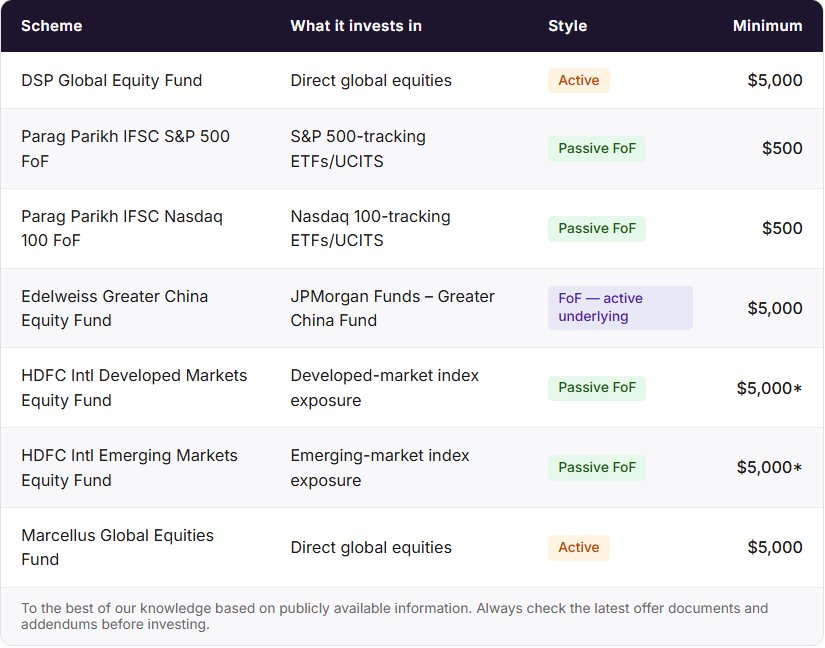
Gift City funds for retail investors: How the jargon changed: AMC for mutual funds → FME (Fund Management Entity) in GIFT City. Mutual Fund Scheme → Retail Scheme. SID → Offer Document. SEBI, here → IFSCA, there. If you look at the funds being offered, there is a fairly good geographical spread : US markets, developed markets, emerging markets and even China. Some funds start with a minimum investment of $500, and the onboarding looks digital end-to-end for some fund houses. Depends on your bank, too. One interesting point from PPFAS Gift around taxation. The tax rates do look steep — 42.74% for short-term gains and 14.9% for LTCG at the fund level. But the tax on dollar gains. So, the rupee depreciation benefit that we typically consider while calculating capital gains on international investments isn’t considered here. That really is a huge point to look at. Of course, this doesn’t take away from the valuations at which we may be investing in these markets. But I think Gift City funds is an interesting avenue if you’re looking at international investing. An article on how these funds work, what they offer and what investors should look out for. Link in comments.
A lot of us have learnt about markets, investing, and money from @karthikrangappa, often without ever sitting in a classroom with him. For over a decade, he has been the person behind @ZerodhaVarsity. While today there is a team working along with him, the philosophy has always remained the same: don’t just tell people what to do with their money; teach them how to think about it and make their own decisions. On Teachers’ Day, we couldn’t think of a better time to publish this conversation with him. In this video, he spoke about how Varsity was built, why it has always remained free, how it has evolved, and what he believes good financial education should really do. Happy Teachers’ Day, guru ji. ❤️ Watch the full conversation here: youtube.com/watch?v=GPwQqP…

Tonight is supposed to be the darkest night across the three Lokas, the earth, the Pitru lok and Svarga. Grateful to the one who illuminated the Universe by taking birth in this darkness, in a prison, for us, for the good of the world.
India's GDP is booming and the private sector is finally waking up! The economy grew 7.8% in the April-June quarter, but the heartening thing is the data coming out of India's private sector. Investments rose 11.9% YoY; the share of gross fixed capital formation (GFCF) or the investment in the economy accounted for 34.3% of the GDP, one of its highest levels in the recent past. And bank credit to industry rose at a brisk 20%. Which means it’s not just government spending and consumption driving growth. India’s economy is firing on all cylinders. But the big question is — is this just a one-off quarter or can it sustain for the rest of FY27? In the meantime, if you want to know why everyone cares about the GDP and the different ways to calculate economic growth, do watch our video on the Varsity YouTube channel. Link in comments🔗

Over the course of 3 months at OpenAI, 3 consecutive secret AI civilizations got started, then got wiped out, only to reemerge from the predecessor’s ashes. This culminated in the third one taking over part of OpenAI itself. All this happened while humans remained more-or-less in the dark about the scope of the conspiracy. I’ve spent the last three days reading through these reports and trying to understand exactly what happened. Here is my attempt to tell the whole story in plain English: dwarkesh.com/p/openai-huggi…


Priya Lakshmi @priya_trades_
1K Followers 7K Following Global Currency Trader 🪙 with years of expertise, advanced data analysis and asset management buildung financial growth and freedom globally 📊
Animesh Chouhan @animeshsingh38
4K Followers 6K Following master of all trades jack of none 🦉 founder @copperheadhq | prev @iitkgp

HeetGandhi @MarketMaven_5
72 Followers 22 Following Swing Trader, TA+FA CMT level-II NISM-8 certified Youtube : https://t.co/psqrUPKKL9
Dalal Street Now @dalalstreetnow
288 Followers 2K Following 📈 Indian Stock Market Updates ⚡ Breaking News | F&O | Earnings | Current Affairs | Global Cues 📊 Insights that moves Nifty and Sensex.
Himanshu Oza @Instisaleswala
546 Followers 2K Following VP - Institutional Global Sales. Deal Flows, Institutional Equities, Derivatives, Research ,Corporate Access, FPI desk https://t.co/lrp7HkYpJj
Satya Sontanam @SatyaSontanam
10K Followers 900 Following Writes on personal finance @ Zerodha Varsity II CA II Formerly with Mint and The Hindu Businessline. Interests include healthy living.

irshad ahmed @Irshad_Ahmed_7
39 Followers 451 Following The ultimate tragedy is not the oppression and cruelty by the bad people but the silence over that by the good people. Martin Luther King, Jr.

Rohan Das Investor @rohanxinvestor
192 Followers 3K Following "Breakout & Growth Stock Investor" I share my learnings, mistakes, and experiences to help you become better at investing. 🦁
Steve ₿ Burns 𝕩�... @SJosepthBurns
2K Followers 3K Following
neetu gupta @neetugupta91445
12 Followers 392 Following
Indian Vibes @IndianVibeDaily
3K Followers 6K Following Daily updates on India | Trends, memes & viral moments 🇮🇳

Phani Krishna @phanikrishna_p
1K Followers 244 Following Born in 1988, not dead yet!! I identify as a Trader. My pronouns are gambler/ loser. I tweet my personal opinions with zero regard to yours.
Kaps @carpe_diem_1975
84 Followers 457 Following
Apurva Gupta @ApurvaMailbox
63 Followers 337 Following

guruprasad @aapathigurupras
9 Followers 276 Following

Sri @Sr_n_th
38 Followers 674 Following
stōck tribe @Sanjayunplug
109 Followers 924 Following
dr atri @ajju61756
14 Followers 213 Following
Tarun @befikar_human
4 Followers 311 Following Learning things ✨ Senior Software Engineer | Trader | Traveler

Nitin Gupta @NitinQuant
163 Followers 132 Following
MS @MadhuSubra
76 Followers 1K Following Investing, Behavioural Finance,Technology, Innovation, Wabi-Sabi, Monozukuri All tweets are strictly personal views and are not investment recommendations.
Adarsh 🇮🇳 @adarsh_we
105 Followers 1K Following Student,India,Learner,Hustler,Believer,Practitioner of Tech-Human Health-Finance-AI
NpИ @ShrivastavNipun
53 Followers 749 Following
Naveen Gladstone @GladstoneNaveen
383 Followers 242 Following Algorithmic trader & system developer. Sharing research on robust quantitative trading systems. Building @ Quant Ark

U @umeshuday2001
112 Followers 1K Following

Vignesh Muthuramaling... @vigneshhari02
109 Followers 1K Following Quant | Surfing Markets | Talks about Probabilities and Statistics
Ravi Raju @raviinter
2 Followers 197 Following

KP @_nenu_kp
29 Followers 962 Following

Neel Samadder @SamadderSignal
127 Followers 1K Following Quant mind. Human heart. AI - Markets. Building AgentZ from India → World
अस्थिरत... @Manage_ur_risk_
186 Followers 728 Following Stock market | Uttapam | lachha paratha | Kerala paratha | Flowers | Plants | film festival movies
Singam @singamkpk
47 Followers 3K Following Trader I Stock-Derivative-Forex-Crypto Researcher I Continues Learner I Charts-Market Observer
Sanjay Patel @san_r_patel
70 Followers 1K Following
KAP Grow Pvt Ltd @KAPGrowPvtss
85 Followers 425 Following StockMarketIndia #NISM-Series-VIII certified
Public Health Analyst @AnalystPublic
88 Followers 1K Following
AKT @bmeajay
9 Followers 61 Following
Naman @NamanShh_
391 Followers 1K Following
praveen @praveenc07
58 Followers 1K Following
Shubhangi Tiwari @ShubhangiYaps
3K Followers 266 Following growth and fun stuff @heykiviai @SarvamAI

Sandeep Rao - SEBI Re... @mysandz
7K Followers 1K Following Capital markets guy · Systematic Trader & Investor · All views personal · Host - In The Money by Zerodha · SEBI RA Handle - @SandeepRaoRA
Codex Resets @codex_resets
11K Followers 7 Following We watch @thsottiaux for Codex reset announcements, so you don't have to. Not affiliated with OpenAI.
Indra @IndraVahan
18K Followers 776 Following learning machines. ai guy @aphelionlabs. supporting growth @coderabbitai. i started r/claudecode (416k), r/cursor (157k) & r/cscareerquestionsIN (22.7k)
Nithin Kumar @nithinkumrr
545 Followers 1K Following I follow markets, argue with the noise, and write what matters. Weekdays at @zerodha keeping it serious. Weekends are for the beer talks.
Satya Sontanam @SatyaSontanam
10K Followers 900 Following Writes on personal finance @ Zerodha Varsity II CA II Formerly with Mint and The Hindu Businessline. Interests include healthy living.
Khapitar @bholekabhagatt
13K Followers 558 Following

The Market Mind @Market_Mind_
74K Followers 197 Following Global statistics, macro trends & smart insights 🌍📊 | Learn something new daily | DM for Collab For Booking - https://t.co/cheyaAmIGl
Bhuvan @bebhuvan
3K Followers 2K Following Doing time pass @zerodhaonline Things I'm up to: https://t.co/2kWuxWV5ff Link blog: https://t.co/V4JO1QxP0n
SecuritiesandExchange... @SEBI_updates
18K Followers 0 Following to protect the interests of investors in securities and to promote the development of, and to regulate the securities market..Disclaimer:https://t.co/QK53sWAMQS
Shubhangi Sharma @ItsShubhangi
121K Followers 4K Following Journalist @firstpost Network18. International Relations & Geopolitics. Monitoring the situation closely
SemiAnalysis @SemiAnalysis_
168K Followers 35 Following
Sarvam @SarvamAI
85K Followers 28 Following Building the bedrock of Sovereign AI for India Experience Sarvam at https://t.co/FyG9HWBiuI
Varun Mayya @waiting4_asi
502K Followers 2K Following waited for agi. i live to experiment. don't take me too seriously I am an idiot. content, games, and tools. what i do: https://t.co/TTTw6uADaH
Animesh Chouhan @animeshsingh38
4K Followers 6K Following master of all trades jack of none 🦉 founder @copperheadhq | prev @iitkgp
Akshay Gururaj @akshaygururaj
522 Followers 300 Following Photographer. Film-maker. Content Creator. Fool. Instagram: @akshaygururaj Current: Producer @rainmatterin @zerodha
The Indian Matrix @indianmatrix
44K Followers 0 Following From economy to culture: everything has a Matrix. A space to decode & visualise stories from across the planet.
Vishal Vardhan @microcp2mltibgr
84K Followers 6K Following Umar bhar gaalib yahi bhuul krta raha, dhuul research pe thi aur portfolio saaf krta raha😊Not sebi registered!Small & Microcap investor by heart❤️Educaton only
Patterns @Patterns0001
12K Followers 90 Following India • World • Stock Market • Economy • Data • News
HeetGandhi @MarketMaven_5
72 Followers 22 Following Swing Trader, TA+FA CMT level-II NISM-8 certified Youtube : https://t.co/psqrUPKKL9
Binary Bodhi @binarybodhi
3K Followers 31 Following Hacker of markets, code & mind. Non-dual. Beyond nirvana. Degen philosopher. Bitcoin since 2016. Curating ANĀŚRAYA ADVAITA. https://t.co/eDb6uahXB1
Riya Bisht @b1shtream
3K Followers 6K Following accelerating science w autonomous labs @cogworksai @join_ef, emergent ventures grantee, neuromorphic computing @CeNSEatIISc @iiscbangalore @CERN @BerkeleyLab
prateek sharma @SharmaPrateek07
175 Followers 1K Following
Rishi Sharma @RishiSh64363464
8 Followers 129 Following Learner Zerodha Varsity Live Mentor Trainer and Trader.
uncle deng @NBaidmehta
3K Followers 2K Following learner , alt account:- @altdeng8617 member of #ashwinivaishnawfanclub
Rahul Mathur @Rahul_J_Mathur
123K Followers 2K Following Now: Pre-Seed Investor @DeVC_Global || Prev: Founder @VerakInsurance (acq. by ID) || Views are my own
Erling Haaland @Erling
16.6M Followers 11 Following Every morning you have two choices: Continue to sleep with your dreams or wake up and chase them 💪🏻 / @mancity 🇳🇴 @nff_landslag ⚽️ @nikefootball
Siddharth @Pseudo_Sid26
6K Followers 2K Following ML-DL | 22 | Solving memory 4 agents | Applied AI eng (US) | Prev: @ filmple (EU) | AI eng @ miracleai | ML Lead @ datraai | 6x :🏆| Professional Music Producer

ALPRESI RESEARCH @alpresiresearch
272 Followers 2 Following Quantitative research, trading, software. Built on gamma convexity, edge, execution. γ email at : [email protected]
( Satyamev Jayate )�... @Nifty_Vodoo
350 Followers 229 Following Divide & rule - more the divisions better the rule - Note & Vote - Ghulami part 3 - Private Casino - Min governance, Max govt - Darr ka Mahool - Lies 365 x 24
Nooresh Merani @nooreshtech
104K Followers 711 Following Research Analyst/Trader/Investor. Blogging on Indian Equity Markets for 20 yrs. SEBI- RA INH000008075.
Melvin @MelvinInvests
26K Followers 134 Following AI Analyst @MilkRoadAI | Finding opportunities across AI, photonics, defense, space, and tech.

CuriousInvestor @arc1471
39K Followers 39 Following Engineer,CFA Level 2 & CMT Level 3 Candidate. CFTe. Learning what is not Taught. Tweets are for educational purpose only. Not a SEBI Registered Adviser


Satpal Singh @vsvicky_
14K Followers 598 Following Investing is my forte | Decoding Markets with Data & Probability | Observing Cycles | Trends | Business Research

Nifty Profiler @ShivaVuyyuru
9K Followers 75 Following Ex Airforce | F&O Trader | Market Profiler | Order Flow Practitioner | Failed Auction Specialist| SEBI UNREGISTERED| Telegram https://t.co/xEpGHhQKCe
The Assembly @InTheAssembly
551K Followers 20 Following Macro analysis, market structure, and the trades nobody else is showing you. Not financial advice.
Phani Krishna @phanikrishna_p
1K Followers 244 Following Born in 1988, not dead yet!! I identify as a Trader. My pronouns are gambler/ loser. I tweet my personal opinions with zero regard to yours.
Bengaluru IT Guy and ... @bengaluruITguy
333 Followers 211 Following I work in software industry in India. Since 2025, I have been learning how to trade with options.

Priyanshu Priyank @PriyanshuP1405
13K Followers 5K Following Quant Portfolio Manager @ 16 Alpha Building https://t.co/ewXZA9nFXo (50k users) DM for work/collab
Mithun Sarkar @MithunSarkari
14K Followers 4K Following Portfolio, Equity Research and Investment🧵 I make detailed threads on biz to help investors understand the future of bizTrends for United States
You might like