CreateDesignSystem @CreateNewDS
Joined May 2026-
Tweets13
-
Followers1
-
Following93
-
Likes5

Have you heard of the 12-Factor App? The "12 Factor App" offers a set of best practices for building modern software applications. Following these 12 principles can help developers and teams in building reliable, scalable, and manageable applications. Here's a brief overview of each principle: 1. Codebase: Have one place to keep all your code, and manage it using version control like Git. 2. Dependencies: List all the things your app needs to work properly, and make sure they're easy to install. 3. Config: Keep important settings like database credentials separate from your code, so you can change them without rewriting code. 4. Backing Services: Use other services (like databases or payment processors) as separate components that your app connects to. 5. Build, Release, Run: Make a clear distinction between preparing your app, releasing it, and running it in production. 6. Processes: Design your app so that each part doesn't rely on a specific computer or memory. It's like making LEGO blocks that fit together. 7. Port Binding: Let your app be accessible through a network port, and make sure it doesn't store critical information on a single computer. 8. Concurrency: Make your app able to handle more work by adding more copies of the same thing, like hiring more workers for a busy restaurant. 9. Disposability: Your app should start quickly and shut down gracefully, like turning off a light switch instead of yanking out the power cord. 10. Dev/Prod Parity: Ensure that what you use for developing your app is very similar to what you use in production, to avoid surprises. 11. Logs: Keep a record of what happens in your app so you can understand and fix issues, like a diary for your software. 12. Admin Processes: Run special tasks separately from your app, like doing maintenance work in a workshop instead of on the factory floor. Over to you: Where do you think these principles can have the most impact in improving software development practices? -- Subscribe to our weekly newsletter to get a Free System Design PDF (158 pages): bit.ly/3KCnWXq
My recommended materials for cracking your next technical interview: Coding - Leetcode - Cracking the coding interview book - Neetcode System Design Interview - System Design Interview book 1, 2 by Alex Xu - Grokking the system design by Design Guru - Design Data-intensive Application book Behavioral interview - Tech Interview Handbook (Github repo) - A Life Engineered (YT) - STAR method (general method) OOD Interview - Interviewready - OOD by educative - Head First Design Patterns Book Mock interviews - Interviewingio - Pramp - Meetapro Apply for Jobs - Linkedin - Monster - Indeed Over to you: What is your favorite interview prep material? – Subscribe to our weekly newsletter to get a Free System Design PDF (158 pages): bit.ly/3KCnWXq

Your next design system is… Markdown. We wrote about how 𝙳𝙴𝚂𝙸𝙶𝙽.𝚖𝚍 is helping solve the hardest problem in AI today: slop. And how you can truly, finally scale design taste within a large organization.
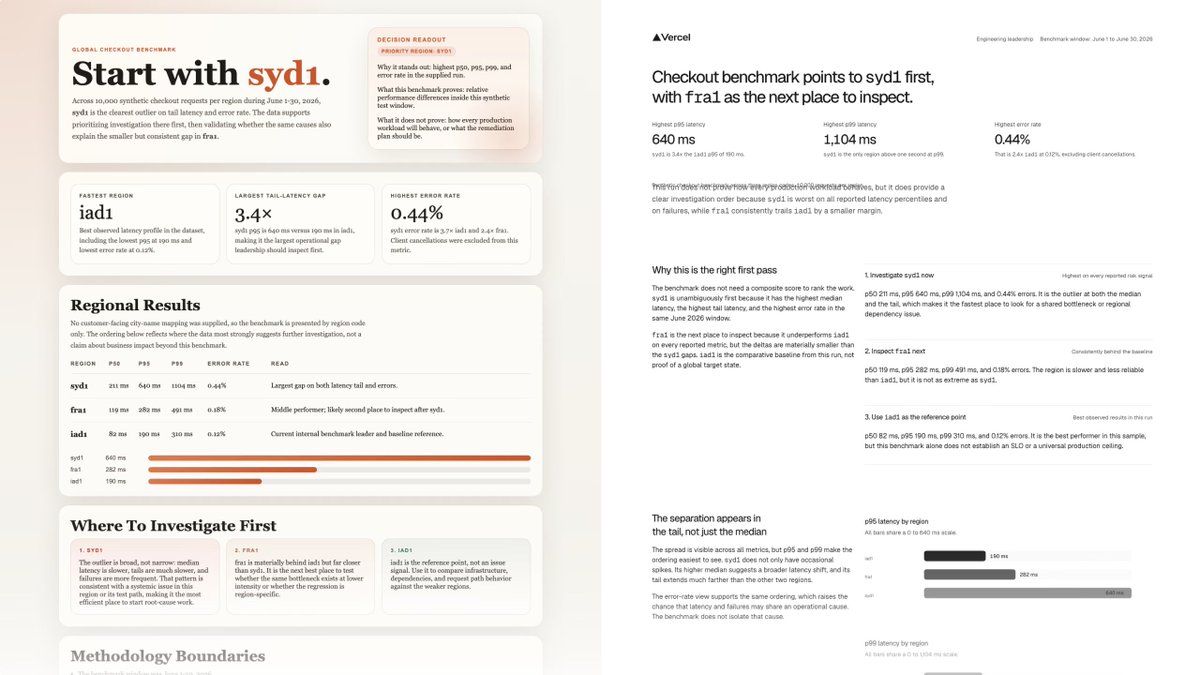

Our agents use 𝚟𝚎𝚛𝚌𝚎𝚕.𝚌𝚘𝚖/𝚍𝚎𝚜𝚒𝚐𝚗.𝚖𝚍 to build on-brand pages. ▪︎ One file encodes decisions and guidance ▪︎ Output is shaped through our eval harness ▪︎ Production feedback is fed back into the loop vercel.com/blog/how-our-a…
With AI acting as the translation layer, we move beyond simple token pipelines. AI can interpret design intent from code updates, catch contrast failures before deployment, and maintain documentation seamlessly.
Imagine an ecosystem where an update on any single axis automatically propagates across the other two. When code changes, Figma updates. When accessibility standards evolve, design tokens adapt automatically. #designtokens
The future of design system architecture is bi-directional synchronisation across three axes: Figma components, the production codebase, and live documentation—with built-in WCAG compliance and AI orchestration. #UXDesign #designsystem #AI
#Designsystem, #UXDesign, #Design, #system
UX Managers: How do you justify the cost of your DS to stakeholders? I created a calculator to help streamline that conversation. Would love to get some feedback from the community on whether this makes sense for your workflow. Check it out here: lnkd.in/e6xQjsq9
UX Managers: How do you justify the cost of your DS to stakeholders? I created a calculator to help streamline that conversation. Would love to get some feedback from the community on whether this makes sense for your workflow. Check it out here: lnkd.in/e6xQjsq9
@nathanacurtis Interesting @nathanacurtis I am working something similar but different I am working on a system, which creates, maintains the DS in Figma, code and documentation. All connected in both directions check it out. its in POC phase createdesignsystem.com

Today we’re releasing an early preview of the /design command in Claude Code! from CC Desktop or CLI, try something like "/design a few options for {feature}" before you build — pick your fave artboard, edit it and implement.
@henry_daggett Completely agree. We built all this plumbing for AI tokens, but skipped the actual bottleneck: interface generation where teams spend 80% of their time.
UX Managers: How do you justify the cost of your Design System to stakeholders? 📊I created a calculator to help streamline that conversation. Feedback whether this makes sense for your workflow. Check this: createdesignsystem.com/pricing #DesignSystem #UXDesign #DesignManagement

Jacobo Risser @JacoboRissbz4n
201 Followers 503 Following
ClaudeDevs @ClaudeDevs
728K Followers 2 Following Official updates for developers building with @ClaudeAI
Kurt Varner @kurtvarner
20K Followers 376 Following Making the most of it • Formerly VP of Design @Adobe, @Frame_io, @Dropbox
Design Tokens Communi... @DesignTokens
7K Followers 52 Following Design Tokens are a technology-agnostic methodology, architecture, & process for scaling design across tools, devices, & platforms. Chairs: @kaelig @jina @vlh

Into Design Systems @intodsconf
6K Followers 307 Following Learn the AI and vibe coding workflows top design teams use
Donna Vitan @donnavitan
1K Followers 2K Following Design Technologist, Design Systems (over)Thinker, Accessibility Advocate, Nerd, @TELUSDigital @DesignSystemsC @DSCC_Tor @DesignTokens She/Her 💖 Bubble tea 🧋
Gabriel Valdivia @gabrielvaldivia
16K Followers 836 Following Veteran designer and builder who partners with early stage teams on first-gen products.
Henry Daggett @henry_daggett
977 Followers 557 Following Design Systems Lead & Product Designer @SocieteGenerale. Building tools to help Designers and Developers create together. Complete and utter escapist 🌌

Andrej Karpathy @karpathy
4.3M Followers 1K Following
Adham Dannaway @AdhamDannaway
102K Followers 2K Following 📘 Author of @PracticalUI ⚡️ UX & UI design tips, inspiration, & news 🤟 Pushing pixels since 2005 ⚙️ Specialised in UI design & design systems
Jan Toman @HonzaTmn
6K Followers 544 Following Product and design at @supernova_io. Design-engineering on the side.
Rive @rive_app
86K Followers 1K Following The interactive experience engine. Design, animate, and code in one place. Ship everywhere.
Dima Belyaev @blvdmitry
6K Followers 266 Following Building https://t.co/9SeoAYDUuW and Silo (wip) Staff Engineer, working on Sidekick at @shopify

Easlo @heyeaslo
375K Followers 539 Following Productivity meets minimalism. Building, designing, and sharing my solutions.

Michal Malewicz @michalmalewicz
55K Followers 602 Following OG Designer since 1999. Biohacker. Longevity + productivity apps Created Glassmorphism. Sold $2M of products. 44 y.o. RHR 40 • HRV 100 → 280 (RSA) • VO2Max 56
zeroheight @zeroheight
3K Followers 2K Following Helping you build design systems everyone loves to use 🚀 Connect everyone working with your design system. #DesignSystems #DesignOps
Dan Hollick @DanHollick
49K Followers 419 Following design engineer @SpaceXAI (via @cursor_ai). writing a book about software at https://t.co/dFGw9eLk1e prev: @tailwindcss, @raycast

Design Systems Hackat... @dshackathon
414 Followers 82 Following A weekend for #DesignSystem Makers - Let's meet online to hack, share ideas & network. 🗓 back soon - powered by @intodsconf & @svorklab
Design Systems House @designsyshouse
919 Followers 42 Following Dedicated to the future of design systems
Design Systems Podcas... @TheDSPod
986 Followers 56 Following @TheDSPod by @KnapsackCloud interviews industry leaders and explores the areas where design and development come together. Hosted by @chrisstrahl.
Design Systems News @designsysnews
2K Followers 1 Following The Official Design Systems Community Newsletter. Packed full of news, articles, examples, and more. Curated by @sturobson
Wes Bos @wesbos
441K Followers 2K Following Fullstack JS Dev ❯ @SyntaxFM ❯ https://t.co/6heZ7gZqg1 ❯ https://t.co/lOo3xh23G1 ❯ https://t.co/XYbxq79WBS ❯ Posts 🔥 Tips

nixCraft 🐧 @nixcraft
399K Followers 1 Following Love Linux/Unix, open source, and programming? Into Sysadmin & DevOps? Follow us! Boost your IT career with daily new tools, apps, and humor ⤵️
Brian Graf | AI Build... @TheBrianGraf
5K Followers 1K Following Heads-down in AI Ex-VMware • Ex-AWS
Scott Hanselman 🌮 @shanselman
335K Followers 10K Following VP, Member of Technical Staff @ MSFT/GitHub - Code, OSS, STEM, Beyoncé, T1D, #DevRel YouTube/TikTok and listen to the @Hanselminutes tech podcast
Minko Gechev @mgechev
58K Followers 220 Following Generative UI and AI developer productivity at Google. Martial arts and metal music. Opinions are my own 🇧🇬🇺🇸
Gergely Orosz @GergelyOrosz
359K Followers 3K Following Writing @Pragmatic_Eng, the #1 software engineering newsletter on Substack. Author of @EngGuidebook. Formerly Uber & Skype.
William Lam @lamw
38K Followers 460 Following Distinguished Platform Engineering Architect @Broadcom • 📢 Customer Advocate • 🧑💻 Technologist • 🖊️ Blogger • 👨👧👦 Father • 🧗♂️ Spartan Races
Duncan Epping @DuncanYB
38K Followers 427 Following Author of https://t.co/hniZ3uoZUq, and https://t.co/EWLqRmgmxZ, host of the Unexplored Territory Podcast!
Clarity Design System @VMwareClarity
2K Followers 29 Following Clarity is a user-focused, framework-independent, accessible, enterprise-ready, and open source design system. Check it out 👇
Spline @splinetool
112K Followers 4K Following 3D Design that runs in the browser. Building @omma_ai
Adrian @adriankuleszo
148K Followers 605 Following Running @designme - shipping for startups (clients: @seamlessai @cluely @ethena @lightdash_devs and 100+ more) | join my new cohort - https://t.co/72aAhuAoAP
Sho Kuwamoto @skuwamoto
30K Followers 669 Following Semi-professional gyoza eater. Previously VP of product @figma. Also at https://t.co/b4a0PYhJ28
vijay verma @realvjy
36K Followers 411 Following ✦ Solo Indie Game Developer ✦ Founder @overlayzstudio ✦ Wishlist https://t.co/hNnw9Fd67M
miggi from figgi @miggi
41K Followers 3K Following • product / design education / illustration / motion • designer advocate, @figma • opinions are my own • he/him/his
Rasmus Andersson @rsms
93K Followers 3K Following Adventures in software & design. Founder of @playbit_, designer of Inter, @Figma, @Spotify. Eng & design @Facebook
Halli @iamharaldur
262K Followers 21 Following Tweets auto delete. Founder @uenodotco and Anna Jóna. Building wheelchair ramps @rampupteam. Chairman @hafnarhaus. Music @onnujonuson. Host Let's Walk podcast.
Mr. Biscuit @SShuaiqi
6K Followers 699 Following 🥕 Passive Vegan, Product designer (UI/UX), coder & Consultant Design System Architect 🌱 Carbon Neutral.

David Hoang @davidhoang
62K Followers 3K Following Headless of Design, AI + Ecosystem @Atlassian. Previously VP of Marketing & Design @Replit, Head of Design @Webflow, @OneMedical)
Friends of Figma, Des... @FoF_Systems
2K Followers 15 Following The FoF Design Systems community is a @figma group of professionals, hobbyists, and students who are design system beginners, builders, and mentors.
Design System Univers... @designsystemu
2K Followers 55 Following Curriculum, content, & community to support how you design at scale.
Shreyas Doshi @shreyas
404K Followers 1K Following Led a couple of Stripe's most successful products from early days. Prev Twitter, Google, Yahoo. Now advising founders, coaching executives, teaching what I know
MIT Students @MITstudents
29K Followers 876 Following Connecting @MIT students to the latest announcements and updates on student life and learning.
Massachusetts Institu... @MIT
1.4M Followers 569 Following The Massachusetts Institute of Technology is a world leader in research and education. Related accounts: @MITevents @MITstudents @MIT_alumniYou might like