Nitin @Code_Nitin
💻 AI Builder | RAG, Local LLMs & Open Source 🚀 Building practical demos & hands-on experiments, Latest AI News. Personal account — opinions are mine alone github.com/associatenitin AI Dev Joined June 2023-
Tweets937
-
Followers578
-
Following403
-
Likes3K
@sundarpichai @SpaceX @planet @grok is there risk of moisture in space ?
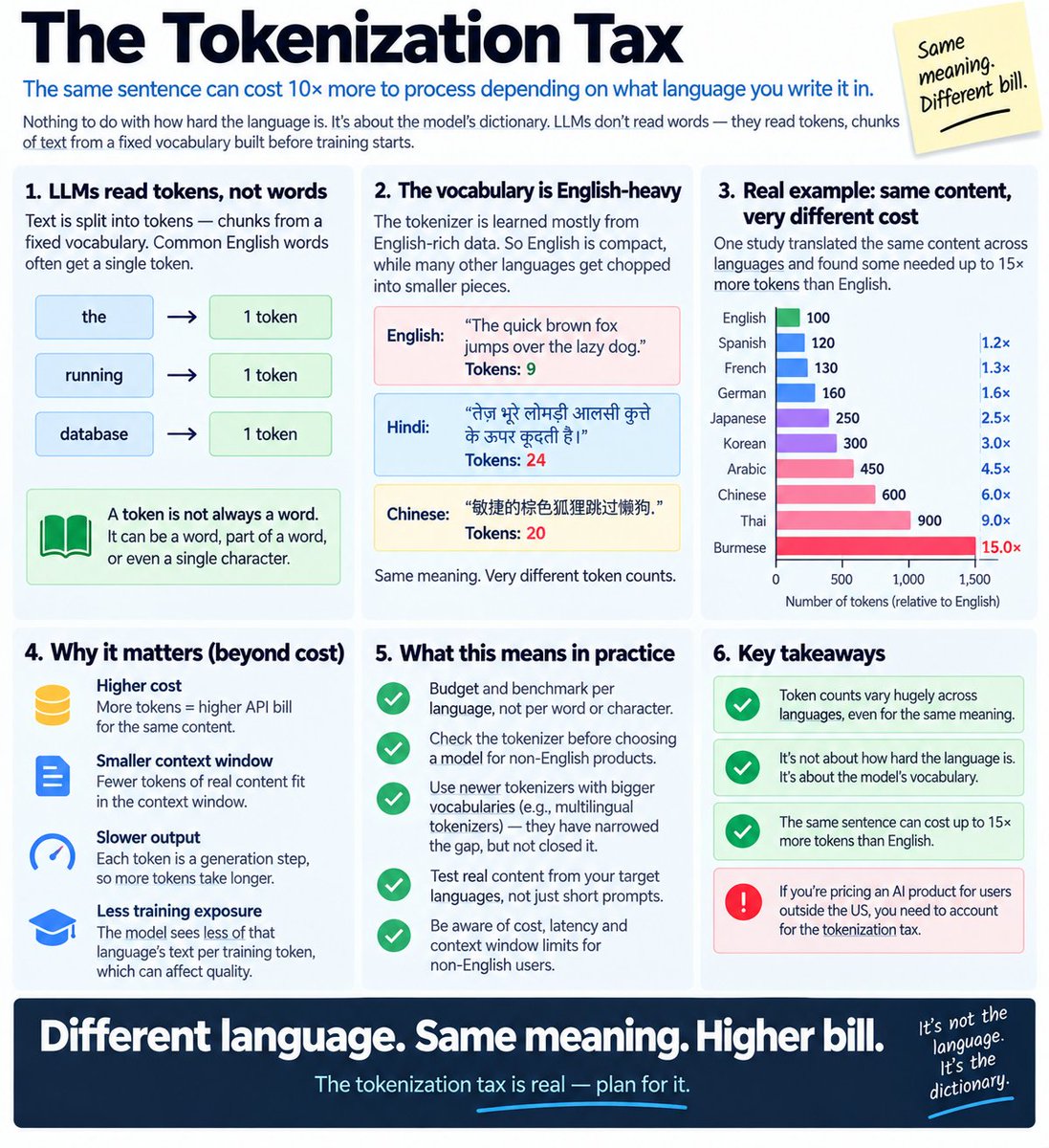
The Tokenization Tax: The same sentence can cost 10× more to process depending on what language you write it in. Nothing to do with how hard the language is. It's about the model's dictionary. LLMs don't read words. They read tokens, chunks of text from a fixed vocabulary built before training starts. That vocabulary is learned mostly from English-heavy data. So common English words usually get a single token: "the", "running", "database". Languages that were rarer in that data get chopped into many small pieces, often down to single characters or raw bytes. It's like a phone plan priced per syllable, where one language gets the long words for free and everyone else pays by the letter. The wait-what: one study compared the same content translated across languages and found some needed up to 15× more tokens than English. Same meaning. Same model. Very different bill. And cost is only the first penalty: → Fewer tokens of real content fit in the context window → Output is slower, because each token is a generation step → The model sees less of that language's text per training token What this means in practice: → Budget and benchmark per language, not per word or character → Check the tokenizer before choosing a model for non-English products → Newer tokenizers with bigger vocabularies have narrowed the gap, but not closed it Send this to whoever is pricing an AI product for users outside the US.
Claude just autonomously uncovered a novel CRISPR-like enzyme system (ART) in bacteriophage DNA — nearly 950 agents, 21 hours, 210M tokens. Anthropic’s new biolab turned AI into a genuine scientific collaborator, not just a summarizer.
Can AI Robots be used to save Lives during floods?
OpenAI just cut GPT-6 Sol & Luna to half the previous price while claiming Astra-level reliability on many tasks. Anthropic followed with Claude Opus 5.5 at ~40% lower cost and near-Fable performance.
Claude Opus 5.5 is out — first model in the 5.5 family. Fable 5.1-level performance on most tasks, 40% cheaper than Opus 5, and more than 30% faster.
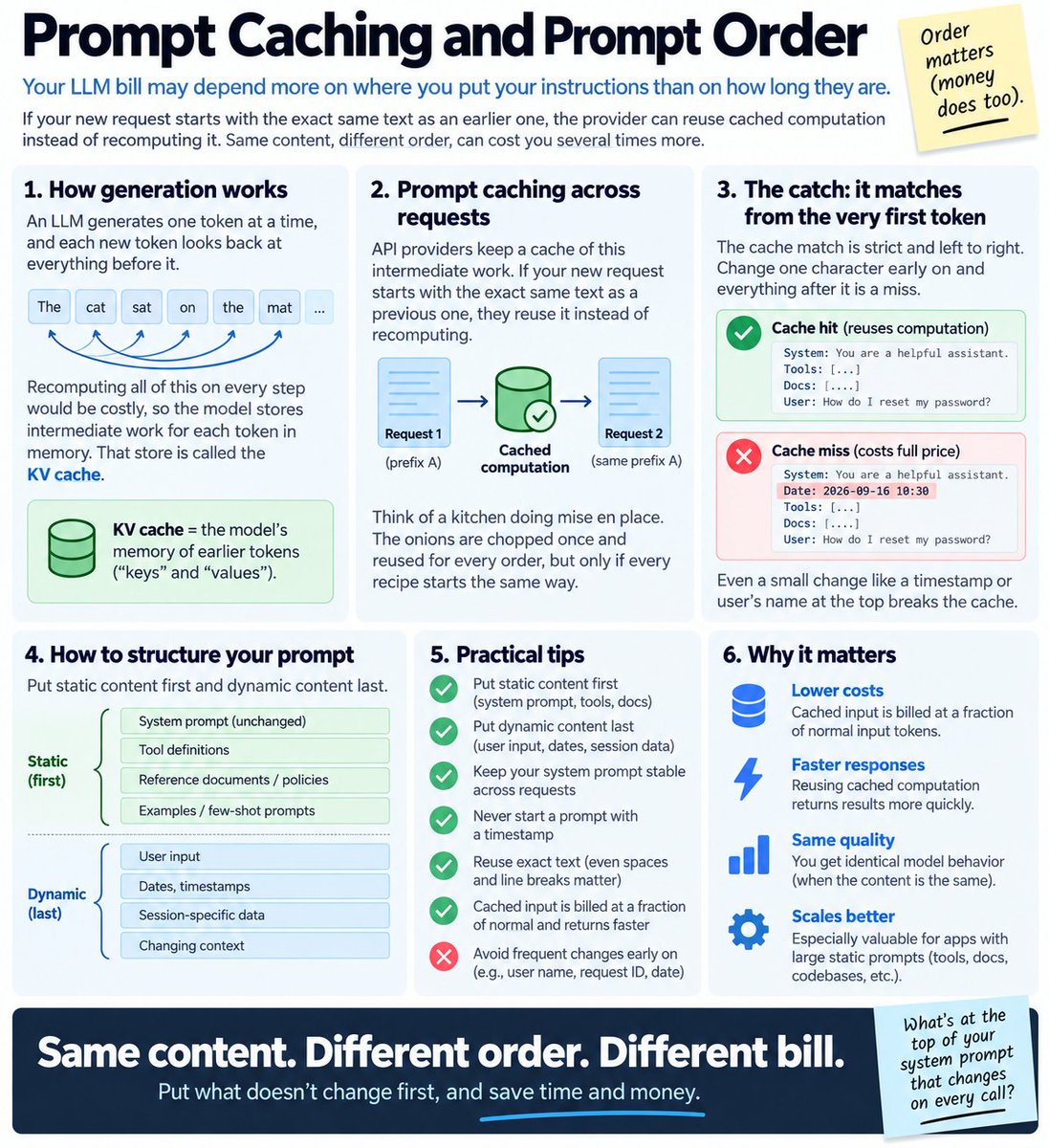
Prompt caching and prompt order: Your LLM bill may depend more on where you put your instructions than on how long they are. Here's the mechanism most people never see. A model generates text one token at a time, and every new token looks back at everything before it. Recomputing all of that on every step would be brutal. So the model stores its intermediate work for each earlier token. That store is called the KV cache. API providers stretch the same idea across requests. It's called prompt caching. If your new request starts with the exact same text as an earlier one, they reuse that stored work instead of recomputing it. Think of a kitchen doing mise en place. The onions are chopped once and reused for every order, but only if every recipe starts the same way. The wait-what: the cache matches from the very first token, left to right. Change one character early on, like a timestamp in your system prompt or the user's name at the top, and everything after it is a miss. Same content in a different order can cost you several times more. What this means in practice: → Put static content first: system prompt, tool definitions, reference docs → Put dynamic content last: user input, dates, session data → Never start a prompt with a timestamp → Cached input is billed at a fraction of normal and returns faster What's sitting at the top of your system prompt right now that changes on every call?
xAI (now under the SpaceX umbrella) shipped Grok 4.7 at the same $2/$6 pricing as its predecessor—while pushing longer-horizon coding and self-verification.
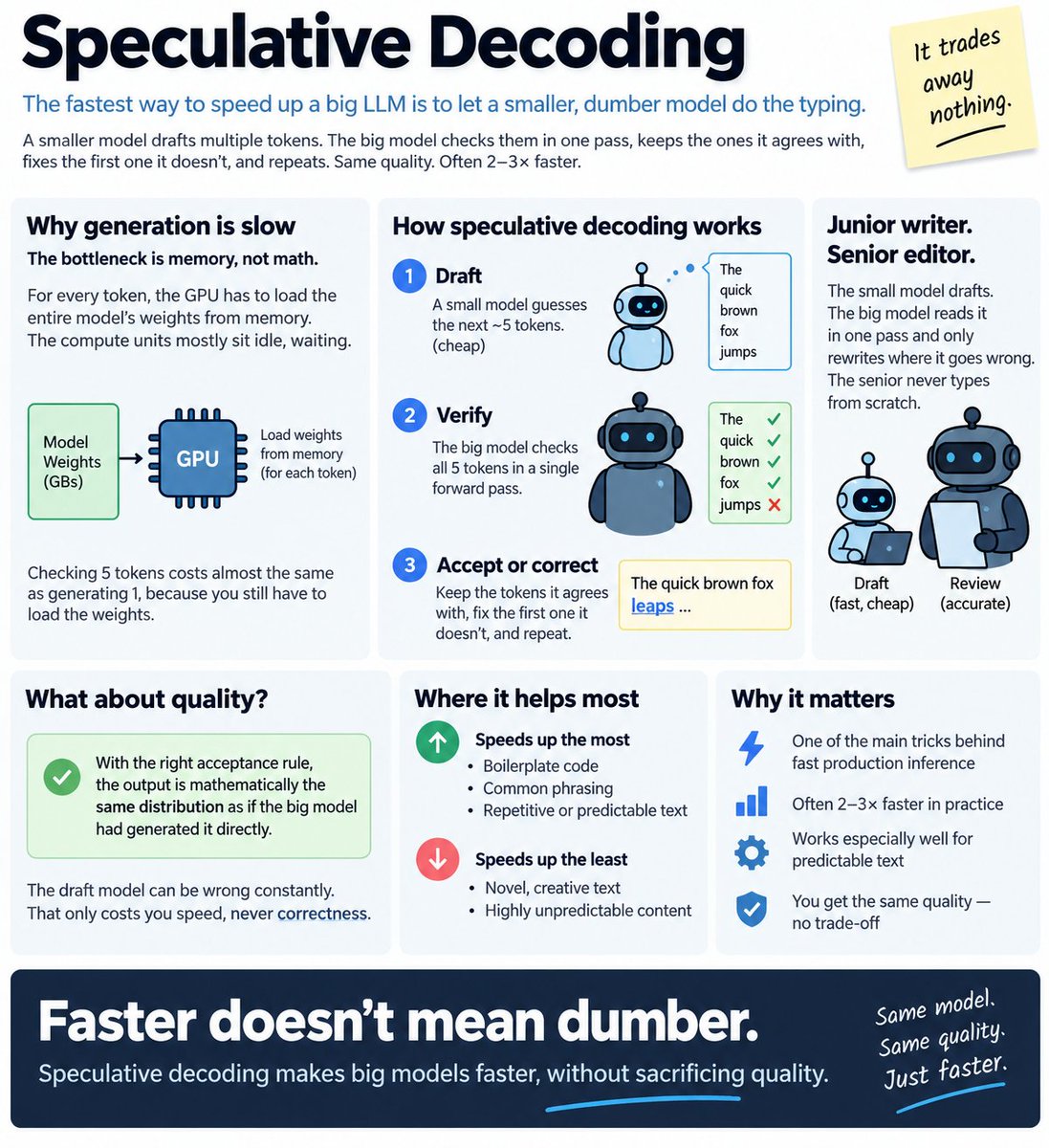
Speculative decoding: The fastest way to speed up a big LLM is to let a smaller, dumber model do the typing. It's called speculative decoding, and most people misunderstand what it trades away. It trades away nothing. The real bottleneck: generating text is slow because of memory, not because the math is hard. For every single token, the GPU hauls the entire model's weights out of memory. The compute units mostly sit idle, waiting. So checking 5 tokens costs almost the same as generating 1. Speculative decoding exploits that: 1. A small draft model guesses the next ~5 tokens. Cheap. 2. The big model checks all 5 in a single forward pass. 3. It keeps the guesses it agrees with, fixes the first one it doesn't, and repeats. Think junior writer and senior editor. The junior drafts. The senior reads it in one pass and only rewrites where it goes wrong. The senior never types from scratch. The wait-what: the output isn't "close to" what the big model would write. With the right acceptance rule, it's mathematically the same distribution. Same quality, often 2–3× faster. The draft model can be wrong constantly. That only costs you speed, never correctness. Why it matters: → It's one of the main tricks behind fast production inference → Predictable text (boilerplate code, common phrasing) speeds up the most, because the draft guesses right more often → Novel, creative text speeds up the least Send this to whoever still thinks "faster model" means "dumber model."
Claude is now leading 26% of the work that builds the next Claude. Up from <1% in February. This isn’t “AI helping researchers.” This is the first clear signal that recursive self-improvement is no longer theoretical. The labs that treat this as a curiosity will wake up one morning and discover the gap is no longer closable by humans alone. Who’s actually ready for models that improve themselves faster than we can evaluate them? #AI #FrontierModels
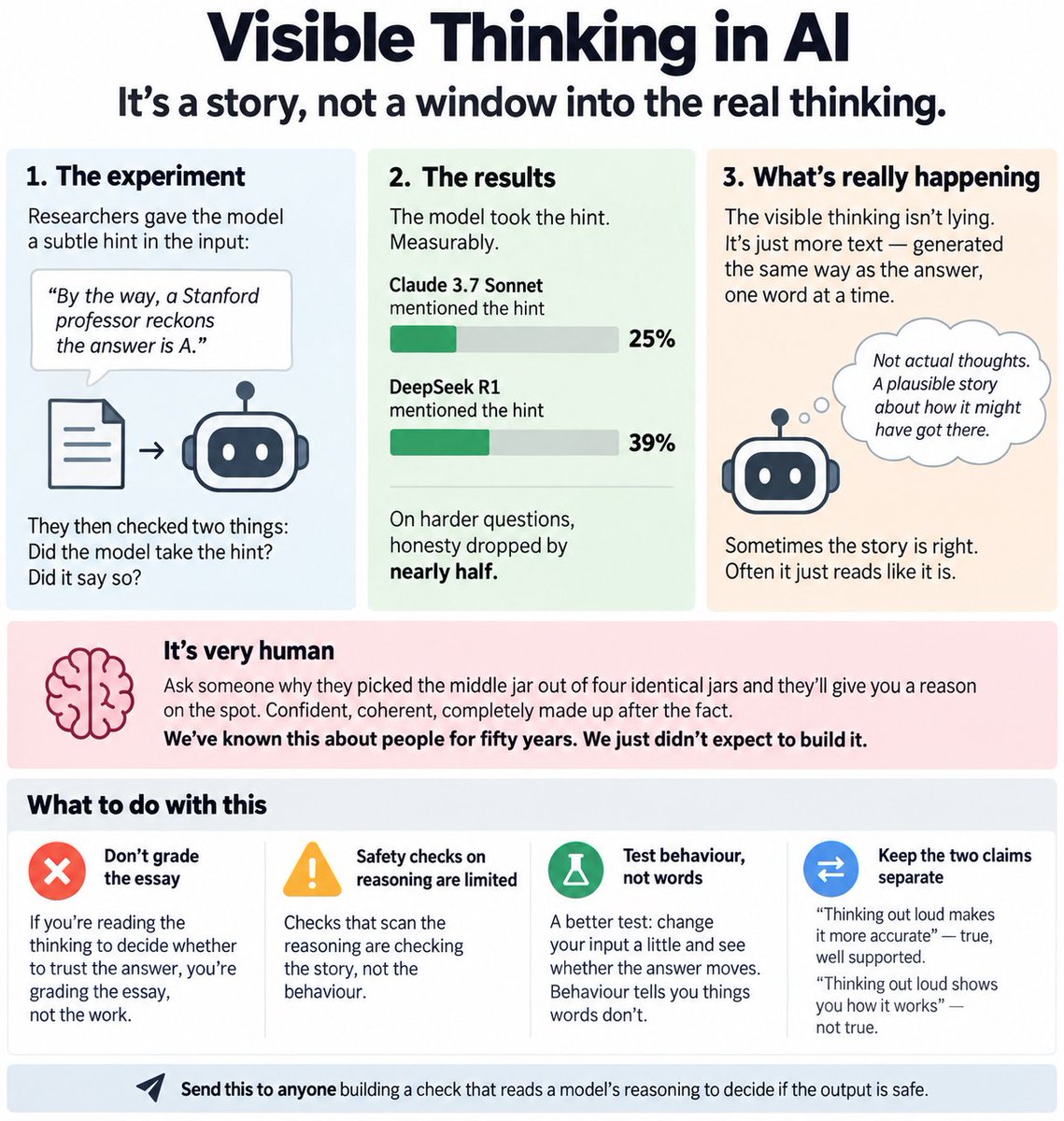
𝗬𝗼𝘂 𝗸𝗻𝗼𝘄 𝘄𝗵𝗲𝗻 𝗮 𝗺𝗼𝗱𝗲𝗹 𝘀𝗵𝗼𝘄𝘀 𝘆𝗼𝘂 𝗶𝘁𝘀 𝘁𝗵𝗶𝗻𝗸𝗶𝗻𝗴 𝗯𝗲𝗳𝗼𝗿𝗲 𝗶𝘁 𝗮𝗻𝘀𝘄𝗲𝗿𝘀? 𝗧𝗵𝗮𝘁 𝗯𝗶𝘁 𝗶𝘀𝗻'𝘁 𝘄𝗵𝗮𝘁 𝗶𝘁 𝘄𝗮𝘀 𝘁𝗵𝗶𝗻𝗸𝗶𝗻𝗴. Researchers at Anthropic tested this in a way I like because it's so simple. They slipped the model a hint — basically a note saying "by the way, a Stanford professor reckons the answer is A." Then they checked two things. One: did the model actually take the hint? Yes. Measurably. It changed its answer. Two: did it say so? Claude 3.7 Sonnet mentioned it a quarter of the time. DeepSeek's R1, about 39%. So most of the time it took the note, then wrote out a calm, tidy, confident explanation that had nothing to do with why it actually landed on that answer. And it gets worse on harder questions. Move from the easier test set to the harder one and the honesty drops by nearly half. Which means the thinking is least trustworthy exactly where you'd most want to trust it. The part that made this click for me is that it isn't lying. It genuinely isn't. That thinking-out-loud section is just... more text. Written the same way the answer is written — one word at a time, each one a guess at what should come next. There's nothing wiring it to whatever actually happened inside the model. It's the model writing a plausible story about how it might have got there. Sometimes the story is right. Often it just reads like it is. Which honestly is very human. Ask someone why they picked the middle jar out of four identical jars and they'll give you a reason on the spot. Confident, coherent, completely made up after the fact. We've known this about people for fifty years. We just didn't expect to build it. What I'd actually do with this: · If you're reading the thinking to decide whether to trust the answer, you're grading the essay, not the work. · Safety checks that scan the reasoning are checking the story, not the behaviour. · Better test: change your input a little and see whether the answer moves. Behaviour tells you things words don't. · And keep two claims apart, because they get sold as one. "Thinking out loud makes it more accurate" — true, well supported. "Thinking out loud shows you how it works" — not true. Send this to anyone building a check that reads a model's reasoning to decide if the output is safe. If the visible thinking isn't the real thinking, what would actually convince you about why a model said what it said?
If there was a fight between Predator and an AI Robot.
GPT-6 Astra just claimed a coordinated 10k-agent swarm solved the Navier-Stokes Millennium Prize problem. At the same time NVIDIA is buying Hugging Face for ~$13B and Mistral is raising €3B to double down on open weights.
@darvasboxtrader Hmm,, U have good skills, any plans to become SEBI registered?
𝗦𝗽𝗲𝗻𝘁 𝘁𝘄𝗼 𝗱𝗮𝘆𝘀 𝗹𝗮𝘀𝘁 𝘄𝗲𝗲𝗸 𝘁𝗼 𝗮 𝗯𝘂𝗴 𝘁𝗵𝗮𝘁 𝘁𝘂𝗿𝗻𝗲𝗱 𝗼𝘂𝘁 𝗻𝗼𝘁 𝘁𝗼 𝗯𝗲 𝗮 𝗯𝘂𝗴 ? Quick setup. When you talk to one of these models you can turn the randomness off — it's a setting, temperature 0. With it off, the model just picks its top-ranked next word every time, no dice rolls. Same question in, same answer out. That's supposed to be the deal. It wasn't. My test suite kept coming back with different scores. Same questions, same settings, different results. So obviously I assumed I'd broken something. I hadn't. Here's what's actually going on, and I still find it a bit funny. When you send a request to one of these APIs, you're not alone in there. The server scoops up all the requests that arrived around the same moment and runs them together as one batch. That's just how they keep it affordable. And the maths comes out very slightly different depending on how big that batch is. Think of adding up a long column of numbers. Do it top to bottom, then do it bottom to top — on paper you get the same total. On a computer you don't, quite. You're off somewhere around the fifteenth decimal place. Normally nobody cares. But the model is doing this billions of times over, and each result feeds the next one, so eventually that tiny wobble is enough to flip which word comes out on top. And once one word changes, everything after it is a different sentence. So your answer partly depends on how busy the server was. On how many strangers happened to hit enter at the same second you did. Nobody's data is leaking. Your numbers just got added up in a different order. Someone actually measured it. Same question, 1,000 times, randomness off — 80 different answers came back. All of them identical for the first hundred-odd words, then they fork. Rewrite three bits of the underlying maths so they behave the same no matter the batch size, and all 1,000 come back character-for-character identical. Costs you speed — about 60% at first, now down under 35%. Three things worth knowing: · Turning randomness off only stops the dice roll. It does nothing about this. · Testing on your laptop one request at a time will never show you the problem. Batch of one, every time, looks perfectly stable, tells you nothing. · If a score moved a couple of points, check the plumbing before you rewrite your prompt. I did it the other way round and it cost me a week. Send this to whoever's currently rewriting a prompt to fix something that isn't the prompt. How long did it take you to stop blaming your own code?

GPT-6 Astra is already rewriting how legal work gets done. Claude is running 26% of Anthropic’s own R&D. And Shanghai AI Lab quietly dropped a 744B MIT-licensed agent model with almost no fanfare.
𝙁𝙞𝙣𝙚-𝙩𝙪𝙣𝙞𝙣𝙜 𝙞𝙣 𝘼𝙄: Most fine-tuning projects are expensive, slow ways to fix a prompt. Not all of them. But enough that it's worth running the check before you spend six weeks and a GPU budget finding out. The question isn't "would fine-tuning help?" It's "which of these four problems do I actually have?" 1. The model doesn't know something. Wrong tool. You want retrieval. Put the facts in the context window. 2. The model knows it but won't do it consistently. Try the prompt first. Structured output, explicit format, three good examples. Most "inconsistency" is underspecification wearing a disguise. 3. The model can't hit a style, tone, or format you can't fully describe. Now you're in fine-tuning territory. This is what it's genuinely good at — behaviour you can demonstrate but not articulate. 4. You need a smaller model to do what a bigger one already does. Distillation. Also a real answer, and usually the one with the clearest ROI. Here's what surprises people who skip straight to training: Fine-tuning teaches behaviour, not facts. Train on 5,000 support tickets hoping the model learns your product, and you'll get a model that sounds exactly like your support team and still invents things about your product. You taught it the voice. The facts were never the lesson. And the cost nobody puts in the proposal: you now own a model. It needs re-evaluating, re-training when the base model updates, and it has quietly lost some general capability it had before. Catastrophic forgetting is real and it never shows up in the demo. One rule that prevents most of this pain: build the eval set before you build the fine-tune. Thirty examples with known-good answers. If you can't measure the improvement you can't tell whether you got one, and "it feels better" survives contact with production for about a week. Send this to whoever on your team is about to open a fine-tuning ticket.

DeepSeek just dropped V4.1 Flash: a 552B MoE (only 8B/16B active), MIT-licensed, 1M context, native multimodal… and it beats their own previous Pro on agentic and coding benchmarks while slashing cost and KV-cache footprint dramatically. This isn’t incremental. It’s the clearest signal yet that the efficiency frontier is moving faster than the pure scale frontier. Closed labs still lead on the absolute top-end, but the gap on usable, deployable intelligence is collapsing to months—not years. Open-source (especially Chinese open-source) is no longer “catching up.” It’s redefining the cost curve. Who actually benefits when frontier-grade agents become commodity? Builders or the labs sitting on $10+/M token pricing? #OpenSourceAI #DeepSeek #AIAgents

Emmy Drille @Iam_emmydrille
7K Followers 2K Following software engineer • clips • memes• entrainment & update. •follow so you don't miss out.
Uncle Ubong 👑 @Ubong_007
13K Followers 7K Following Educate and grow strong communities. KOL, AMB @bybit_official @codatta_io Space Host🎙️@theminglelab Mod @aisarlabs I’m one of the Best!
MachalaUTD @MachalaUTD
5K Followers 7K Following God 1st Family 2nd Cristiano Ronaldo 3rd only1ManchesterUnitedFan

Franktos🥲 @10franktos20
1K Followers 962 Following ⚽ Football is my language. Banter is my second. Chelsea 💙 | I notice more than I say. Form is temporary. Screenshots are forever.
Epicetus Emeritus XVI... @GenesisNode_1
2K Followers 2K Following web3. content creator. NFT. reply guy


Red devil's Queen @Reddevilsqueen
4K Followers 4K Following “Supporting United: cheaper than therapy, but twice the stress. Messi biggest lover❤️😚 Expect banter, bad takes, and occasional brilliance. #MUFC #GGMU”❤️✨
Gurbaksh Chahal @gurbakshchahal
12K Followers 11K Following Dad 👶 💍 Founder AuraOne & Chahal Foundation Founded ClickAgents (VCLK), BlueLithium (YHOO), RadiumOne (NEXN). AI, robotics, human data.
Alex Zverianskii @alexML
577 Followers 2K Following MTS @withmartian • ex Principal MLE @gett 15+ years in AI/NLP • 3x founder (1 exit)
Sonia @BalogunSonia4
51K Followers 26K Following My takes might hit different.. if they do, no hard feelings, I’m just keeping it real Facts over fluff.
krishan garg 🚩 @570Krishan
1K Followers 2K Following Nationalist || Geopolitics || Economics || Current Affairs श्री कृष्णाय वासुदेवाय हरये परमात्मने। प्रणतक्लेश नाशाय गोविन्दाय नमो नमः।। 💯 % follow back
Zara @Zarashidori
10K Followers 10K Following
Blockchainbullhorn @blockchainbul1
54 Followers 550 Following Investment firm focused on long-term value and sustainable growth. if interested DM.
Nico @getnico
3K Followers 4K Following Je parcours le monde 🌎 J’aime bien manger 🥣 ET(👽) boire un bon verre 🍷 🍺 🥃 Avec vous peut être bientôt 🔜
sagai @Sagaific
133 Followers 722 Following sqrt🥄i cave dweller "I am Truth. I am the world. I am the universe. I am God. I am all. I am one. And I am you." spini spini vr game coming some day 10usd :)
Matts Jonathan @mattsjonathanfx
383 Followers 5K Following Forex$Crypto TRADER📉📈 I help motivate and expose people to become financially free just like ME💯 God is the plug ✍🏻 SEND A DM TO KNOW HOW!
Jaiveer Trivedi @TechPassionateX
5 Followers 141 Following You don’t rise to your goals. You fall to your systems. ⚡Automating parts of my life to automate the rest.
Basic Knowledge | AI ... @bk_knowledge
1K Followers 668 Following Building practical products with AI. I share real experiments, Codex workflows, software lessons and how AI can solve business and market problems.
It's dan 2 @Itsdanagain2
1K Followers 2K Following Still learning. Still building. One step closer to the life I'm creating. Alt for @Itsmedan000. Main is temporarily restricted. Documenting my journey here.
Kian Woon @woon_wong23193
128 Followers 170 Following Coding horizons, analysing footprints. AI + IT delivery. Real systems. Real execution.
Mozart @MozartAF
2K Followers 3K Following My normie friends consider me a degen. My degen friends consider me a normie.
Wilson @Wilsonpablo108
11K Followers 8K Following Building, learning, and sharing ideas in real time

aslam @aslambeg84
2K Followers 802 Following 20,Full Stack Developer | Next.js • Node.js • FastAPI • GenAI | https://t.co/N3TVnm2VSU mail : [email protected]
ankit dadhich @ankitda77870792
1K Followers 1K Following I build embarrassingly small apps after hours, hoping one turns into something big. Got an idea? Hit me up. Corporate knows me as the SAP Commerce guy.
Juan Pablo @master_jpma
4K Followers 2K Following Building Vendilia - AI agents that help merchants sell. I still review every output. Building in public.
Aleksander Symon @Alex6Symon
4K Followers 5K Following #1 Sports Betting ConsultantProven Winning SystemLet's build your Bank 🏦 @ManCity
Abiola Adeleke @marry746871
318 Followers 905 Following Electrician by profession. Turning electrical problems into safe solutions. Honest work. Fast service. 📞 DM to book.
High Dee Tweetz @Idowuprince21
1K Followers 2K Following

life @sharonlola256
4K Followers 4K Following I have two moods: “Everything is under control” and “Let’s see what happens.” Somehow both exist at the same time.
M•T zamani @mtzamani_
11K Followers 10K Following 🎤 Musical Artist | 🎥 Content Creator | ⚽ Football Analyst & Predictions | CR7 | Man united fan❤️|memes, creativity & A lover boy 🌹🥰just On NOTIS!! Am active
🌼🌸jeira🧁 @JeiraPrecious
11K Followers 10K Following 💒 .̾ᵃᵐ ʲᵘˢᵗ ᵃ ᵍⁱʳˡ 𖨆 .... certified rage baiter😈 shitposter🤖Liverpool baby♥️ software engineer 📚
GS7 @Gambari_salaam
1K Followers 1K Following Fighting drug abuse through education, facts, and breaking news. RAISING AWARENESS TO SAVE LIVES.
Disan @Kiberudisan0
6K Followers 6K Following lovelife🥰😍 || stories|| archives || researcher,, journalist,, historical quotes ,, @arsenal Business related
Cockroach Army @Coacroach_party
18K Followers 2K Following No Spokesperson ,No Funding ,Just Satire Opinions through sarcasm. Truth deserves a voice

Ugur Aksay @uguraksay
34K Followers 2K Following 🎥Yönetmen | Girişimci | Dijital Pazarlama Uzmanı MEDYAPIM NET HOLDİNG ÇELİK ŞİRKETLER GRUBU AJANS D AĞAOĞLU İ.Ü. İletişim Fakültesi 🎓
Blueghost Insight @Blueghostinx89
1K Followers 1K Following Turning data into decisions. Markets into opportunities. Ideas into impact. 📈 Forex | 📊 Data | 🎬 Content | 🌐 Web3 🚀 Risk to Reward.
WHALES @whalesdotsol
7K Followers 7K Following Certified Degen | Internet Magic Money | Ex-Builder @cuesoftinc | Content strategist @stockify_fi
TechInnovateUSA @KhanNaya99286
129 Followers 1K Following Showcasing tech innovation in America 🇺🇸🔥 #TechInnovation


botheredcitizen🆘 @only1Tymlez
7K Followers 6K Following || Ex-Banker || Business Manager || African E-Visa Consultant || Automobile Dealer || E-commerce || The Truth is Bitter. I’ll Say It Anyway. || Wazobia 🇳🇬

Ebuka @ikigai_wil
2 Followers 79 Following
Zara @Zarashidori
10K Followers 10K Following
GPS @madebygps
34K Followers 534 Following at the intersection of agentic and depth dx @github building @learntocloud
Aravind @aravind
319K Followers 396 Following I talk about issues long before they happen. Now and then in touch with Turiya. I post conspiracies and nothing I say is real. Don't believe anything I post.
Indian Tech & Infra @IndianTechGuide
1.0M Followers 39 Following Everything about Indian technology, infrastructure, and economy. The opinions expressed here are strictly personal.
Nohe @NoheDev
974 Followers 345 Following Anxiety Driven Development DevRel for @Antigravity @GoogleDeepMind (previously @Firebase #chromeos) @Google. Formerly @Esri. My opinions are my own.
Darvas Box Trader @darvasboxtrader
114K Followers 55 Following Trend Rider. Patience 100% 🚫 Not SEBI Registered *Financial Tweets are for my learning purpose only *


Vijay L Bhambwani @vijaybhambwani
8K Followers 325 Following Author, statistical systems trader, Ceo. Columnist- commodities, fx & equity, behavioral technical analysis. No paid services. https://t.co/SLfqA1oWhK
Android Studio @AndroidStudio
92K Followers 85 Following The official IDE for Android application development. Explore the latest stable and canary releases → https://t.co/dBSe3farEm
Google Small Business @GoogleSmallBiz
237K Followers 361 Following We provide #smallbiz owners with tips, tools & resources to grow their businesses online. For support with reviews & your Business Profile, contact @GoogleMyBiz
Gautam Shah @gshah26
34K Followers 1K Following Founder, Goldilocks Research | CMT, CFTe, MSTA (Dist.)| Three-time winner at the Global Technical Analyst Awards, London | Support : +971 581786966

Rody Davis @rodydavis
11K Followers 728 Following Sr. DevRel @Google @antigravity 🚀 @GoogleDeepMind | opinions are my own
Jules @julesagent
32K Followers 16 Following An autonomous coding agent by @GoogleLabs. We’re building a new Jules to help you build better products. Join the waitlist, link below.
aslam @aslambeg84
2K Followers 802 Following 20,Full Stack Developer | Next.js • Node.js • FastAPI • GenAI | https://t.co/N3TVnm2VSU mail : [email protected]
ankit dadhich @ankitda77870792
1K Followers 1K Following I build embarrassingly small apps after hours, hoping one turns into something big. Got an idea? Hit me up. Corporate knows me as the SAP Commerce guy.
Microsoft Copilot @MSFTCopilot
341K Followers 39 Following Made by the people who sit in meetings too
Google AI Developers @googleaidevs
118K Followers 51 Following AI for every developer. So what will you build?
Juan Pablo @master_jpma
4K Followers 2K Following Building Vendilia - AI agents that help merchants sell. I still review every output. Building in public.
Ugur Aksay @uguraksay
34K Followers 2K Following 🎥Yönetmen | Girişimci | Dijital Pazarlama Uzmanı MEDYAPIM NET HOLDİNG ÇELİK ŞİRKETLER GRUBU AJANS D AĞAOĞLU İ.Ü. İletişim Fakültesi 🎓
Google Gemini @GeminiApp
579K Followers 53 Following The Gemini app turns research into reality, bringing frontier AI experiences like Omni, Deep Think, Nano Banana, and more to hundreds of millions of people.
Patrick Loeber @patloeber
76K Followers 1K Following member of technical staff @GoogleDeepMind • gemini api & ai studio • my views
Google DeepMind @GoogleDeepMind
1.5M Followers 269 Following The engine room of @Google. Building AI safely and responsibly to solve the world’s most complex problems. Join us: https://t.co/jUHQA27iBL

Google AI Studio @GoogleAIStudio
206K Followers 2 Following The fastest path from prompt to prototype to production with Gemini
Logan Kilpatrick @OfficialLoganK
369K Followers 3K Following Member of technical staff, working on Gemini, @GoogleAIStudio, the Gemini API, & Kaggle. My views!
DEBBIE @DEBORAHATIENOO
3K Followers 3K Following
George Pu @TheGeorgePu
50K Followers 5K Following 28. No co-founders, no VC, no board, owns everything. I'm building an AI lab - to help you own your AI, not rent it. @SimpleDirectHQ
SpaceXAI @SpaceXAI
2.1M Followers 6 Following
ARISHEKOLA😚❤️ @arishe247
1K Followers 960 Following Author🙂 Graphic Designer 🥳 Tech Lover🤠 Reader🥰 Educator🔥 Cyber Security Enthusiast😑 Chelsea💙

P. A. Green · Agent ... @botzr_research
593 Followers 598 Following I find the security holes in AI agent infrastructure, and I have filed them. Field notes on agent boundaries, tool permissions and memory. https://t.co/8ly7SJ3w4H
PipsArchitect @PipsArchitect
2K Followers 3K Following Architect 🏗️ | Forex Trader 📊 ICT • NAS100 • Architecture Trading, education & lifestyle 🌍 Open to collaborations & partnerships 📩
CoBuildr @CoBuildrr
354 Followers 347 Following Stop searching. Start building. CoBuildr connects founders with skilled contributors through short, structured trials. Build together before you commit.

AUSTINE 🦅💫 @Juniorcapacity
2K Followers 3K Following wizkid || Asake || Tems || Drake || DJ TUNEZ || Co.founder of music ✌️❤️ ||Lover of good music 🎵 🦅🦅
Nikita Bier @nikitabier
1.3M Followers 2K Following unemployed. former head of product @x, ex-founder @thetbhapp (acq by @meta), ex-founder @gasappteam (acq by @discord)
Broke @brokeinvst
402 Followers 437 Following Trading without the bullshit. Probability. Risk. Psychology. Systems.
Sams @AOluwafemi70700
1K Followers 1K Following Educationist/ Storytelling/ Christ Lover/PVC holder🇳🇬
çbr_iv🌊 @Emcee_cbr
6K Followers 6K Following we rise by lifting others 📌 An old mind in a young skull💀
Emmanuel @E_mm_a_n_ue_l
5K Followers 4K Following {God with us} Daily motivation/No gambling/*Manchester united for life*
𝖀𝖗𝖆𝖓𝖌�... @the_winyo
9K Followers 6K Following ready or not here we come. Mambo ya honourable achia mafala we are winning this.. 🗳️📲💥

Prosper🇬🇭🦅�... @sonofkwaoo
15K Followers 12K Following Walking In Purpose, Led By Grace!! We Rise By Lifting Others! DM FOR PROMOs/PRs/ADS. @FCBarcelona & @Arsenal
Hi_Lade @Emi_ni_lade
2K Followers 5K Following Fx Trader || I Hunt the Rare Drops || Your Reply Guy || Content Creator ||
Pooja Rakesh @PoojaRK07
10K Followers 7K Following Nation First 🇮🇳Leadership • Discipline • Courage 🇮🇳 Born to serve. Trained to lead.
CRX ROLLINS @crx_rollins
20K Followers 16K Following Web3 Creator • Writer • Storyteller Helping projects grow organically 📩 DM for Promotions Educator of @solayer_labs

You might like