Chef Robotics @ChefRobotics
Empowering humans to do what humans do best. We're hiring: https://t.co/Nk06QAGCQo chefrobotics.ai San Francisco, CA Joined May 2018-
Tweets318
-
Followers1K
-
Following2
-
Likes131

@ChefRobotics is the last food robotics company from the late 2010's that is still standing—or rather, thriving. So what did @RajatBhageria do differently? He says customers come first. "Understand the customer pain points, and go from there." "Honestly, I have a good enough intuition of engineering to hire people to be able to build a product and get venture capital." "BUT, if the customers don't want it, you're screwed." "And there's an opportunity cost to everything: like, should I even spend my mental energy doing this thing for the next X years unless customers desperately want this thing?"
Our fireside chat with @RajatBhageria (Founder & CEO of @ChefRobotics), moderated by @ashis_ghosh_ (Robotics Venture Partner at @savant_vc) 00:14 Introductions 00:38 Being in robotics is hard 01:21 What was the road like leading up to Chef? 04:28 When is it time to jump in?
We’re at the @allinpod's Summit in LA today and tomorrow! Stop by the Frontier Tech Hub anytime to see a live demo of a Chef robot and chat with our team. #AllInSummit

Day One of the All-In Summit is officially in the books. Tomorrow, the stage takes over. Stay tuned to catch it all in real-time. #AllInSummit
We're featured on S3! Big thanks to @jasonjoyride and his team for this excellent story! Check out the full video: youtube.com/watch?v=XPcfqs…

In less than 7 years, @ChefRobotics has built and deployed robots that have assembled more than 100 million servings of food. S3 went inside their factory to see how the technology works, and asked a labor rep whether automation could solve the food industry’s labor challenges.
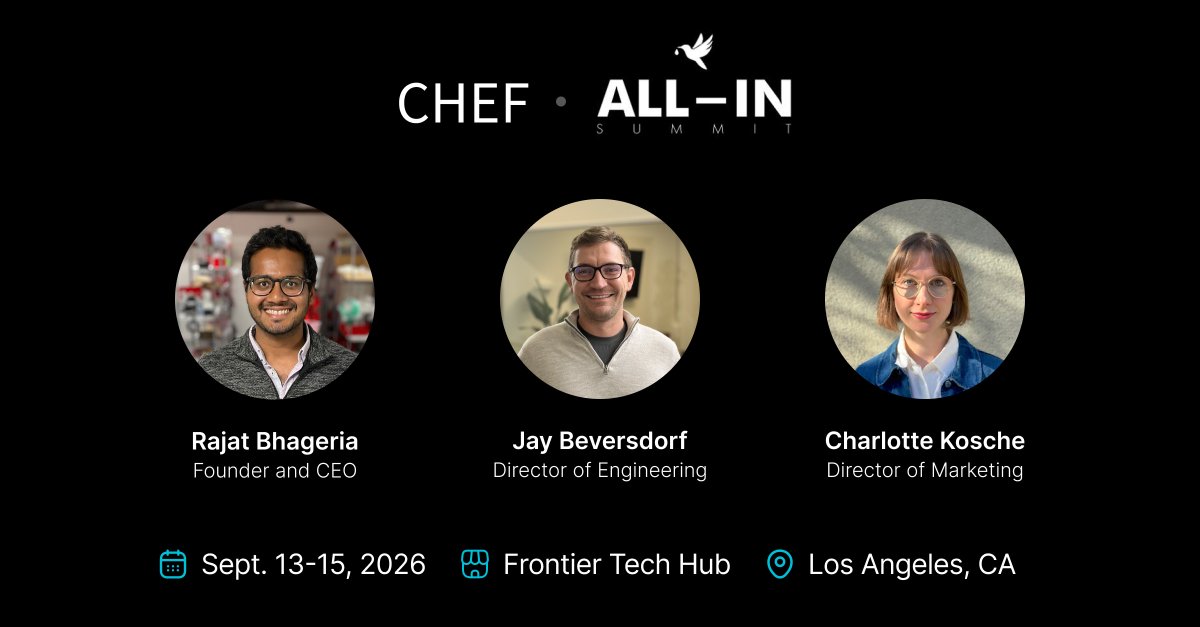
Chef Robotics is heading to the All-In Summit! 🤖 📅 Sept. 13-15, 2026 📍 Los Angeles, CA Our team - Rajat Bhageria, Jay Beversdorf, and Charlotte Kosche will show a Chef robot in action and answer your questions about physical AI, food manipulation, and what it takes to scale robotics in production. If you're attending the Summit, come find us. We'd love to connect! #allinsummit #physicalai #foodautomation #foodproduction
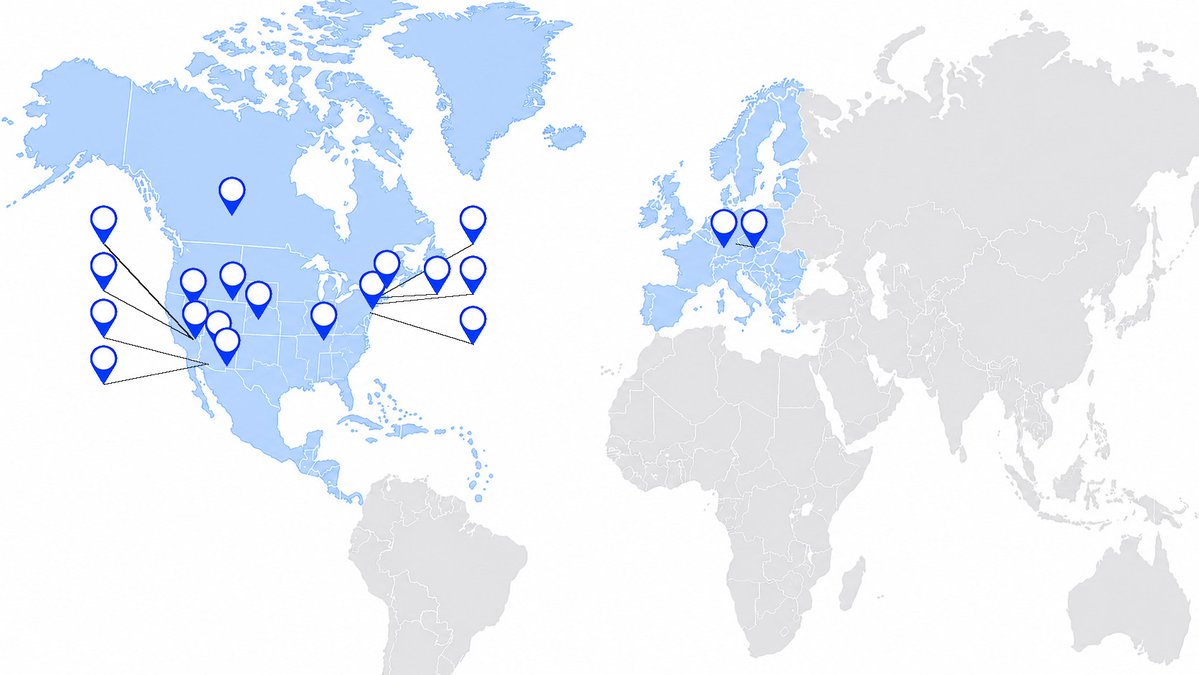
Chef robots run in production across North America and Europe today. Each robot needs to stay up, get fixed fast, and keep improving over time, no matter the time zone. 𝗧𝗵𝗲 𝗽𝗿𝗼𝗯𝗹𝗲𝗺 A robot in Europe can go down while our US team is asleep. Our robots combine hardware and software, so when something breaks, our engineers aren't just debugging code; they're often diagnosing physical wear on a real machine too. Spare parts crossing borders and language differences with local facility teams add friction on top of that. 𝗧𝗵𝗲 𝘀𝗼𝗹𝘂𝘁𝗶𝗼𝗻 Here's how we keep 100+ robots running across three countries: 1. Customer requests flow into an integrated portal for triage. 2. Simple issues get resolved right away. 3. Complex ones escalate to our support engineers, who use tools like Foxglove and in-house tools to debug live systems from thousands of miles away. 4. For hands-on repairs, a network of certified local technicians handles routine maintenance, and our own engineers travel on-site for the bigger integrations. 𝗧𝗵𝗲 𝗿𝗲𝘀𝘂𝗹𝘁 Customers expand with us. One customer grew from 2 robots to 36. Another went from 2 to 22. And we didn't need to add more headcount to our support team to make that happen. Read the full story on our blog: chefrobotics.ai/post/how-chef-…
What if a robot could predict the outcome of an action before it starts moving? Chef robots have made over 130 million servings in production. Each serving generates real-world data about the robot’s action and its measured outcome. We’re using this data to train a Food World Model, a neural simulator that predicts both how much food a robot will pick and the surface it will leave behind. In an initial run, the model: 1. Improved overall weight-prediction error from 13.6 g to 10.3 g 2. Reduced post-pick surface errors by 42% 3. Learned from measurements collected during normal production without additional manual labeling This is an early step toward our robots simulating candidate actions, choosing the one most likely to hit the target weight, and adapting faster to new ingredients. Read part 1 of our Food World Model blog series and explore the interactive pick visualizer: chefrobotics.ai/post/building-…

AI is changing not only software, but also how physical products are designed and built. In robotics, we’re seeing shorter development cycles, fewer physical prototypes, and the ability to test more ideas before committing to one. Of course, AI can’t replace every hardware-dependent process in an industry built around the physical world. But it can give us better tools to solve complex engineering problems faster. Rajat Bhageria spoke with Packaging Insights about what this looks like at Chef and where AI-enabled manufacturing is headed: packaginginsights.com/special-report…

You've probably already eaten food made by one of our robots; you just didn't know it. → The wrap you grabbed on your way to work → The frozen meal at Whole Foods → The salad from Trader Joe's → The meal on your last flight → The tray at a hospital → The lunch at a school cafeteria Today, Chef has: → 100+ robots in the field → 130,000,000 meals in production - more than everyone else combined by an order of magnitude → 170,000 hours of production data → Customers across the US, Canada, and Europe To learn more about how automation is reshaping the food industry, watch Rajat's full conversation with NYSE theCUBE: youtube.com/watch?v=eT6GaO…
How many auger fillers does it take to fill a three-ingredient tray? Three, as each filler is calibrated for one ingredient. High-mix meal assembly requires equipment to handle many ingredients, constant SKU changes, quick changeovers, and zero tolerance for giveaway. 𝗛𝗼𝘄 𝗮𝘂𝗴𝗲𝗿 𝗳𝗶𝗹𝗹𝗲𝗿𝘀 𝗯𝗲𝗵𝗮𝘃𝗲 𝗼𝗻 𝗮 𝗵𝗶𝗴𝗵-𝗺𝗶𝘅 𝗹𝗶𝗻𝗲 → Each filler has custom hardware for one ingredient; running dozens of SKUs means dozens of single-purpose fillers sitting idle between runs → Changeovers take hours, cleaning and recalibrating between every SKU; Allergen switches take even longer, since fine powder residue can become airborne 𝗪𝗵𝗮𝘁 𝗮𝘂𝗴𝗲𝗿 𝗳𝗶𝗹𝗹𝗲𝗿𝘀 𝗮𝗿𝗲 𝗮𝗰𝘁𝘂𝗮𝗹𝗹𝘆 𝗯𝘂𝗶𝗹𝘁 𝗳𝗼𝗿 → Built to run one dry, free-flowing ingredient, like spices, flour, or protein powder, at high volume, reliably 𝗪𝗵𝘆 𝘄𝗲 𝗯𝘂𝗶𝗹𝘁 𝗖𝗵𝗲𝗳 𝗿𝗼𝗯𝗼𝘁𝘀 → Chef's AI-enabled meal assembly robots pick and place ingredients by weight, not volume, so weight never drifts the way a rotation count would → Changeovers take minutes, not hours, because there's no hopper to clear or screw to recalibrate → One robot handles every ingredient in a SKU, wet or dry, that would otherwise need a separate filler, or a person, for each one Full comparison, including where an auger filler is still the right call: chefrobotics.ai/guides/chef-ro… #FoodManufacturing #FoodRobotics #Automation
What if robots could imagine what happens next before they act? That's the promise of world models: AI systems that learn to predict possible futures, plan, learn, and generate new experience before taking an action in the physical world. In our latest survey paper, we map the rapidly evolving field of world models and world-action models. We cover over 220 research contributions and look at 160 systems across six modeling approaches and six application domains, from robotics and autonomous driving to reinforcement learning, gaming, and general-purpose simulation. One of the biggest open questions is whether models that generate a convincing future actually understand the physical world. That distinction is critical for robotics: a future that looks plausible but violates physics isn't good enough when a robot needs to act on it. Read our paper for an accessible overview of the field, the major approaches, and the research challenges that need to be solved before we can bring world models into the physical world: chefrobotics.ai/post/world-mod… #robotics #worldmodels #physicalai

Most companies raise capital to find product-market fit. At Chef Robotics, we did it the other way around. From day one, our CEO, Rajat Bhageria, insisted on this: don't go to investors with a vision alone. Bring evidence from customers. Signed commitments. Willingness to pay. Proof that the problem is real, not just interesting. That sequencing runs against the standard playbook, where most companies raise first and look for proof after. We wanted proof first, so that when we did raise, investors weren't asked to believe in a hypothesis. Proving traction first is slower in the short term in a category as capital-intensive and unforgiving as robotics. But eventually it compounds: Chef robots have now completed over 127 million servings in production, with customers seeing 2-3x output increases and changeovers under 10 minutes. More of this in the TechCrunch Disrupt conversation: youtube.com/watch?v=02hqvJ… #techcrunchdisrupt #aiandrobotics #foodautomation #physicalAI
What does it take to build a lasting food business? In Episode 2 of our Food Builders podcast, Rajat sits down with Sameer Malhotra, Co-Founder and CEO of Cafe Spice, to discuss the company's journey from a family-run restaurant business in New York City to a leading producer of ready-to-eat meals. Sameer shares how he and his father, Sushil, scaled Cafe Spice by expanding into new markets, launching new product lines—including Latin American meals under the Cantina Latina brand—and building a strong team along the way. They also discuss leadership, hiring, company culture, and what the future holds for Cafe Spice and the food industry. 🎙️ Watch or listen to the full episode on YouTube: youtube.com/watch?v=83sWTh… or Spotify: open.spotify.com/episode/2gn4Ua…
We just published a new survey paper on vision-language-action models (VLAs) for bimanual manipulation. VLAs have gained popularity in robotics research, but while they've demonstrated impressive capabilities, it can be difficult to understand how different architectures compare and which ones are best suited for real-world deployment, especially for bimanual manipulation. To answer these questions, we reviewed more than 200 papers and compared 31 VLA methods. We examined their architectures, training strategies, action representations, and real-world applications. Our key takeaway is that not all bimanual tasks require the same level of coordination, which impacts the best VLA method and architecture to use. For tasks that require two robot arms to remain tightly synchronized, architectures that generate both arms' actions jointly are better suited than approaches that generate them sequentially. Among today's methods, flow-based action generation offers one of the strongest reported combinations of coordinated action generation and the speed required for real-time control. The survey also examines where the field needs to go next, including: 1. Standardized benchmarks for bimanual manipulation 2. Better force, tactile, and multimodal sensing 3. The safety and reliability needed for large-scale commercial deployment Read the full survey paper: chefrobotics.ai/post/vision-la… #robotics #physicalai
A food depositor deposits one ingredient. A Chef robot assembles an entire meal. Here's when each one is the right fit. Depositors (also called dispensers or fillers) are excellent at depositing one flowable ingredient like sauces or dressings at high speed. But they fall short for high-mix meal assembly for two reasons: → A depositor is unable to handle many ingredients such as diced proteins, vegetables, grains, and mixed foods, as they don't flow well through a nozzle. → Even for ingredients a depositor can handle, like sauces, changeover time makes it impractical. Switching ingredients means cleaning the full ingredient contact path, which takes hours when SKUs switch several times a day. We built Chef robots to solve this. Here's a buying guide comparing the two in detail: chefrobotics.ai/guides/chef-ro… #foodmanufacturing #foodautomation #mealassembly #foodrobotics
How should robots learn when things don't go as planned? Our latest engineering blog introduces ValueFormer, a lightweight critic model that helps our Food Foundation Model learn from mistakes, not just successes. ValueFormer watches the same camera feeds as our robot, evaluates progress in real time, and provides feedback that behavior cloning alone can't. By incorporating human interventions and critic-generated feedback into training, we improved successful burger assembly from 70% to 85% on a challenging consecutive assembly task. This work builds on our broader vision for physical AI: combining production data, human expertise, and continuous learning to create robots that improve over time. Read the full tech blog: chefrobotics.ai/post/building-…
Every meal makes the next one better. Chef robots have assembled more than 120 million servings in production, generating one of the world's largest datasets for food manipulation along the way. Every serving adds production data that improves our physical AI models—helping Chef robots handle more ingredients, more tray types, and more edge cases, all on the same hardware. This data flywheel has been turning since our first deployment. Today, it helps customers: - Reduce giveaway by up to 88% - Increase output by 2–3× - Improve labor productivity by up to 60% - Reach full production faster than earlier deployments Unlike language AI, there is no internet-scale dataset for food manipulation. The only way to build these models is through years of production experience on real manufacturing lines. In our latest blog, we explain how this flywheel works, why it compounds over time, and why we believe production data is one of the strongest moats in physical AI. Read more: chefrobotics.ai/post/the-data-…

Throwback to last year's Foodservice Conference trade show. A lot has happened since last year's show: Chef's physical AI models now handle more applications and ingredients at higher speed. We're bringing the team back to Monterey this week. Stop by to see how Chef robots pick and place a wide range of ingredients, scoopable and discrete, across high-mix meal assembly lines. Find us at booth 808 from July 22–24 in Monterey! Request a meeting: chefrobotics.ai/events/the-foo… #foodserviceconference #foodautomation #foodmanufacturing #physicalai
Food manufacturers usually adopt meal assembly robots to solve labor shortages, increase throughput, improve consistency, and reduce giveaway. There's another benefit resulting from all of these: reduced carbon emissions. When manufacturers reduce giveaway, improve portion consistency, minimize spillage, and prevent food waste from incomplete production runs, they save costs (see our carousel below), but they also reduce the amount of food that needs to be grown, processed, and transported in the first place. Since food loss and waste account for roughly 8–10% of global greenhouse gas emissions, reducing waste at the source can have a meaningful environmental impact. In our latest blog, we break down four ways in which robotic food assembly helps manufacturers reduce both operating costs and emissions: chefrobotics.ai/post/how-robot… #foodmanufacturing #sustainability #foodwaste


Chef Robotics is heading to the Foodservice Conference in Monterey! 🤖 Stop by booth #808 to meet our team, see how Chef robots work, and learn how food manufacturers use them to increase throughput and reduce labor dependency. Attending the show? Request a meeting with our team: chefrobotics.ai/events/the-foo… See you in Monterey! #foodserviceconference #foodautomation #foodmanufacturing #physicalai


Gizmo Coder @CoderGizmo
35 Followers 214 Following
Tracy Simek @TracySimek
185 Followers 1K Following CPO @LocusRobotics, posting about tech, talent, careers, science, sci-fi, music, bikes and whatever else crosses my mind. Opinions are my own.

Starkiller Okin @OkinStarkiller
67 Followers 737 Following

Kadimali @Kadimalishka
11 Followers 144 Following
Bryan @Bryan_Bi
2 Followers 67 Following
xyzzy @xyzzyapps
64 Followers 1K Following IndieHacker | DSL | Animation | Audiodev | Malleable UX | Data Flow | Literate Programming ex-@deshawgroup Find my hacking stuff and announcements here
J @Jtrwhg
10 Followers 412 Following
Tanish Mitra @tanishgoddammit
1 Followers 95 Following


Rocking Tech @tech_rocking
167 Followers 866 Following
Rajesh on X @rajeshk4u
325 Followers 5K Following
ewig auslaender @ewigauslaender
3 Followers 45 Following
Kyler @AI_evangelist42
633 Followers 6K Following AI evangelist | Spreading the Gospel of AI to the world
Joseph Sottile 🌊 |... @Joesott
1K Followers 1K Following Co-Founder @DiffractAgency. Building @HeyStreamGenie structured datasets for Robotics and Physical AI, produced to spec. Want to film/train? let’s chat!
Lorenzo Sankara @LorenzoSankara
14 Followers 2K Following
Bálint Hargitai @hargitai_b84173
50 Followers 1K Following AI x National Security Risks | Defense Innovation Research Institute of Hungary
Giuseppe Carotenuto @bipolare79
29 Followers 698 Following
MegaSlayer @MegaaSlaayer
3 Followers 227 Following
Usama Nizamani @UsamaNiz
768 Followers 635 Following Policy - Strategy - Technology | Podcast Host: Chaos Knowledge, Ex-@infer_digital, VF @StimsonCent: Writes @SAVoices, @SCMP_Opinion RTs not endorsements.

Anuj Agrawal @anuj_agrawal08
40 Followers 432 Following Building robots @SkildAI (Mech Engg @IITKanpur)
Bohdan @us_bogdan21040
11 Followers 808 Following

Aleksandar Gavric @AcaGavric
56 Followers 537 Following University Assistant at Technische Universität Wien (Vienna University of Technology)
Aghyad Kabbani @toborimous
14 Followers 3K Following
Rishabh | Humyn Labs @RishAhuja
642 Followers 2K Following Gamer / Degen / Storyteller Partnerships @ Humyn Labs | Building the human data layer for AI | Voice, Agents, Robotics & Physical AI
H @thermalpastor
2K Followers 2K Following Advancing the frontier of physical intelligence @anyactai | prev founder of moongate (acq by @moonpay)
Harveen Singh Kalra @KalraHarveen
0 Followers 252 Following
Grigor Georgiev @grigorgeorgiev_
60 Followers 757 Following


Cabal Cog @WarioPuzo
100 Followers 1K Following
Thomas Keady @thomaskeady
16 Followers 3K Following
Sri Vigneshwar DJ @ashwath007_
103 Followers 2K Following Building https://t.co/O3oD0Jnnyk . OSS https://t.co/kyV11QEV6L
conste(xpr|val) @constexpr_chart
191 Followers 6K Following Provincial social observer. Powered by spiders.
都市熟女图鉴 @dahailaozhen196
1K Followers 5K Following 内容取材于日常生活及熟友投稿。如有任何侵权或不当之处,请私信联系要求删除!“成熟”一般指30-60岁,成熟之躯曲线,丝缎难掩峰峦,优雅里透着让人沉沦的浓烈春意。白嫖勿扰,可交换,可买,防丢号:企鹅:1918961111;@shunvclub1;更多内容在TG频道获得 ↓ https://t.co/sJ5KJFYF0v
Alykhan Rehmatullah @AlykhanR
2K Followers 7K Following Co-founder/CEO Altru Labs (acq. iCIMS/Vista). My parents came here with nothing, gave me everything. Big shoes to fill.
Vivek ⏻ @vivekdotcurious
126 Followers 3K Following Currently rebuilding my Curiosity. Ex-Engineer @salesforce @ncr_voyix Masters dropout @iiit_hyderabad


Kodebreaker @Kodebreaker13
870 Followers 3K Following Build things. Hunt. Tinkerer with a mechanical mind and AI curiosity. Midwest. I like figuring out how small businesses get found.
Sergey Bergmann @sergeybergmann
46 Followers 429 Following Product Builder, Father Making https://t.co/ooctIYPk2Q Architecting…
Mikael Åkerfeldt @njmube
386 Followers 3K Following
Griffin Cock Foster @gcockfoster
14K Followers 3K Following Co-Founder of @niftygateway - acquired by @gemini
Eric Estudillo @EricEstudillo
0 Followers 391 Following
Molly O’Shea @MollySOShea
74K Followers 823 Following Investing & Tech →Newsletter/Podcast @Sourceryy | BIG Fan @brexhq @Turingcom @public @deel @getvcx
You might like