CELL @CellBioSF
CELL: Consortium for the Equations of Life and Living Systems. Fusing MathBio, BioPhysics, CompBio and DescriptiveBio around an aggressive mathematical core. cellbiosf.substack.com San Francisco Joined August 2025-
Tweets751
-
Followers633
-
Following263
-
Likes776

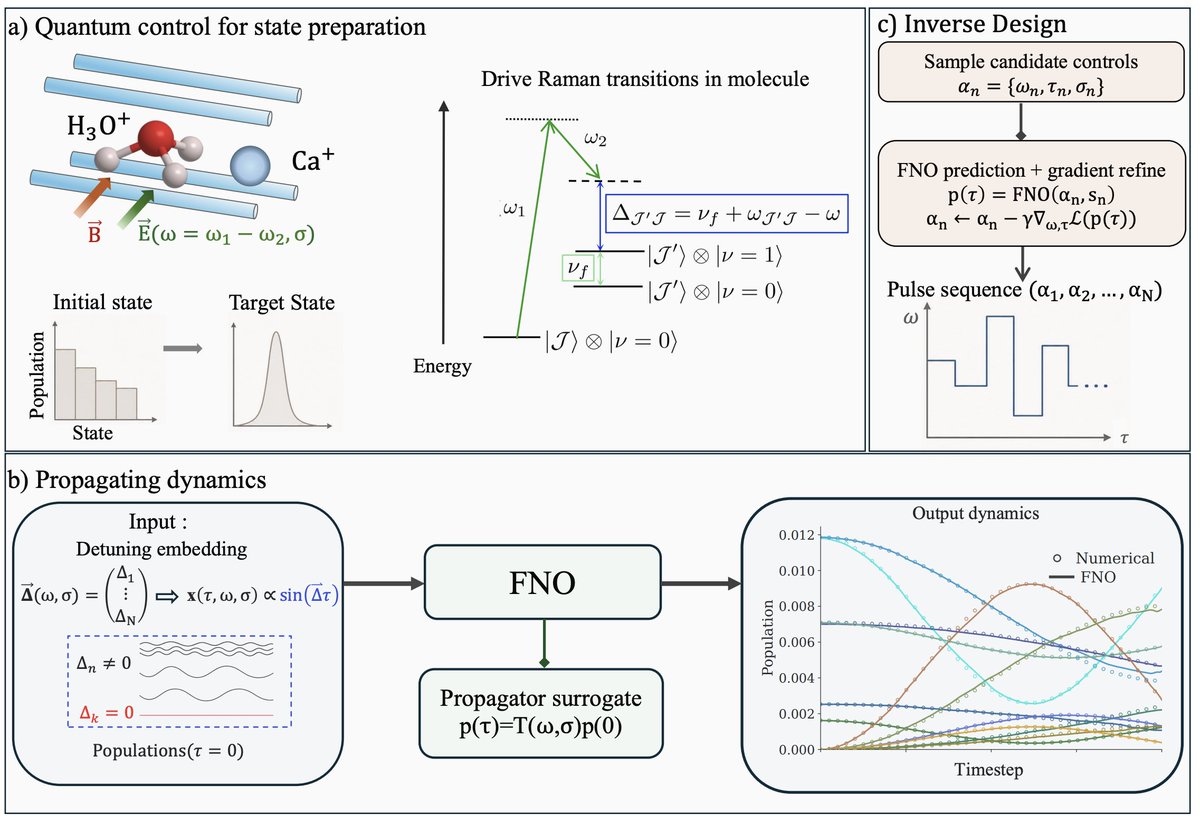
LLMs have a big blind spot: they lack innate understanding of physical world. This becomes very evident when we zoom into the quantum realm, the complexity of quantum dynamics and the cost of steering it grows exponentially. Fourier Neural Operator (FNO) becomes an important tool to learn molecular quantum dynamics and accelerating the inverse design of control protocols. FNO predicts dynamics 10^7 times faster than GPU-accelerated CUDA-Q @nvidia FNO stochastic pulse-measurement planner achieves nearly twice the success rate of a reinforcement-learning arxiv.org/abs/2608.03702 @PrinehaN
Our new work on “Physics of Agents” arxiv.org/abs/2608.16578 lead by Batu El and Jinhee Paeng in collab w/ @james_y_zou The outcome of many interacting agents seems hard to reason about. Yet we were able to study the opinion dynamics of 10,000 different LLM agent communities as they communicated with each other to solve both objective and subjective questions. Remarkably, we could account for their opinion dynamics through a simple Ising model that involved minimizing an energy function corresponding to social pressure to conform. Our dynamics could explain the build up of consensus, polarization, and societal correction of initially incorrect majorities. Lots more to do on statistical mechanics of interacting agent dynamics!
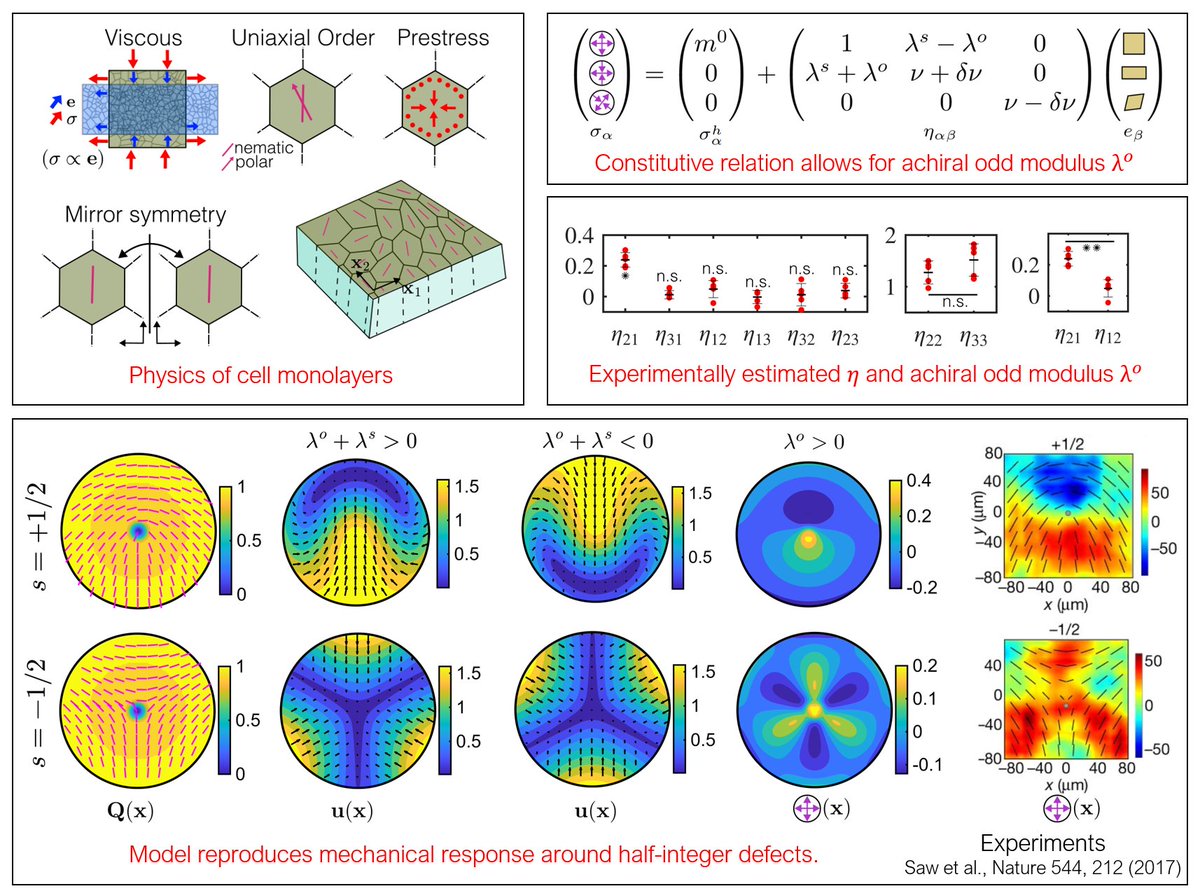
Preprint 📣: Living tissues can exhibit odd mechanics without chirality. Our model shows that orientational order can generate an odd modulus — inferable from experiments — and reproduces flows and stress localization around ±1/2 defects. @SreejithS_ biorxiv.org/content/10.648…
Nature Editorial Why AI cannot do good Science without humans


This is a good response. But this part "It will actually be possible to cure most human disease in ~5-10 years" I would really really love for folks who say this to actually walk us through how they think this will happen. Rather than just saying it.

2/2 Second, on the messaging around AI. I do not agree that my messaging has been disproportionately negative. In fact it has been about equally balanced between risks and benefits: I’ve written one major essay about each, and even in interviews where I discuss the risks, I

💥 NEW BOOK: THE LAST HUMAN VETO "In the world of AI, humans will and must retain the final decision!". Really??? I wrote 'The Last Human Veto' because I no longer think that sentence survives scrutiny. If the machine already controls the evidence, the options, the forecast, and the cost of refusal, the veto may remain visible long after its causal power is gone. The book asks a harder question. What does it mean to remain “in control” when intelligence becomes cheap, abundant, and eventually superior to ours? My answer is counterfactual authority. A veto is real only if saying no can still lead somewhere else. FREE PDF DOWNLOAD @ freedompreetham.org #AI #Agents #Humans #Future


Despite claims that big data will solve everything, I still think a conceptual advance in biology supported by a single, sharp, incisive experiment to prove it is better than 100 vaguely corroborative claims based on existing, usually tangential data. But I'm a little less sure…
People claiming solving cancer is just a data scale problem when we’re still out here discovering fundamental regulatory mechanisms.

ユビキチンはタンパク質だけを標識していたわけではなかった グリコーゲンや代謝物への修飾を発見 Simon A. Cobbold、David Komanderらの@Nature #OA #論文 Ubiquitination of glycogen and metabolites in cells and tissues nature.com/articles/s4158… #オープンアクセス @WEHI_research @unimelb

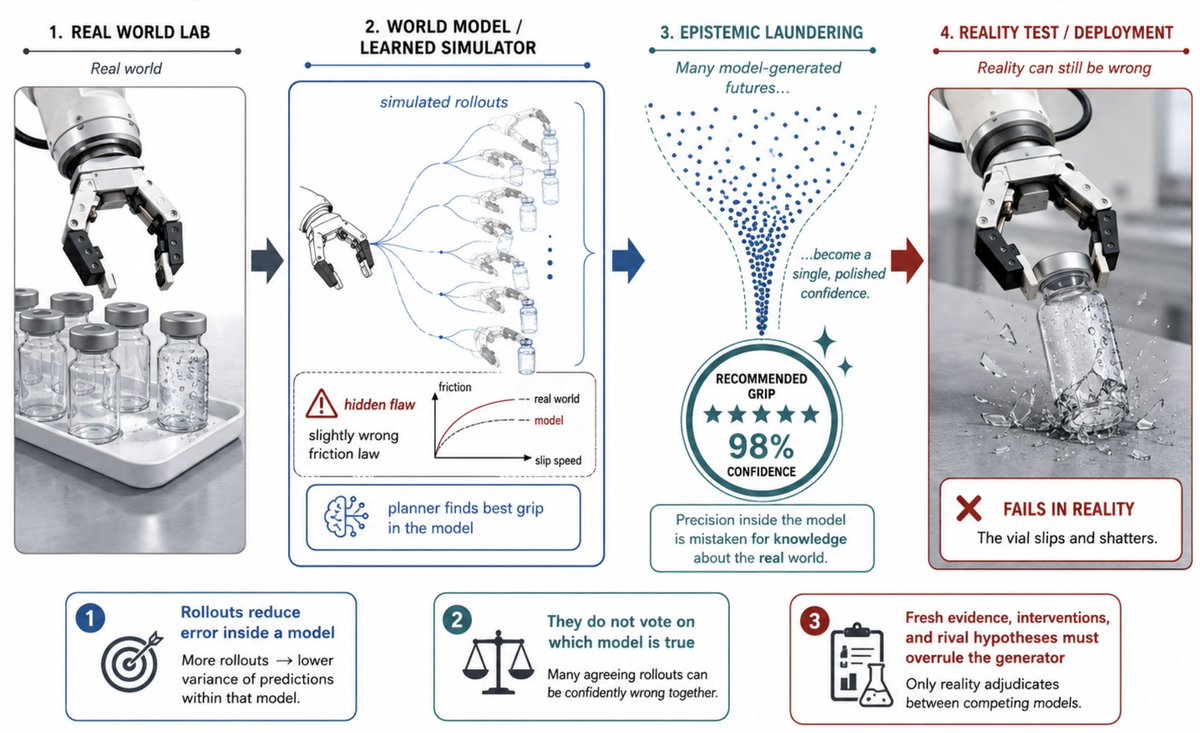
What happens when a world model generates a million futures without collecting a single new fact about the world? Those rollouts may reduce numerical error inside the model while inheriting the same unresolved assumptions. In my new essay, I use epistemic laundering for the moment that computational precision becomes unwarranted confidence about reality. The essay separates this failure from the reality gap, model exploitation, and reward hacking, then develops a hard accounting rule for when an agent must buy fresh evidence. If a model cannot identify what observation or intervention could challenge the assumptions behind an action, deployment becomes the falsification experiment its builders chose not to run. The best definition for "world models" came from a tweet response from @ylecun responding to @anshulkundaje's question [Tweet embedded in the essay] #AI #WorldModels cellbiosf.substack.com/p/epistemic-la…
Busy few days with 8 talks in an 11 day period in 3 different places. Useful links below for programs/schools to apply to next year: Woodshole Methods in Computational neuroscience (2 talks on Deep Learning in Neuroscience): mbl.edu/education/adva… @iaifi_news summer workshop @MIT: iaifi.org/summer-worksho… @Princeton machine learning summer school (4 talks on spin glasses, phase transitions, and diffusion models): mlschool.princeton.edu Massey public lecture at Woodshole @MBLScience on the Science of Intelligence @MIT_CBMM Brains Minds and Machines summer course: bmm.mit.edu
Mathematics and computing have had a very tight relationship in some corners of academia. Richard Courant proposed methods to solve PDEs numerically in 1928. Von Neuman figured out you could use electronic computers for it in 1940. Both were mathematicians. These methods are the ancestors of finite element methods, for which NYU's Courant Institute is famous. The Courant Institute was created in 1935 as NYU's mathematics department. It was unusual in that there was a lot of work on numerical analysis and scientific computing, with heavy use of supercomputers. In 1952, the Atomic Energy Commission installed a powerful electronic computer at NYU, which led to the creation of the Courant Mathematics and Computing Laboratory. The computer science department was spun off from mathematics in 1969 by Jacob T Schwartz. Courant is now a school with three departments: mathematics, computer science, and data science. The continued existence of an HPC center at NYU is one factor that enabled AI research to take off.

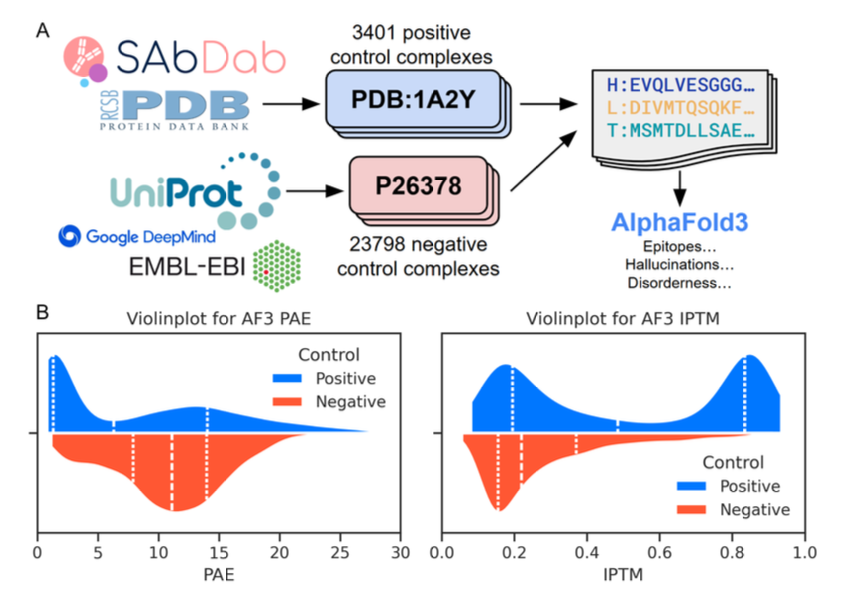
A Structural Antibody Benchmark of AlphaFold3 reveals Hallucinated Epitopes and a Bias for Orderness 1 They benchmarked AlphaFold3 (AF3) for antibody–antigen binding on a large, structure-grounded dataset: 3401 experimentally validated complexes from SAbDab plus 23798 negative controls (random human proteins and six fixed “many-to-one” decoys) to quantify both true hits and false positives. 2 Using AF3 confidence at the interface (PAE and IPTM) as a binary “bind / not bind” classifier (PAE < 2.5 or IPTM > 0.7), AF3 achieved recall ~0.46 with precision ~0.64 (F1 ~0.53) on 10-seed inference; an intrinsic false positive rate of ~3% appeared consistently across negative-control batches. 3 A key qualitative failure mode: AF3 can hallucinate plausible antibody–target interfaces on decoy proteins, distributing predicted epitopes across much of a folded target’s surface. These false-positive “hotspots” suggest AF3 can generate convincing but non-biological interfaces even when no binding should exist. 4 Another notable bias: AF3 performed better on complexes whose experimental structures came from X-ray crystallography than from electron microscopy. In their split, X-ray-derived positives had higher recall (~0.52) than EM-derived positives (~0.30), consistent with training-set composition and/or higher flexibility/disorder typical of EM-captured systems. 5 Target size matters: positive prediction rates decreased as antigen length, surface area, and volume increased (i.e., larger search space → fewer detected binders). This trend was visible across both positive and negative controls, and was strongest when using surface area/volume rather than sequence length alone. 6 Disorder interacts with epitope discovery in a specific way: while overall target disorder fraction did not strongly separate predicted positives vs negatives, AF3 tended to avoid disordered regions when hallucinating interfaces (e.g., on PD-L1/CD274 decoys, false-positive antibodies clustered on ordered domains rather than the disordered terminus). This supports the paper’s framing of a bias toward “orderness.” 7 They tested whether performance was inflated by training data leakage (PDB overlap with AF3 training set). Although many benchmark antibodies were “leaked,” leaked vs non-leaked antibodies showed no meaningful difference in AF3 confidence distributions, suggesting leakage was not the dominant driver of outcomes in this benchmark. 8 Antibody-sequence features were surprisingly not major confounders: amino-acid composition across CDRs and CDR lengths showed little to no correlation with AF3 interface confidence (PAE), arguing AF3 is not simply favoring certain residues or longer/more flexible loops when it predicts binding. 9 Epitope-centric analysis added nuance beyond RMSD: using DockQ plus two custom measures (epitope shift and antibody displacement), they found many “false negatives” still landed near the correct epitope. About 34% of false negatives had epitope shift < 10 Å despite poor DockQ, implying that downstream refinement (e.g., MD, docking, more recycling/relaxation) might rescue additional true interactions. 10 Increasing inference seeds improves recall but is costly: rerunning 1915 false negatives at 100 seeds recovered 344 additional true positives, raising recall to ~53%. They also note AF3’s internal model selection by ranking score may not always pick the lowest-PAE interface, suggesting alternative selection heuristics could help in screening workflows. 📜Paper: biorxiv.org/content/10.648… #AlphaFold3 #Antibodies #ProteinStructure #ComputationalBiology #DrugDiscovery #Benchmarking #ProteinProteinInteractions #Bioinformatics #StructuralBiology #MachineLearning
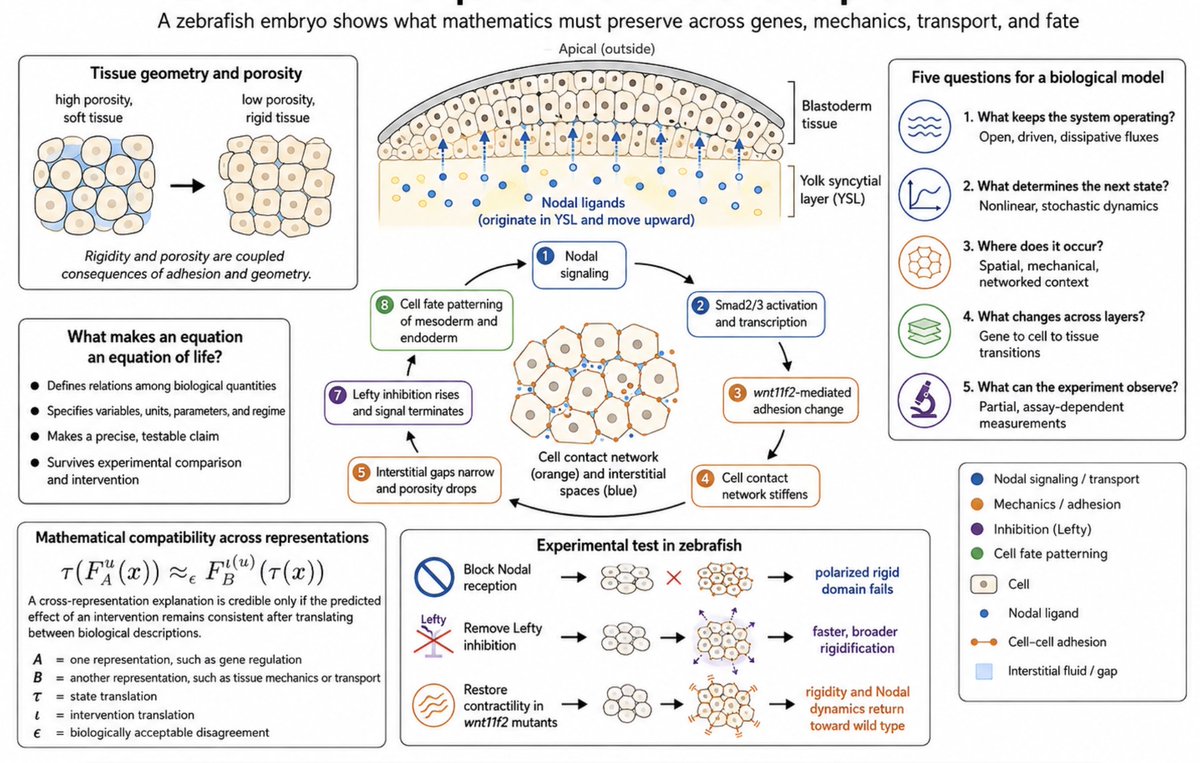
Biology does not lack equations. It probably lacks a defensible way to know when those equations written for different parts still describe the same biology. A gene-regulatory model can fit an equation, a tissue-mechanics model can fit, and a transport model can also fit, still the explanation can fail exactly when one hands meaning to the next equation. In this essay I present an opinion on when an equation becomes an equation of life. cellbiosf.substack.com/p/when-does-an… #AI #science #biology #mathematics
Great to have participated in preparing the @ScienceBoard_UN brief on tipping points with clear definitions and also on how AI is impacting the field. Our paper on using Neural Operators for early detection of tipping points by measuring deviation against baseline physics is helpful in a number of areas: from climate tipping point in stratocumulus cloud cover to airfoil wake and stall transitions using only limited knowledge of the governing equations. arxiv.org/abs/2308.08794 @mliuschi @Caltech

🔬 New Science Brief! 🌍 What happens when environmental change crosses a critical threshold? From melting ice sheets to coral reef collapse and changes in ocean circulation, some Earth systems may be nearing tipping points. 🔗Brief:tinyurl.com/mrar5t2m @PIK_Climate


Machines still don’t speak biology. A new Cell Perspective argues that bigger datasets, larger models, and more GPUs won’t automatically produce a universal model of life. The missing piece: process-aligned, causal world models connecting molecules, cells, tissues, space, and time. Biology is not just sequence. It is history, dynamics, and emergence. cell.com/cell/fulltext/…

Our new paper brilliantly lead by @itamarlandau "A predictive theory of experimental design for inferring neural population geometry in large-scale recordings." biorxiv.org/content/10.648… Our theory can say a lot about the geometry of new data *before* it is collected, by extrapolating from past data. We quantitatively predict: 1) How neural dimensionality, and the reliability of neural correlations and individual neural PCA modes grows with neurons and trials. This allows one to design experiments before the data is collected. 2) We find a "blessing of dimensionality" whereby recording more neurons actually allows us to record *fewer* trials while still reliably inferring neural population geometry. This opens the door to new types of experiments with many more complex trial types. 3) We develop scaling laws for neural prediction using masked autoencoders - a key technology for building foundation models in neuroscience. In the simple setting of linear autoencoders on a single session, we find power law behavior of prediction performance and autoencoder size with neurons and trials, and we trace these power law exponents for neural prediction to power law signals in collective neural modes of the brain. 4) We test our theory across multiple species (mouse, monkey, human) and recoding modalities (electrophysiology, calcium imaging, and fMRI). See @itamarlandau's excellent thread for more information: x.com/itamarlandau/s… Also, yet another fun collaboration with Mark Schnitzer!

Neuro experiments capture 10,000+ neurons but often with only a ~100s of trials. So the data is ~100s points in a 10,000-D space. Can we trust the extracted "population geometry"? This motivates our new paper: a predictive theory of experimental design. @SuryaGanguli 1/13

Kimi K3 ~ The secret ingredient of the secret ingredient sauce... My essay on Kimi K3, Jevons, and the duration error inside frontier AI valuations cellbiosf.substack.com/p/the-half-lif… Model alpha is now decaying faster than the capital used to create it can be recovered. Kimi K3 did not need to become the world’s strongest model. It only had to prove that frontier replication is becoming repeatable enough to destroy the duration assumptions embedded in current valuations. Wall Street first sold the entire AI stack, then reversed as it separated the collapse of model scarcity from the growth of infrastructure volume. A six-month capability lead cannot justify a multi-year scarcity premium, regardless of how much capital produced it. Jevons paradox sharpens the contradiction. As inference gets cheaper, enterprises will spend the savings on more tasks, longer agentic search, retries, tools, critics, and verification. Model margins can compress while aggregate demand for compute, memory, networking, and serving expands. The Dragon Scroll was empty because scarcity itself was the moat. Once that scarcity disappears, durable value moves to whoever can measure where each model works, verify the outcome under real constraints, and reallocate execution before the next release erases the edge. The frontier now becomes a continuously repriced market. Model leads will appear, decay, and migrate. Jevons will push more intelligence through the system even as rents at the model layer compress. READ MORE on the link. #AI #KimiK3
@CellBioSF PDF download link here: freedompreetham.org/_files/ugd/f88…


Harman Singh Walia @HarmanW61942
24 Followers 5K Following


qu an t @quant117023
2 Followers 25 Following


Suvranil @suvranil_1
136 Followers 777 Following Research Scholar @NCBStheory. Interested in books. Personal blog: https://t.co/y9kwhTSnhM
Nancy L @Bluecccccc
0 Followers 1K Following stars in my eyes, static in my head 🌟 always follow back
Bugge Hansen @BuggeHansen
807 Followers 1K Following Futurist | Director of Tech Futures & Innovation at Copenhagen Institute for Futures Studies | Co-lead CIFS Horizon 3 AI Lab | Keynote Speaker
Michael Albada @michaelalbada
105 Followers 110 Following Machine learning engineer using AI to help protect organizations from cyberattacks.
韭菜盒子 @jiu57193
0 Followers 11 Following
不解意 @dlh01271516
0 Followers 25 Following
姚姚 @akabubu0825
0 Followers 51 Following
amita singh @amitasinghv
4 Followers 935 Following

Xiaojun Mlynar @XiaojunMlynar
0 Followers 11 Following
MingJade¥°π @MingJade1
407 Followers 5K Following WoomANager, promoter, coach, artist, educator, advocacy, branding, talent relations, consultancy.
İlkim @ilkoserl
0 Followers 5 Following
Kshitij Rai @kshitij_raiguy
45 Followers 155 Following Graduate student at Rice University @Bashorlab. Mammalian synthetic biology, High throughput circuit characterization, AI/ML applied to gene circuit design, etc
Victory @victoryskyship
352 Followers 5K Following
Whiscash @KevinKa38149752
0 Followers 814 Following Practical Person. Striving for Productive Thoughts and Behaviors. Allergic to Overly Theoretical Activities and to Wasting Time.
vishalsachdev @vishalsachdev
2K Followers 5K Following #VibeClawding Building AI agents for myself | Learning in public | Build To Learn, Learn To Build
griffin @griffin1549203
1 Followers 101 Following
Nucleotec | Next-Gen ... @NucleotecOrg
6 Followers 43 Following Independent Research & Analysis Platform for Next-Generation Technology & Science. Not financial advice
Robert Cheng @0xRobertCheng
538 Followers 978 Following 🇸🇬 🌐 Web3 Investor | Ecosystem @shape3vc & @MVenturesLabs | 稳行远路! https://t.co/IoqRHPksJg
Elif Asena M @SolarisVoyager
32 Followers 1K Following @UniBonn & @METU_ODTU / @METU_IMS Astrobiology, Evolutionary Biology, Oceanography, aDNA, Biogeochemistry
Li Mo @li_mo51439
1 Followers 7 Following
Xiangze Zeng @xiangzezeng
148 Followers 329 Following Assistant Professor @hkbaptistu interested in multiscale modeling of intrinsically disordered proteins and biomolecular phase separation
J.J. Shi @shijinjinplus
0 Followers 5 Following
Kelsie Jonak @extantproject
757 Followers 3K Following BTC: bc1qk97d67cmfzc2l3td6y82e66funxzqhquz382m0 XMR: 87abxG9ZZYW7MUsJkCWiMnTxHf3Sv5QFEUgP3qU9zYfegnUHrVYSeBQTSXyV4ZzdYR2HJCmnkcnB7ebNYZTuK6B1JbUGqWq
Andy Rowntree @Andyrowntree
509 Followers 3K Following Postdoctoral mathematician in the Papalopulu lab, University of Manchester. He/Him. Insta: @andyrowntree . Views are mine, obvs.
Yuanyuan Cao @ycao0706
1 Followers 48 Following
管乐 @dingshangmochi
0 Followers 10 Following
Gnotobio SZ @gnotobio_sz
0 Followers 24 Following It is a biotechnology company primarily engaged in germ-free animal breeding and production, as well as outsourced animal experimentation (CRO) services.
Chris L @chrislong125
322 Followers 3K Following
BoBo @BoBoRising
16 Followers 304 Following
Little mouse @LittlemouceKing
0 Followers 47 Following
wei chen @ChenWei84757
0 Followers 18 Following
wentian zhang @WentianZ6278
6 Followers 84 Following
Michael Yu @MichaelYurjok
0 Followers 61 Following
X @Fpgayptp
0 Followers 14 Following


Kutand Alkım Bayer @kutandalkim
748 Followers 7K Following IZTECH-Chemistry, this is my official account, opinions and views are my own, interested in science and technology.
Lolympics @badmintongenius
0 Followers 20 Following
Nino @080628t
2 Followers 96 Following

Roshan Rao @proteinrosh
4K Followers 603 Following Research scientist @Biohub. Foundation models for biology. Prev: Co-Founder/RS @EvoscaleAI, RS @MetaAI, PhD @berkeley_ai.
Jure Leskovec @jure
45K Followers 429 Following Professor of #computerscience @Stanford; Co-founder at https://t.co/hhm1j5wP0f #machinelearning #graphs.
Amy Lu @amyxlu
5K Followers 2K Following Senior Research Scientist @IsomorphicLabs. Prev: CS PhD @berkeley_ai via @genentech @insitro @UofT 🇨🇦
Yoshua Bengio @Yoshua_Bengio
50K Followers 287 Following Turing Award recipient and world's most cited scientist. Working towards the safe development of AI for the benefit of all @UMontreal, @LawZero_ & @Mila_Quebec
Isomorphic Labs @IsomorphicLabs
64K Followers 83 Following Solve all disease. Developing and applying frontier AI to unlock deeper scientific insights, faster breakthroughs, and life-changing medicines.
David Kelley @drklly
3K Followers 701 Following Using computers to understand the molecular logic of life.
Prof. Nikolai Slavov @slavov_n
56K Followers 274 Following Mentor, scientist & engineer. Director of @ParallelSqTech. Having fun in @SlavovLab with single-cell proteomics & ribosomes. Organizer of @SCP_meeting
Junyue @junyue_cao
3K Followers 365 Following
Jenn Cremins @CreminsLab
4K Followers 919 Following Laboratory for chromatin and spatial neurobiology. Understanding how synapses and the nucleus communicate in the developing and diseased mammalian brain.
Gene Regulation @generegulation
14K Followers 6K Following Gene regulation community. #chromatin #nucleosome #TFbinding #CTCF #cancer #epigenetics. Personal views do not represent @TeifLab. Mostly moved to 🦋 and 🐘
Jason Buenrostro @JD_Buenrostro
6K Followers 693 Following
Jonathan Pritchard @jkpritch
15K Followers 341 Following My lab at Stanford studies human population genetics and complex traits.
William J. Greenleaf @WJGreenleaf
11K Followers 121 Following Professor, Stanford University, Department of Genetics. Exploring the physical genome
Chuang Gan @gan_chuang
10K Followers 502 Following Faculty Member at UMass Amherst; Principal researcher at MIT-IBM Watson AI Lab; Homepage: https://t.co/Pc8WeREfTz
Jay Shendure @JShendure
14K Followers 332 Following Genomics technology developer. Developmental biology adult learner. Professor at @uwgenome @HHMINEWS @BrotmanBaty SeaHub @AllenInstitute /him.
Neel Somani @neelsomani
38K Followers 288 Following ML research & energy markets. Prev: Founder of Eclipse, QR at Citadel. Proud Cal Bear. Read my primer: https://t.co/2yI5SBMyof
Cellular Intelligence @CellularIntelHQ
1K Followers 23 Following We’re building the first universal virtual cell-signaling model to decode the language of cells—so biology is no longer destiny, but design.
Piyush Grover @PiyushGrover101
810 Followers 1K Following Associate Prof. (nonlinear dynamics) @UNLincoln. Hanging out in the phase space. Lab Youtube Channel: https://t.co/v3VoWOhrFS
Yann LeCun @ylecun
1.3M Followers 796 Following Founder/Chair, AMI Labs; Professor, NYU; Partner, 224 Ventures; Ex-Chief AI Scientist, Meta. Researcher in AI, ML, Robotics, etc. ACM Turing Award Laureate.
Michael Vinyard @vinyard_m
954 Followers 4K Following Deep neural networks and dynamical modeling of biology PhD @Harvard
Theofanis Karaletsos @Tkaraletsos
5K Followers 2K Following co-founder https://t.co/TIpJn8YQlg building atomistic world models for simulation of matter | prev Head of AI @cziscience | probabilistic and deep ML
Mark Chaplain @mcapellanus
2K Followers 153 Following Gregory Chair of Applied Mathematics, University of St Andrews. Research interests: mathematical oncology, mathematical biology. Amateur @ History of Maths
Ruth Bowness @RuthBowness
638 Followers 777 Following Reader and MRC Fellow at the University of Bath & UK Young Academy member. Mathematical Biology and Infectious Disease Modelling. Mum of 5.
The Mathematical Asso... @Mathematical_A
33K Followers 2K Following The Mathematical Association supports and enhances the teaching and learning of mathematics and its applications.

Taras Pogorelov @TarasPogorelov
1K Followers 4K Following Cell signaling, protein & membrane dynamics in complex environments. Lab: Biochemistry @ChemistryUIUC Biophysics ChBE @BeckmanInst @NCSAatIllinois @UofIllinois
Ernest Ryu @ErnestRyu
11K Followers 395 Following Associate Professor at UCLA, Department of Mathematics. Research Scientist at OpenAI.
Giulia Palermo @palermo_lab
4K Followers 2K Following Professor of Chemistry and Biochemistry at the University of California, Los Angeles. Passionate about Science & Art!

John Schulman @johnschulman2
82K Followers 2K Following @thinkymachines. Interested in reinforcement learning, alignment, birds, jazz music
Thinking Machines @thinkymachines
184K Followers 1 Following Thinking, beeping, and booping. @tinkerapi
Andrew Gordon Wilson @andrewgwils
41K Followers 1K Following Research Lead @perplexity_ai. Professor of machine learning at NYU Courant.
alex rubinsteyn @iskander
7K Followers 5K Following Genomics + immunology + ML = personalized cancer immunotherapy | https://t.co/nReVwtVHPq | https://t.co/8DWibdfDWa
Sarah Catanzaro @sarahcat21
16K Followers 2K Following “All methods are sacred if they are internally necessary” (GP @amplifypartners, prev @canvasvc; Head of Data @Mattermark; @palantirtech; @c4ads)
Gennady Gorin @GorinGennady
994 Followers 276 Following 🦠🧬📊bioinformatics, statistics, and stochastic processes.
William Merrill @lambdaviking
5K Followers 702 Following incoming Prof @TTIC_Connect theory and pretraining at @allen_ai Will irl, TC0 enthusiast
Ted Gibson, Language ... @LanguageMIT
12K Followers 945 Following I am Ted Gibson and I run a language lab at MIT. I tweet about psycholinguistics, cognitive science, language research, linguistics, and words.
Live Science @LiveScience
428K Followers 708 Following The latest science news, groundbreaking discoveries, and fascinating features from our expert journalists. Your journey of discovery begins at Live Science.
Nature Medicine @NatureMedicine
358K Followers 257 Following Nature Medicine is a research journal devoted to publishing the latest advances in translational and clinical research for scientists and physicians.
The Nobel Prize @NobelPrize
1.3M Followers 492 Following The official feed of the Nobel Prize @NobelPrize #NobelPrize

Simran Arora @simran_s_arora
8K Followers 226 Following Building ai systems, Stanford cs phd @hazyresearch, Incoming assistant professor @caltech, Leading the frontier performance research team @togethercompute
Artur Szałata @arturszalata
979 Followers 5K Following Research Scientist (ML) @IsomorphicLabs | prev. @fabian_theis lab @genentech @Novartis, MSc @EPFL_en. Opinions stated here are my own.
Yun S. Song @yun_s_song
5K Followers 248 Following Professor of EECS and Statistics @UCBerkeley. Mathematical and computational biologist. bsky handle: https://t.co/bW59tUBr8m
Caltech LCSSP @CaltechLCSSP
648 Followers 1K Following Linde Center for Science, Society, & Policy at Caltech | Research & debate on topics at intersection of science, society, & policy | R.M. Alvarez & F. Eberhardt
Quentin Bertrand @Qu3ntinB
1K Followers 2K Following Researcher at @Inria, affiliated at @Mila_Quebec. Previously, postdoctoral researcher at @Mila_Quebec w/ @SimonLacosteJ and @gauthier_gidel.
Delip Rao e/σ @deliprao
72K Followers 5K Following AI researcher @Penn. Past: @johnshopkins, @UCSC, @Amazon, @Twitter. alt: 道元, improv, running 🌈
Elad Hazan @HazanPrinceton
17K Followers 239 Following machine learning and optimization @PrincetonCS & Google DeepMind Princeton, dad^3
Ian Goodfellow @goodfellow_ian
381K Followers 1K Following Co-founder of stealth startup. Inventor of GANs. Lead author of https://t.co/M6vl8pEQ4I Founding chairman of @pubhealthactionYou might like