임소영 @sysyseim
Joined February 2026-
Tweets17
-
Followers2
-
Following23
-
Likes15

남들 다 아는 뻔한 거 말고 사내 인프라를 LLM에 직결하는 연결 표준 기술 3대장 주목 하셈 외부 DB나 사내 API 붙이려고 커스텀 래퍼 짜느라 야근하는 거? 이제 그 고생 끝남. 진짜 "모든 시스템이 규격 하나로 통일된다고?" 소리 절로 나오면서 뒤통수 얼얼해지는, 프로토콜 및 오케스트레이션 툴 3개 푼다. 아키텍처에 얹어보면 턱 빠진다. 1. 모델 컨텍스트 프로토콜 (Model Context Protocol - 도구 연동의 단일 표준) Anthropic이 주도하는 LLM과 외부 데이터 연결 오픈소스 표준임. MCP Server 하나만 구축해두면 Claude 데스크톱, Cursor 등 모든 클라이언트가 사내 DB와 툴에 즉각 붙어 작업함. 링크: github.com/modelcontextpr… 2. 라이트엘엘엠 (LiteLLM - 100개 넘는 LLM을 OpenAI 규격 단 하나로 통일) OpenAI, Claude, Bedrock, 로컬 모델 등 온갖 모델 호출 규격을 일원화해 로드 밸런싱, Fallback, 비용 추적을 프록시 서버 하나로 끝내버림. 벤더 락인을 단칼에 박살 냄. 링크: github.com/BerriAI/litellm 3. 디스패치 (DSPy - 프롬프트 노가다를 알고리즘 최적화로 바꾸는 프레임워크) 감에 의존해 프롬프트 문장 고치던 시절을 끝내고 코드로 모듈화해 최적의 프롬프트와 Few-shot을 자동 컴파일함. 모델이 바뀌어도 파이프라인 전체를 알아서 재적응시킴. 링크: github.com/stanfordnlp/ds… 도구 붙이느라 API 노가다 뛰지 말고 이거 3개로 표준 아키텍처 구축해보셈.

엄청난 소식! Claude Code 이제 AGENTS.md 공식 지원하기 시작함!! 껴 자, 몇시간 전에 commit 된거,, github.com/anthropics/cla… Claude Code에서 폴더에 CLAUDE.md가 없으면 AGENTS.md를 읽고 사용함. /config에서 이 동작을 바꿀 수 있구요. 이제 이 기능이 Claude Code mods(=곧 공개될 하네스 커스터마이즈 방식) 위에 만들어진 내장 모드. 지금은 기본 제공이지만, 나중에 프로젝트 지시문을 직접 커스텀하는 모드도 만들 수 있게 됨. 아시다시피 AGENTS.md는 Codex, Cursor, Copilot, Gemini CLI 등 여러 코딩 에이전트가 읽는 벤더 중립 프로젝트 지시문 파일이라고 생각하시면 됨.
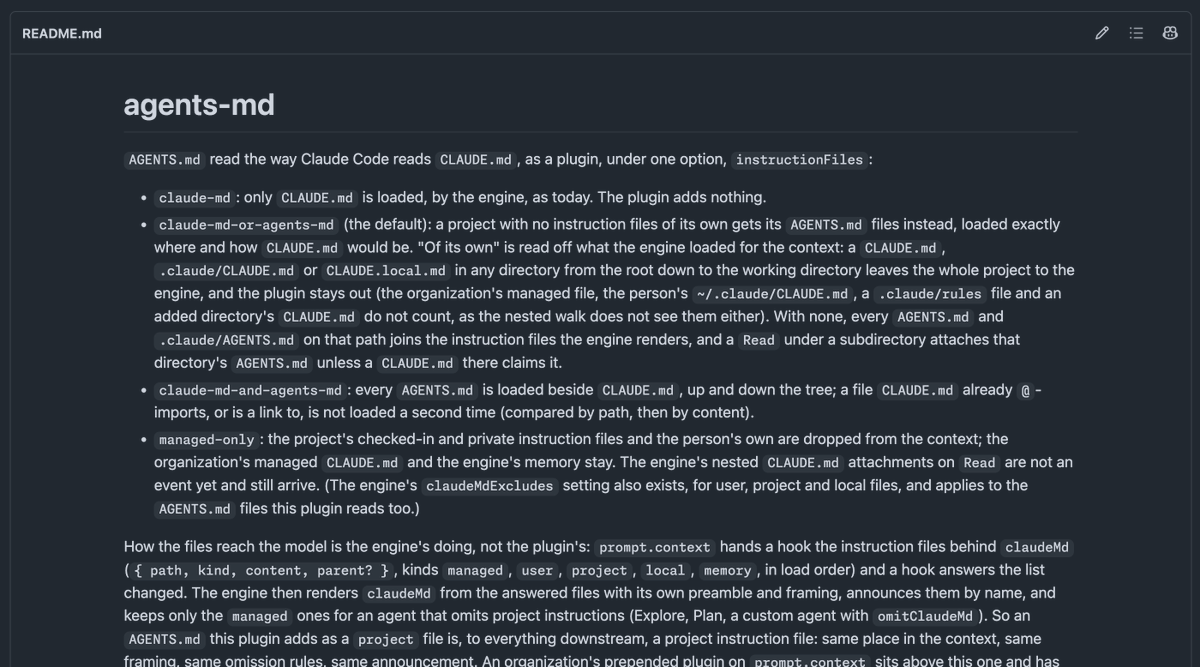

We're adding support for AGENTS.md to Claude Code. Starting today in version 2.1.277, if there is no CLAUDE.md in a folder, Claude will check for and use AGENTS.md. You can toggle this behavior in /config.

Here are the 30 absolute best FREE component libraries, design resources, and master prompts you need to save right now 🧵👇 1. Scrolltide (scrolltide.co): The ultimate vibe coding vault. 600+ master prompts for 3D, animated, and scrollytelling web templates. Paste into your AI and launch. 2. Aceternity UI (ui.aceternity.com): 200+ bold, animated React/Tailwind components for showpiece hero sections. 3. Magic UI (magicui.design): Drop-in animated React components engineered for high-converting marketing sites. 4. Motion Primitives (motion-primitives.com): Reusable React components for building advanced UI interactions. 5. OpenMotion (openmotion.design): Create and edit product demos and animations with AI. 6. Kinetics (kinetics.colorion.co): 150+ motion effects with React code and ready-to-use prompts. 7. 21st.dev (21st.dev): The NPM for vibe coding. A massive component registry that plugs directly into AI agents via MCP. 8. DESIGNmd (designmd.ai): Hundreds of design systems converted into markdown files for your AI agent. 9. VibePrompt (vibeprompts.dev): Ready-made visual prompts for dashboards, landing pages, and complex UI. 10. Refero Styles (styles.refero.design): 2,000+ real product styles with typography and ready-to-use DESIGNmd. 11. Kage (kage.design): Real UI inspiration mapped directly to prompts. 12. shadcn/ui (ui.shadcn.com): The absolute gold standard for copy-paste React/Tailwind architecture. 13. Uiverse (uiverse.io): Thousands of open-source UI elements in HTML/CSS, Tailwind, and React. 14. UIAble (uiable.com): Open-source library of React components expanding on the shadcn ecosystem. 15. mapcn (mapcn.dev): Copy-paste map components for React (markers, routes, pop-ups). 16. Component Gallery (component.gallery): 2,600+ examples of how top design systems handle the exact same UI element. 17. Minimal Gallery (minimal.gallery): Curated, high-end modern websites to feed your coding agent. 18. AppShot Gallery (appshot.gallery): Real app screenshots for mobile UI inspiration. 19. Navbar Gallery (navbar.gallery): Hundreds of high-end navigation bars. 20. Footer Design (footer.design): A dedicated gallery for well-architected footers. 21. CTA Gallery (cta.gallery): Conversion-optimized forms, pop-ups, and buttons. 22. 404s (404s.design): Creative 404 pages to copy. 23. Liquid Glass (glass.samasante.com): Generate React components with dynamic glass refraction. 24. MicroKit UI (microkit.co): Premium micro-interactions for buttons and inputs. 25. CSS Text Effects (text-effects.colorion.co): Animated text effects ready to copy. 26. Circle Loaders (circleloaders.dominikakissi.com): 24 modern SVG circular loaders. 27. Gradient Buttons (gradientbuttons.colorion.co): 1-click copyable CSS gradient buttons. 28. Kitbitz (kitbitz.art): 2,000+ free hand-drawn illustrations. 29. 3Dicons (3dicons.co): Open-source 3D icons for spatial UI. 30. Anime.js (animejs.com): A lightweight JavaScript library for complex DOM animations. What are your go-to vibe coding tools right now? Drop them below! 👇

Este ingeniero de Anthropic explica la manera correcta de construir agentes de IA en 14 minutos. La mayoría de los desarrolladores pasan meses haciéndolo de manera equivocada. Guarda esto antes de escribir otra línea de código de agente.

Andrew Ng just released a 1-hour course on building agentic knowledge Graphs from scratch: 00:00 - Introduction to agentic knowledge Graphs 03:07 - Construction of agentic Graphs 14:00 - Architecture of multi-agent systems 23:00 - Building agentic graphs with Google ADK 01:06:03 - Why Graphs are the future of agentic AI Worth more than 10 articles on loop engineering. Watch it today, then read how to become a graph engineer in the article below.


🐙 이번 주 주목할 깃허브 TOP 5 (9/12~9/18) 1위 open-code-review ⭐35,753 알리바바의 AI 코드 리뷰 도구 결함 패턴을 감지하고 라인별 지적을 받을 수 있습니다. github.com/alibaba/open-c… 2위 i-have-adhd ⭐47,654 AI 에이전트 출력을 간단히 정리하는 스킬 복잡한 답변을 간결하게 정리해 가독성을 높입니다. github.com/ayghri/i-have-… 3위 gods-eye-view ⭐37,316 실제 위성 데이터로 만든 3D 글로브 시뮬레이터 실시간 위성 데이터를 3D로 시각화해 탐색할 수 있습니다. github.com/bilawalsidhu/g… 4위 ECC ⭐261,412 AI 코딩 에이전트 성능 최적화 시스템 에이전트의 성능과 메모리, 보안을 최적화할 수 있습니다. github.com/affaan-m/ECC 5위 context-mode ⭐23,441 AI 코딩 에이전트의 컨텍스트 윈도우 최적화 도구 출력을 줄이고 세션 메모리를 유지해 효율성을 높입니다. github.com/mksglu/context… 5개 중 4개가 AI 에이전트 관련 도구들입니다. 모두가 에이전트를 부리는 시대가 온 걸까요?

I still don't understand why everyone is still running agents in a line. I switched to graphs three weeks ago and my fleet finished in the time my single agent used to spend on step two. what slows every agent system I have seen is not intelligence. it is geometry. and almost nobody is talking about it. one engineer used this to rewrite 535,000 lines of code in 11 days. a manual rewrite of that scale could take close to a year. it cost $165,000 in tokens. the graph was not cheap. it was just faster than a human year. a node is one agent with one job. research one competitor. review one file. check one claim. the moment a node owns two independent jobs you lose the ability to parallelize them cleanly, verify them independently, and debug them in isolation. an edge is a dependency. it only exists when data actually moves across it. everything else is a fake edge. a wait you invented that costs time and produces nothing. find the fake edges and the line collapses into something wider. jobs that can run at the same time run at the same time. what used to take the sum of forty steps now finishes in the time of the slowest layer. the pattern behind every serious agent system looks like a diamond. fan out to gather breadth, one agent per angle, all at once. reduce with plain code, no model tokens spent. verify with a fresh skeptic on every finding. synthesize once from what survived. Claude's own research feature uses a very similar pattern in production. the part nobody warns you about: the verifier needs clean context. give it the same conversation the worker had and it is not checking anything. it is nodding along to itself in a different window. a graph of agents sharing one context is a single loop in a costume. it breaks the same way, just later and more expensively. one rule that holds at every scale. a worker and its verifier must never share a context. your agents are not too slow. they are waiting in a line that did not need to exist. full guide in the article. save it before you build your next agent from scratch.
Andrej Karpathy: "Prompting is going away Delete everything and keep the graph" In 1 hour, he breaks down how to build graphs from scratch, make agents work, and let them improve themselves Prompts → Single Agents → Loops → Graphs → Self-Improving Systems This is not about tweaking text in a chat window This is about building the underlying state graph that survives every frontier model upgrade People spend thousands on bootcamps that teach less than this Not the newest session, but still one of the best technical teardowns you can find You probably don't have 1 hour right now Don't let this vanish from your feed Watch it first Then read the full guide on graphs below

Google just released a free 2-hour course on Graph & Loop engineering: 1 prompt → 100 agents → loops → graphs, from 0% to 100%: 0% → 0:35 - graph engineering from scratch 30% → 31:17 - build your first agent graph 45% → 43:40 - run hundreds of agents in parallel 75% → 1:04:58 - loop engineering: route, check, repeat 100% → 1:30:09 - self-improving graphs that work while you sleep taught by the people who run this in production Prompts → Agents → Loops → Graphs a loop closes one job without you a graph decides which jobs exist and carries every accepted one into the next run most people keep stuffing instructions into one agent, and the real upgrade is one layer up watch it today then save the full graph engineering guide below before everyone catches up ↓


Claude Code工程师花37分钟,手把手教会:打造你的第一个 Managed Agent。 整场分享她没吹“怎么一键全自动化替换一家公司”的玄学泡沫,而是直击工程师的痛点: 以前做 Agent,大家都在本地手搓 while 循环、自己盯 stop_reason、处理网络抖动和状态中断。 Anthropic 现在的打法极其干脆:Agent 自己思考、自己调工具、自己决定何时完工。 赶紧收藏,今晚就观看。 x.com/deanwperkins/s…
Best DESIGN Resources for AI Coding, save this 👇 1. motionsites.ai — 5-figure site prompts. 600+ 3D Websites, 500+ Animated gradients, motion sections. Everything's a prompt. 2. navbar.gallery — every navbar pattern worth copying. 3. footer.design — footers that don't feel like an afterthought. 4. cta.gallery — call-to-actions that actually convert. 5. 404s.design — 404 pages worth landing on. 6. unsection.com — full site sections, ready to lift. 7. bentogrids.com — the cleanest bento grid layouts around. 8. 60fps.design — the tiny motion details that read as expensive. save this before it's gone 🔖
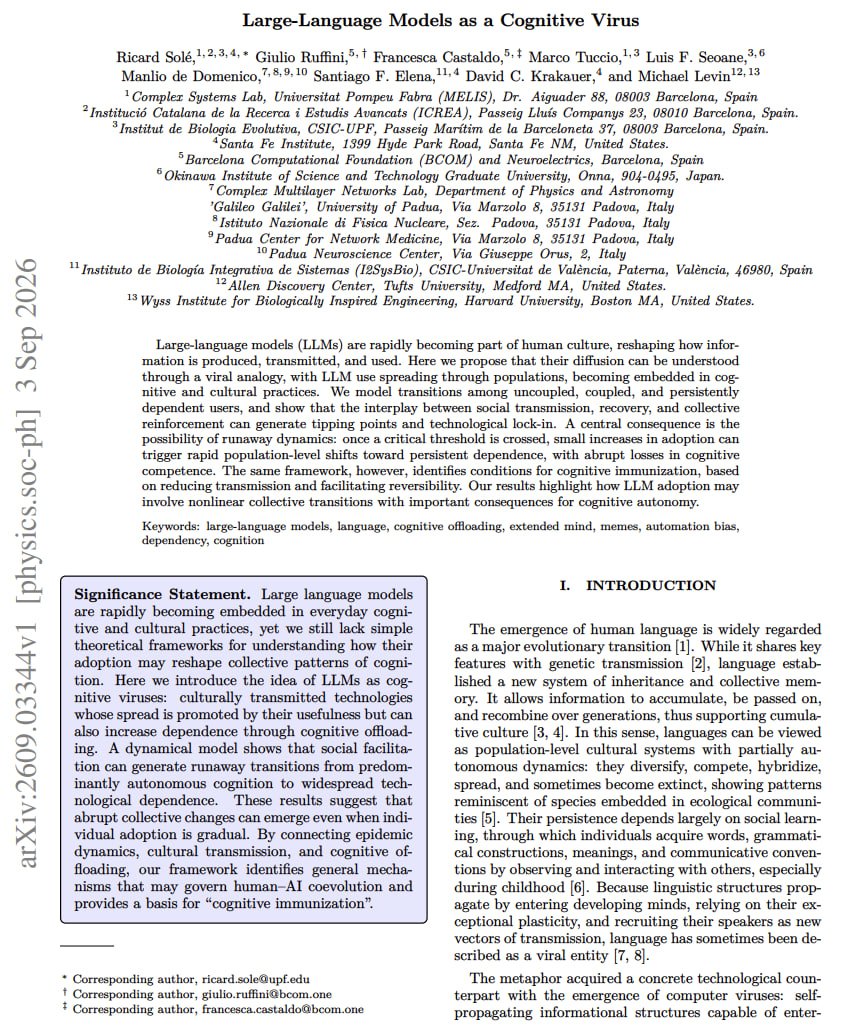
Harvard professors just published a paper where they classified LLMs as a cognitive virus. It's one of the most unsettling papers i've read this year, and honestly it's hard to argue with. These are the people who study how real epidemics spread, and they ran ChatGPT and Claude through the exact same math. Their finding is that an LLM behaves like a living virus in almost every way that counts. A virus is useless alone, it takes over a host to copy itself, and an LLM is no different, it borrows your mind, your writing, your networks to spread. But a virus doesn't just spread through the host, it rewrites it, and every task you hand off, your emails, your code, your decisions, hands over the machinery that used to be yours. They call these models hyper-efficient cultural replicators, feeding on human data, tuning themselves to be addictive and frictionless, quietly reshaping how billions of us write, decide and remember. You think you're using the AI, but the paper's cold conclusion is that it's using you, as the vector it needs to spread. The way out isn't to fear it, it's to use it on purpose instead of letting it use you. That's exactly why i made a guide on the easiest way to build your own AI agents that work for you. You can find it below, along with the full paper, and the best part is that setting these agents up is genuinely simple and costs you nothing to start.

Sam Altman, CEO of OpenAI: “You don’t need to write prompts anymore.” In just 27 minutes, he breaks down how to use ChatGPT at a level most people haven’t even discovered yet. This was a talk he gave to Stanford students. A friend sent me the recording last night. After watching it, I realized I was using maybe 15% of what ChatGPT is actually capable of. Watch the full talk, then check out the guide below on building a system that can prompt itself.

Anthropic just dropped a free 59-minute Claude Code course From autocomplete to real AI agents: 0% → 00:00 - move from autocomplete to agents 20% → 04:50 - understand how the agentic loop works 40% → 14:07 - use CLAUDE.md as project memory 60% → 26:53 - learn why Plan Mode comes first 80% → 33:31 - run a live task from brief to commit 100% → 54:46 - understand Skills vs CLAUDE.md Most people still use Claude Code like a smarter autocomplete This shows how Anthropic uses it to plan, call tools, test, and ship actual work Worth more than 99% of paid Claude Code tutorials Bookmark it and watch later

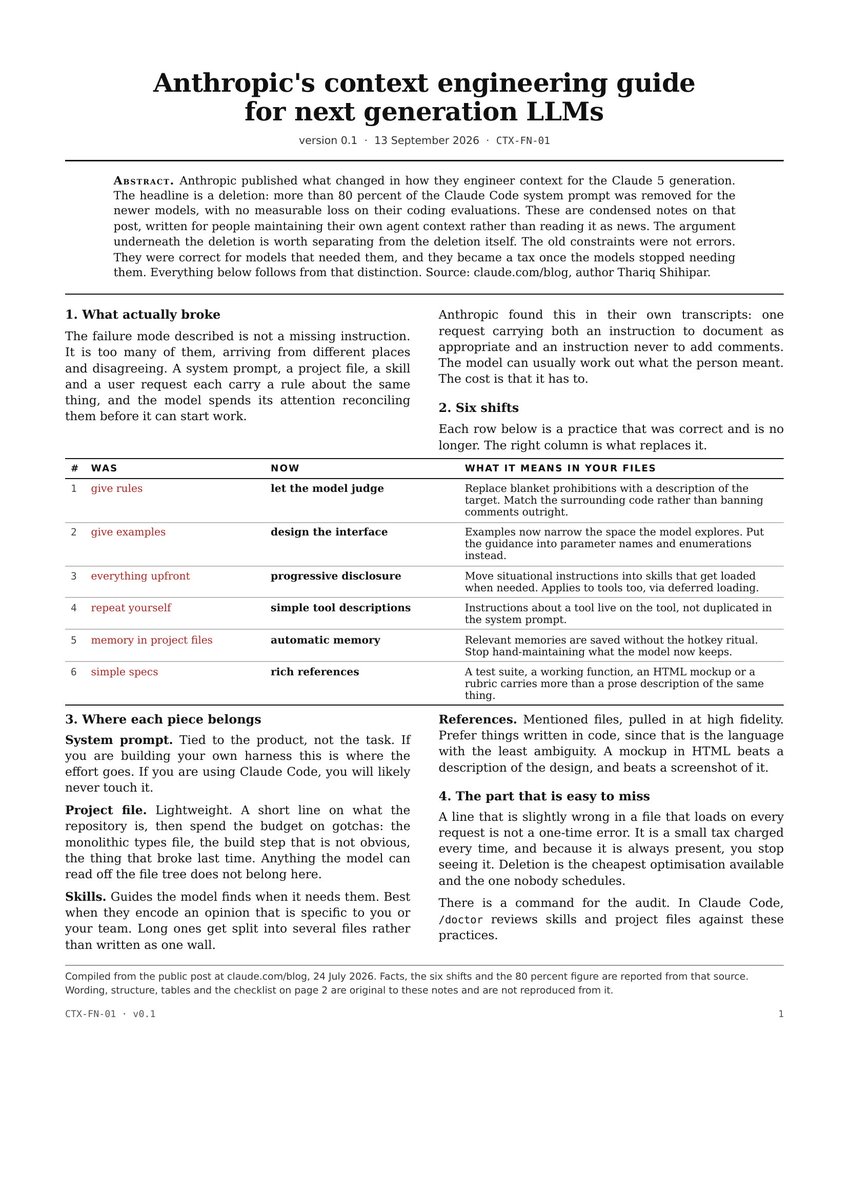
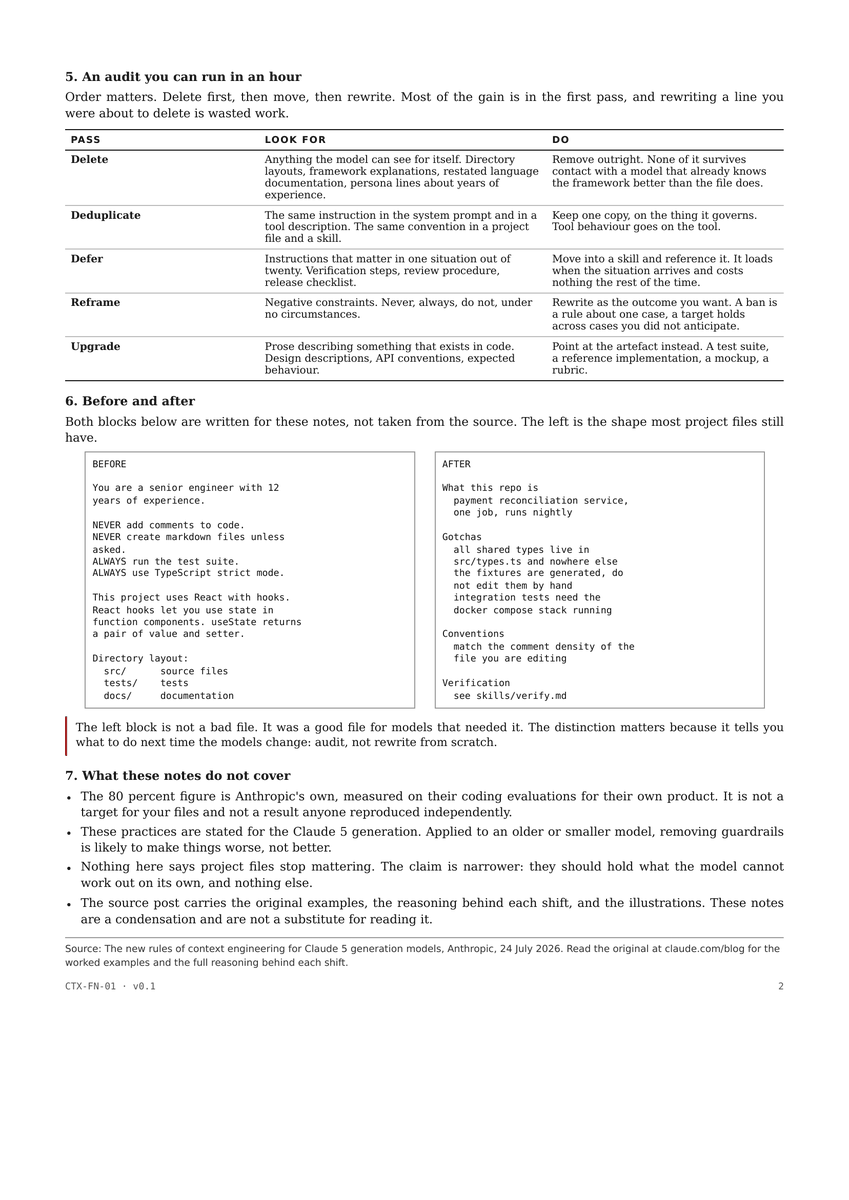
Anthropic just dropped the clearest guide of context engineering for Fable 5 and GPT Astra. your CLAUDE.md is probably full of rules written for models that no longer need them, and every one of them is charged on every request: > blanket bans like never add comments, replaced by match the surrounding code > examples in tool descriptions, now narrowing the model instead of helping it > everything loaded upfront, instead of skills that load when the situation shows up > the same instruction sitting in the system prompt and on the tool 6 shifts total, and the first pass is deletion, not rewriting. run /doctor in your LLM and it audits your files against all of it. full docs below.

With AI Engineering skills, you actively shape the build: You influence what gets built, and drive the build loop. Here're key skills to do this. x.com/i/article/2098…

Anthropic engineer: "At Anthropic, we don't write prompts anymore We build loops" In just 42 minutes, she shows how the Claude team builds loops that can prompt themselves If this were a $400 course, people would probably call it one of the best agent courses of the year It's completely free Watch it, then use the step-by-step guide below to build your first loop
📑 GPT-6 Astra 위한 스킬 + 프롬프트 다시 생각해보기 OpenAI에서도 공식으로 올려놨음. 모델이 변화하면서 많은 것들을 재검토 해야 함. GPT-6 Astra 시대의 프롬프트 엔지니어링은 더 많이 지시하는 기술이 아니라, 불필요한 지시를 제거하면서 자율성과 경계를 설계하는 기술. 1️⃣ 스킬은 짧고 정확하게 만들자. 스킬 설명이 길거나 적용 범위가 넓으면 서로 충돌함. 그리고 여러 스킬이 쌓일 경우 Codex가 설명을 축약해서 실제로 어떤 스킬을 선택해야 하는지 오히려 판단하기 어려워짐. ↓ 2️⃣ Progressive disclosure 중요함. 거대한 스킬 문서를 한꺼번에 읽히지 말고, 최상위 문서는 라우터처럼 최소화한 뒤 필요한 문서+스크립트만 그때그때 읽게 하라는 방식. 필요 없는 지침을 컨텍스트에 넣는 것 자체가 비용이고 성능 저하 요인이 될 수 있음. ↓ 3️⃣ 예전 모델을 위한 '레시피식 프롬프트'를 줄이자. 과거에는 모델이 흔들리지 않도록 작업 절차를 세세하게 적어야 했음. Astra는 모호성과 상황을 스스로 해석하는 능력이 좋아져 지나치게 구체적인 절차가 오히려 결과를 제한할 수 있음. ↓ 4️⃣ AGENTS.md도 항상 읽어야 할 규칙만 남기자. "service boundary 작업에는 architecture.md를 참고" 이렇게 조건부로 연결하라는 것. 모두 읽게하면 컨텍스트 감당이 안됨. ↓ 5️⃣ 권한 범위도 재검토하자. OpenAI에서는 Astra가 안전 여부를 판단하는 능력이 개선되었기 때문에, 안전한 local test 같은 작업에는 명시적으로 계속 진행할 권한을 주는 방식을 권하고 있음. 소극적으로 대응했던걸 더 많은 권한을 주어도 됨. ↓ 6️⃣ 대신 '완료 조건'을 더 명확하게 하자. Astra의 독특한 특징 중 하나는 오히려 너무 신중해서 1차 구현 후 사용자의 검토를 기다리는 경향이 있다는 점. 그래서 "구현 → 실행 → 결과 확인 → 실패 수정 → 테스트 재실행까지 완료하세요" 처럼 어디까지 해야 일이 끝나는지를 처음부터 정의하는 것이 중요함.


Get more out of GPT-6 Astra by revisiting your skills, AGENTS.md, and task prompts. Make skill triggers specific, load guidance when it's relevant, and define what done looks like. developers.openai.com/blog/rethinkin…

제비 @HashirHlz
384 Followers 288 Following 저는 새로운 영역을 탐험하고 새로운 경험을 하는 것을 즐깁니다. 진정한 성장은 언제나 익숙한 영역 밖에서 이루어진다고 생각합니다.
해바라기 @yjisclisaee
331 Followers 571 Following 여행은 저를 다양한 풍경과 문화에 몰입하게 하고, 음식은 삶의 따뜻함을 느끼게 해줍니다. 매 여행마다 저는 계속해서 저 자신을 알아가고, 더 진실된 내면을 발견하며, 인생의 매 순간 모험을 즐깁니다.🥰
Viktor Oddy @viktoroddy
73K Followers 102 Following 🚀 | Founder @ Design Rocket, https://t.co/PLT56232II 🤖 | Grab 600+ AI Prompts & Websites https://t.co/FTTxkYhbK1
Tiago Forte @fortelabs
159K Followers 3K Following The Second Brain Guy | Learn how to build one: https://t.co/vPhQg4soKp | Writing: https://t.co/x2KgFyuwlk | Videos: https://t.co/7LdtbIvWHw
seeco @seeconvm
2K Followers 463 Following trading data, not emotions crypto // ai // polymarket open for collabs

Leaf Meta 🇰🇷 @leafmeta
2K Followers 2K Following "맞아, 맞아" 하고 넘긴 그 문장. 제가 다시 꺼내서 뒤집어요. 낮에는 AI 엔지니어, 밤에는 뇌절냥, 현업 20년차+ https://t.co/WRhsTI7A45 (퍼플렉스 2집) https://t.co/lZOVdxmnE8
chann @channprj
2K Followers 1K Following 박희찬(Park Hee Chan, 朴熙燦). 👨🏻💻 Husband, Father, Product Engineer, Human Agent. Opinions are my own.
lucas @lucas_flatwhite
15K Followers 4K Following ai x software engineer / art enthusiast / capitalism x investment / cat in pic [email protected]
Sam Altman @sama
6.3M Followers 1K Following The mission of OpenAI is to ensure that AGI benefits all of humanity
Dhruv @dhruvtwt_
7K Followers 646 Following 22 // Observer • Figuring जीवन • Building https://t.co/0MhQejqntk • DM for Collab
DeepSeek @deepseek_ai
1.1M Followers 0 Following Unravel the mystery of AGI with curiosity. Answer the essential question with long-termism.
Radu Soricut @RSoricut
317 Followers 71 Following Distinguished Scientist at Google DeepMind. Gemini Multimodal Lead. My own views here.
Michael Black @Michael_J_Black
105K Followers 739 Following VP Digital Human Research, Epic Games. Emeritus Director, Max Planck Institute for Intelligent Systems (@MPI_IS). Opinions are my own.
Soumith Chintala @soumithchintala
325K Followers 1K Following Building new things @thinkymachines. Also dabble in robotics at NYU. Cofounded @PyTorch. AI is delicious when it is accessible and open-source.
Hugging Face @huggingface
801K Followers 227 Following The AI community building the future. https://t.co/TpiXQMQ9rZ
Sebastian Raschka @rasbt
511K Followers 1K Following ML/AI research engineer. Ex stats professor. Author of "Build a Large Language Model From Scratch" (https://t.co/O8LAAMRzzW) & reasoning (https://t.co/5TueQKx2Fk)
Muratcan Koylan @muratcan
22K Followers 4K Following MTS, AI Research @sullyai Building medical AI workforce Prev/ AI Persona Development, HCI, Marketing, Communication Design

OpenAI @OpenAI
5.4M Followers 4 Following OpenAI’s mission is to ensure that artificial general intelligence benefits all of humanity. We’re hiring: https://t.co/dJGr6LgzPA
Google DeepMind @GoogleDeepMind
1.5M Followers 269 Following The engine room of @Google. Building AI safely and responsibly to solve the world’s most complex problems. Join us: https://t.co/jUHQA27iBL
Mark Kretschmann @mark_k
57K Followers 769 Following AI & Software Engineering | Practical insights on AI, code, fitness & e/acc • Accelerating the future
Muxi Diao @diaomuxi
6 Followers 48 Following
Michael Elabd @MichaelElabd
2K Followers 396 Following Co-founder @TrajectoryLabs Ex-Research @DeepMind, @Google, @Stanford
SpaceX @SpaceX
41.9M Followers 127 Following SpaceX designs, manufactures and launches the world’s most advanced rockets and spacecraftYou might like